
Sir Isaac Newton stands as one of the most influential scientists in history. His work laid the foundation for classical mechanics, reshaped our understanding of the universe, and introduced tools still used in modern science. From gravity to light, from motion to calculus, Newton’s contributions were not just incremental—they were transformative. His insights didn’t merely answer existing questions; they redefined how we ask them.
The Laws of Motion: The Framework of Classical Physics
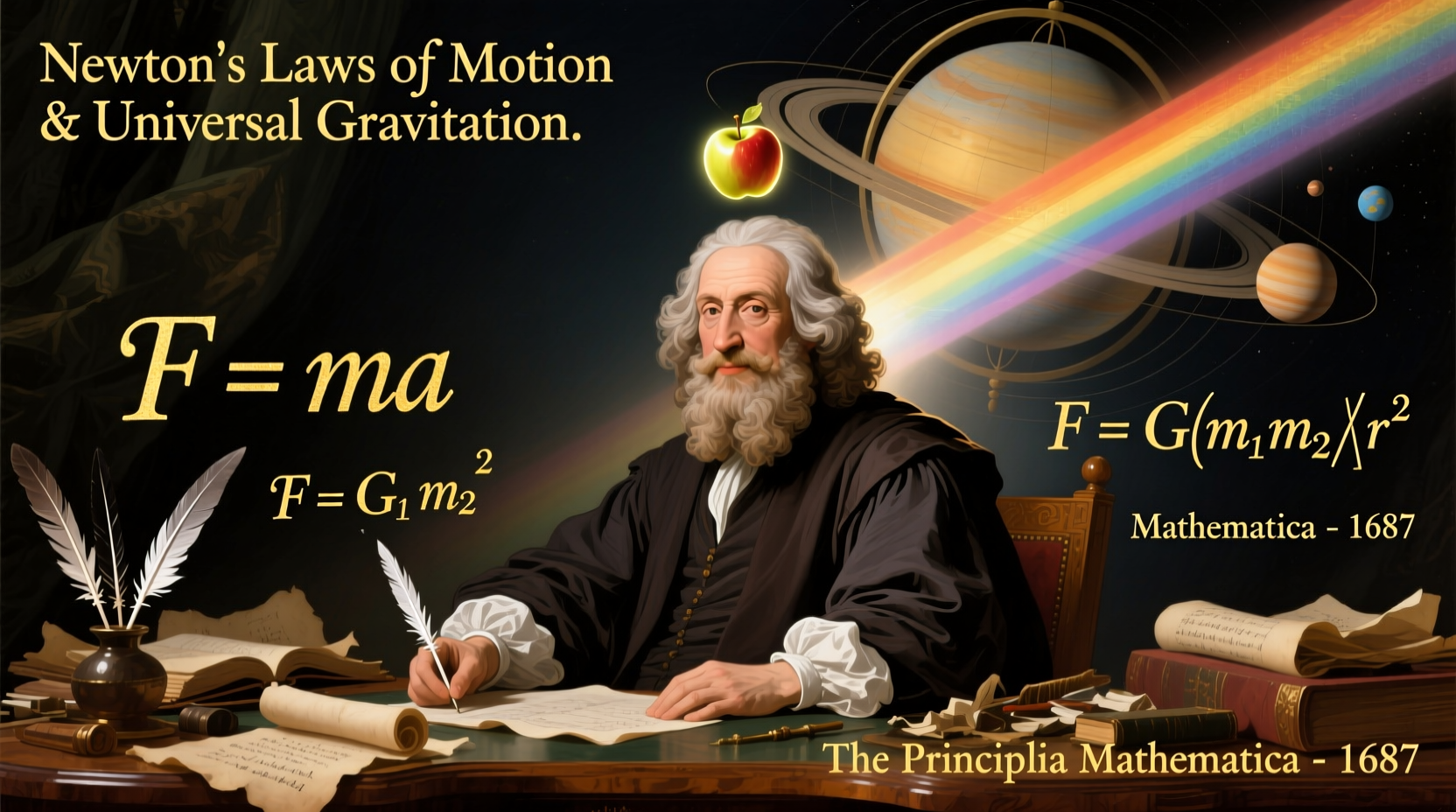
Newton’s three laws of motion are central to his legacy. Published in his 1687 masterpiece Philosophiæ Naturalis Principia Mathematica (Mathematical Principles of Natural Philosophy), these laws provided a unified framework for understanding how objects move.
- First Law (Inertia): An object at rest stays at rest, and an object in motion remains in motion at constant velocity unless acted upon by a net external force.
- Second Law (F = ma): The acceleration of an object is directly proportional to the net force acting on it and inversely proportional to its mass.
- Third Law (Action-Reaction): For every action, there is an equal and opposite reaction.
These principles govern everything from falling apples to planetary orbits. Engineers apply them when designing vehicles, architects use them in structural analysis, and physicists rely on them to model complex systems.
Universal Gravitation: Explaining the Cosmos
While the story of the apple falling on Newton’s head is likely apocryphal, it symbolizes a profound realization: the same force that pulls objects to Earth also keeps the Moon in orbit around it. Newton proposed that every mass in the universe attracts every other mass with a force proportional to the product of their masses and inversely proportional to the square of the distance between them.
This law of universal gravitation explained not only terrestrial phenomena but also celestial ones—why planets orbit the Sun in elliptical paths, why tides rise and fall, and how comets follow predictable trajectories. It unified earthly and cosmic physics into a single coherent system.
“Nature and Nature's laws lay hid in night: God said, Let Newton be! and all was light.” — Alexander Pope, poet
How Gravity Changed Scientific Thought
Before Newton, the heavens were considered a realm governed by different rules than Earth. His theory demolished that divide. By showing that gravity operates universally, he established a mechanistic view of the cosmos—one where natural laws could predict behavior across space and time. This shift paved the way for the Enlightenment and the scientific method as we know it.
Calculus: A New Mathematical Language
Though Gottfried Wilhelm Leibniz independently developed similar methods, Newton created what he called “the method of fluxions”—now known as calculus. This branch of mathematics deals with rates of change (differential calculus) and accumulation of quantities (integral calculus).
Calculus was essential for modeling continuous change, such as planetary motion or fluid dynamics. Without it, modern engineering, economics, and physics would be impossible. While controversy over priority overshadowed part of Newton’s later life, historians now recognize both men’s contributions as foundational.
| Field | Application of Calculus | Example |
|---|---|---|
| Astronomy | Orbital trajectory calculations | Predicting the return of Halley’s Comet |
| Engineering | Structural stress analysis | Designing bridges and skyscrapers |
| Economics | Marginal cost and revenue | Optimizing production levels |
Optics: Unraveling the Nature of Light
Newton made significant advances in optics through experiments with prisms. He demonstrated that white light is composed of a spectrum of colors—a discovery that challenged the prevailing belief that color was a modification of light rather than an inherent property.
He built the first practical reflecting telescope, now known as the Newtonian telescope, which used mirrors instead of lenses to avoid chromatic aberration. This design improved image clarity and became a standard in astronomical observation.
His 1704 work Opticks detailed these findings and explored theories about the particle nature of light—later complemented by wave theories—but his experimental rigor set a precedent for empirical research.
Debates and Legacy in Optics
Newton argued that light consisted of particles (“corpuscles”), while contemporaries like Huygens supported a wave theory. Though both models have merit, Newton’s authority delayed acceptance of wave optics for nearly a century. Still, his insistence on experimentation elevated the standards of scientific inquiry.
Timeline of Key Discoveries and Publications
Understanding Newton’s impact requires looking at the sequence of his breakthroughs:
- 1665–1666: During the Great Plague, Newton retreated to Woolsthorpe Manor. In this “annus mirabilis” (year of wonders), he developed early versions of calculus, formulated his ideas on gravity, and experimented with optics.
- 1687: Publication of Principia, introducing laws of motion and universal gravitation.
- 1704: Release of Opticks, detailing experiments with light and color.
- 1705: Knighted by Queen Anne—the first scientist ever knighted for his work.
- 1727: Death and burial in Westminster Abbey, a testament to his national and scientific importance.
“He was sensible of having been unusually favored by fortune in being able to lay down the foundations of philosophy in his youth, and live to see them so generally received in his old age.” — David Brewster, biographer of Newton
Common Misconceptions About Newton
- Myth: Newton discovered gravity when an apple hit him on the head.
Reality: The apple inspired a question about why it fell straight down, leading him to explore gravitational forces mathematically. - Myth: He worked alone and never collaborated.
Reality: Newton corresponded extensively with scientists like Edmond Halley, who encouraged and funded the publication of Principia. - Myth: He abandoned science after becoming Master of the Mint.
Reality: He remained active in scholarly circles and continued refining his theories until his death.
FAQ
What is Newton’s most important contribution to science?
Many consider the formulation of the laws of motion and universal gravitation in Principia to be his greatest achievement. These laws provided a comprehensive framework that explained both terrestrial and celestial mechanics, unifying physics in a way never done before.
Did Newton invent the telescope?
No, but he invented the first practical reflecting telescope. Earlier telescopes used lenses, which suffered from distortion. Newton’s mirror-based design reduced chromatic aberration and influenced future astronomical instruments.
Why is calculus attributed to both Newton and Leibniz?
Both developed calculus independently. Newton focused on applications in physics, while Leibniz created much of the notation still used today (like ∫ and dx). A bitter dispute arose over priority, but modern scholarship credits both as co-founders.
Checklist: How Newton’s Work Influences Modern Science
- ✅ Engineering designs rely on Newton’s laws for stability and motion analysis.
- ✅ Space missions use gravitational models derived from his equations.
- ✅ Calculus remains essential in advanced mathematics and data science.
- ✅ Optical technologies build on his experiments with light and prisms.
- ✅ Scientific methodology emphasizes observation, experimentation, and mathematical modeling—hallmarks of Newton’s approach.
Conclusion
Sir Isaac Newton transformed science by revealing the mathematical order behind nature’s behavior. His laws of motion and gravity gave humanity the tools to predict planetary movements, engineer complex machines, and understand fundamental forces. Through calculus, he equipped future generations with a language to describe change. In optics, he showed that curiosity and careful experimentation could unveil hidden truths.
More than a genius, Newton was a pioneer of systematic thinking. His legacy endures not just in textbooks, but in every satellite launch, bridge construction, and physics lab around the world. To study Newton is to witness the birth of modern science—and to recognize that one mind, armed with reason and persistence, can illuminate the workings of the universe.




 浙公网安备
33010002000092号
浙公网安备
33010002000092号 浙B2-20120091-4
Comments
No comments yet. Why don't you start the discussion?