
Every holiday season, millions of households string up lights—on trees, railings, eaves, and windows—without a second thought about the electricity humming through those tiny bulbs. Yet behind the twinkle lies a critical engineering decision: voltage. Understanding what voltage powers your lights isn’t just technical trivia—it’s foundational to using them safely, troubleshooting failures, choosing replacements wisely, and protecting your home and family. Voltage alone doesn’t tell the full safety story, but it’s the starting point for informed decisions. This article cuts through common misconceptions, explains real-world voltage standards across light types and regions, and delivers practical, actionable guidance grounded in electrical safety standards and decades of field experience.
Standard Operating Voltages by Region and Light Type
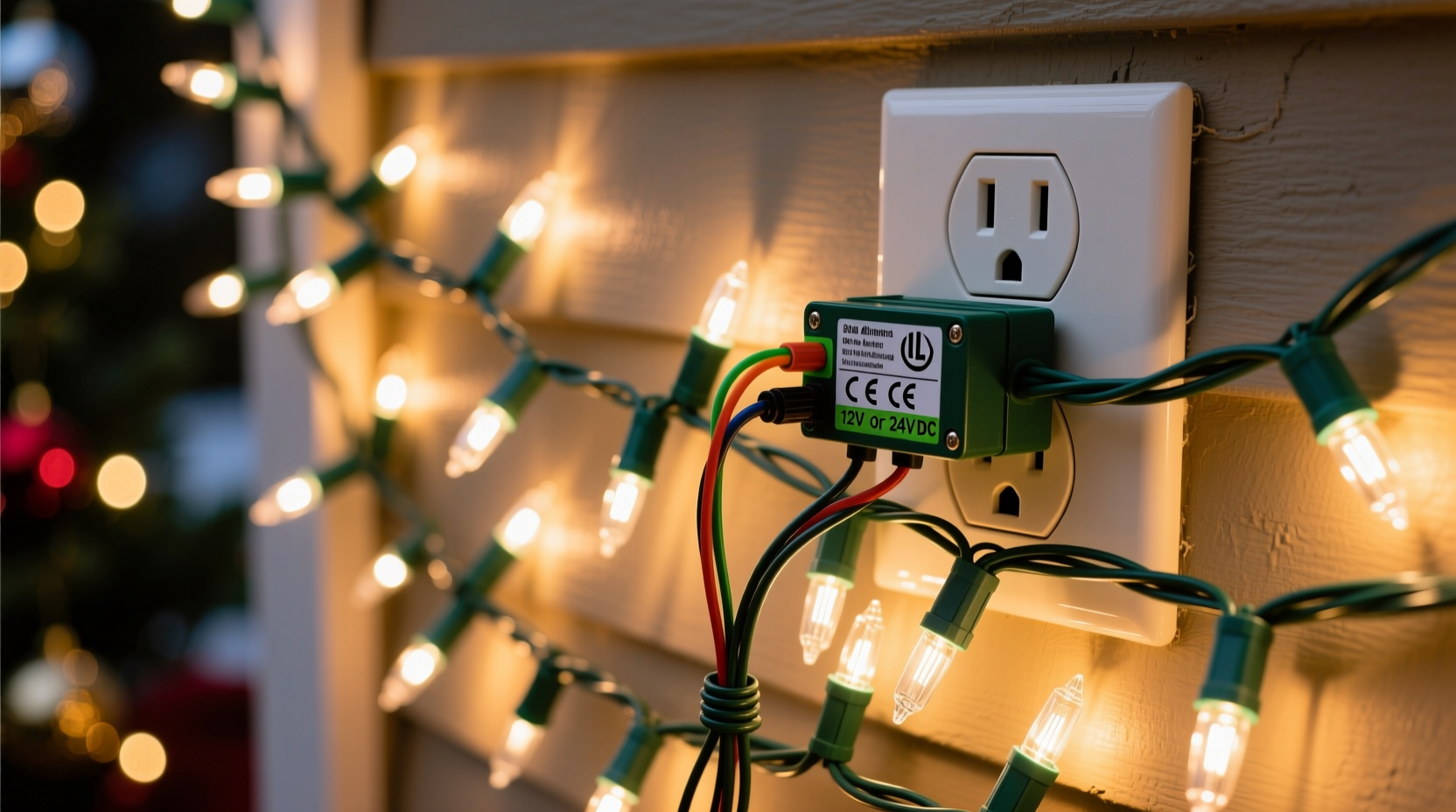
Christmas lights are not one-size-fits-all. Their operating voltage depends heavily on geography, technology generation, and whether they’re designed for indoor or outdoor use. In North America, the standard household supply is 120 volts alternating current (AC) at 60 Hz. Most traditional incandescent mini-lights sold before 2010 were engineered to operate directly at this line voltage—but not in a single-bulb configuration. Instead, they used series-wired circuits where 50 bulbs shared the 120V load, meaning each received roughly 2.4 volts. A break anywhere in that chain extinguished the entire string—a frustrating flaw that spurred innovation.
In contrast, modern LED Christmas lights almost never run directly on 120V. Instead, they rely on internal or external power supplies (often called “adapters” or “controllers”) that convert line voltage down to low-voltage direct current—typically 12V or 24V DC. This shift wasn’t driven by nostalgia or aesthetics; it was an engineering response to efficiency, longevity, and safety. LEDs require precise, stable DC power to operate without flicker or premature failure. The same principle applies across Europe and the UK, where mains voltage is 230V AC at 50 Hz—yet most contemporary LED strings still step down to 12–24V DC for control and reliability.
It’s important to note that “low voltage” in lighting contexts does not automatically mean “safe to touch.” While 12V DC poses negligible shock risk under normal dry conditions, the adapter converting 120V/230V to that low voltage remains a high-voltage component—and if damaged, improperly rated, or used with non-compliant extension cords, it becomes the primary hazard point.
Why Voltage Alone Doesn’t Determine Safety
Safety isn’t defined by a number on a label—it’s determined by how that voltage is delivered, contained, and regulated. Consider two identical-looking strings: one certified to UL 588 (U.S.) or EN 60598 (EU) standards, the other imported without third-party testing. Both may say “120V input,” but only the certified version guarantees insulated wiring, flame-retardant jacketing, thermal cutoffs, and dielectric strength sufficient to withstand surges and moisture exposure.
UL 588—the U.S. Standard for Electric Holiday Lighting Sets—requires rigorous testing: 2,000-volt dielectric withstand tests, temperature rise limits during continuous operation, crush resistance for wire insulation, and flame propagation tests on lamp holders and sockets. A non-certified string might pass a basic continuity test but fail catastrophically when exposed to rain, wind-driven snow, or accidental pinching beneath a door jamb.
“Voltage tells you *how much* electrical pressure exists—but insulation quality, grounding integrity, environmental rating, and circuit protection tell you whether that pressure stays where it belongs. A 12V LED string with cracked, UV-degraded insulation on an outdoor roofline can be more dangerous than a fully certified 120V incandescent set installed per manufacturer instructions.” — Dr. Lena Torres, Electrical Safety Engineer, Underwriters Laboratories (UL)
This distinction matters because consumers often assume “low voltage = inherently safe.” That assumption leads to risky improvisations—like cutting off a certified adapter to hardwire a 12V string into a 120V junction box, or daisy-chaining too many uncertified sets beyond the manufacturer’s stated limit. Neither scenario is about voltage alone; it’s about system integrity.
Comparative Safety Profile: Incandescent vs. LED vs. Commercial Grade
| Light Type | Typical Input Voltage | Operating Voltage per Bulb/LED | Key Safety Features | Risk Factors |
|---|---|---|---|---|
| Traditional Incandescent (pre-2010) | 120V AC (NA) / 230V AC (EU) | 2.4V (50-bulb series) or 3.5V (36-bulb) | Fused plugs, basic thermal cutoffs, UL-listed wiring | High heat output (bulbs reach >200°F), brittle sockets over time, no short-circuit isolation |
| Modern LED (consumer grade) | 120V/230V AC input → 12V/24V DC output | 2–3.6V per LED (parallel or segmented series) | UL/ETL listed adapters, surge protection, IP44 rating (outdoor), auto-shutoff on overload | Poorly made adapters overheating, counterfeit ICs failing silently, non-rated extension cords causing voltage drop & fire risk |
| Commercial/Professional LED | 120V/230V AC or 24V DC distributed via low-voltage conduit | Same as consumer LED, but with redundant drivers | IP65+ weatherproofing, GFCI-integrated controllers, thermally managed housings, UL 1598 listing | Installation complexity requiring licensed electricians; miswiring risks if DIY attempted |
The table reveals a clear trend: safety has migrated from the bulb itself to the supporting ecosystem—drivers, connectors, enclosures, and installation methods. A well-engineered 120V LED string with integrated GFCI and thermal monitoring is objectively safer than a 12V string powered by a $3 unbranded wall adapter left outdoors in freezing rain.
Real-World Example: The Garage Outlet Incident
In December 2022, a homeowner in Portland, Oregon, connected six 100-light LED strings to a single 15-amp garage outlet using a $4 multi-outlet power strip rated for 10A continuous load. Each string’s adapter drew 0.18A—seemingly harmless. But the cumulative draw (1.08A) wasn’t the issue. What caused the incident was the power strip’s lack of thermal cutoff and the garage’s unheated environment. Overnight, condensation formed inside the strip’s housing. By morning, micro-arcing began between corroded contacts. Around 4:30 a.m., the strip’s plastic casing ignited, igniting nearby cardboard boxes. Firefighters arrived within minutes, preventing structural damage—but the home lost its holiday decorations, garage contents, and $12,000 in smoke-damaged tools.
Post-incident investigation revealed three preventable failures: (1) using a non-UL-listed power strip not rated for continuous use; (2) exceeding the strip’s duty cycle in a damp, cold environment; and (3) failing to check the adapter labels—two of the six were counterfeit, lacking required CE markings and internal fusing. Voltage wasn’t the villain here. Complacency about certification, environment, and load management was.
Practical Safety Checklist for Every Household
Before hanging a single bulb, walk through this verified checklist. It accounts for voltage, certification, environment, and human factors—all backed by NFPA 101 (Life Safety Code) and UL guidance.
- ✅ Check certification first: Look for UL 588, ETL Listed, or CSA C22.1 marks on the product packaging and adapter label—not just “CE” stamped on the cord.
- ✅ Match voltage to source: Never plug a 230V EU-rated string into a 120V NA outlet (or vice versa) without a properly rated transformer. Undervoltage causes flickering and driver stress; overvoltage destroys electronics instantly.
- ✅ Limit daisy-chaining: Follow the manufacturer’s maximum string count—usually 3–5 sets for LED, 1–2 for incandescent. Exceeding this overloads internal wiring and adapters.
- ✅ Use outdoor-rated gear outdoors: Indoor-only strings lack UV-stabilized jackets and moisture-resistant sockets. Even under an awning, dew accumulation creates leakage paths.
- ✅ Inspect every inch: Discard strings with cracked insulation, bent pins, corroded sockets, or discoloration near the plug. Heat damage is irreversible and cumulative.
- ✅ Plug into GFCI-protected outlets: Required by NEC Article 410.130(G) for all outdoor and garage lighting. Test GFCIs monthly with the built-in test button.
Step-by-Step: How to Safely Replace a Damaged Adapter or Controller
When an LED string stops working but bulbs test fine, the adapter is usually at fault. Replacing it incorrectly reintroduces risk. Follow this sequence precisely:
- Unplug and disconnect: Remove the faulty string from all power sources—including any extension cords or timers.
- Identify specs: Note the adapter’s input voltage (e.g., “Input: 120V AC”), output voltage (e.g., “Output: 12V DC”), output current (e.g., “1.5A”), and polarity (look for the “center negative” symbol: ⦿–).
- Select replacement: Choose an adapter with identical output voltage and equal or higher current rating (e.g., 12V DC, 2.0A is acceptable for a 1.5A requirement). Ensure it carries UL/ETL listing and is rated for continuous operation.
- Verify connector compatibility: Measure outer diameter (OD), inner diameter (ID), and polarity sleeve length. Mismatched connectors cause intermittent contact and arcing.
- Test before final install: Connect the new adapter to the string indoors, away from flammables. Monitor for 15 minutes: no warmth beyond mild ambient, no buzzing, no flicker.
- Label and document: Write the adapter’s specs and date of replacement on tape affixed to the cord. Helps future troubleshooting and insurance claims.
Frequently Asked Questions
Can I use a 12V car battery to power outdoor Christmas lights?
No—unless the lights are explicitly designed and certified for 12V DC automotive use (rare for decorative lighting). Most consumer LED strings require regulated, filtered DC power. A raw car battery delivers variable voltage (11.8–14.7V), lacks overcurrent protection, and introduces grounding hazards when connected to household wiring or metal fixtures. Use only manufacturer-approved power supplies.
Why do some LED strings have two wires while others have three?
Two-wire strings use simple constant-voltage drivers (12V/24V DC). Three-wire strings incorporate data lines for RGB color control or programmable effects—these require compatible controllers and introduce additional electromagnetic interference (EMI) considerations. Never splice a three-wire controller into a two-wire string; mismatched signaling can damage LEDs or drivers.
Is it safe to leave Christmas lights on overnight or while traveling?
Yes—if all components are UL/ETL listed, undamaged, plugged into GFCI-protected outlets, and not covered by insulation, drapery, or flammable materials. However, NFPA recommends turning off decorative lighting when leaving home unattended for more than 2 hours or sleeping—regardless of certification—as a prudent layer of risk reduction. Smart plugs with automatic shutoff timers add reliability.
Conclusion
Voltage is the headline—but safety is written in the fine print: the certifications, the materials, the installation context, and the habits we bring to seasonal traditions. Most Christmas lights today operate on 120V or 230V input, but deliver gentle 12–24V DC to the LEDs themselves. That lower voltage reduces shock risk, yet it doesn’t eliminate fire risk—especially when paired with uncertified components, improper loading, or environmental neglect. The safest string isn’t the one with the lowest number on the label; it’s the one that meets rigorous independent standards, is installed with intention, and is inspected with care each year.
Your holiday lights should spark joy—not emergency calls. Start this season by auditing last year’s strings: check for certifications, inspect for damage, verify adapters, and commit to one upgrade—whether it’s replacing a worn power strip with a UL-listed model or installing a dedicated GFCI outlet in your garage. Small actions, grounded in knowledge, make the difference between a quiet evening of lights and an avoidable crisis.




 浙公网安备
33010002000092号
浙公网安备
33010002000092号 浙B2-20120091-4
Comments
No comments yet. Why don't you start the discussion?