
Every holiday season, millions of homes light up with festive displays—but too often, those lights come with an unwanted side effect: a sudden blackout when a circuit breaker trips. This isn’t just inconvenient; it can signal an overloaded circuit, which poses a fire risk. Understanding how much wattage your Christmas light setup demands—and how much your home circuits can safely handle—is essential for a safe, bright, and uninterrupted holiday.
The average household circuit in the U.S. is rated for 15 or 20 amps at 120 volts, translating to 1,800 watts (15A × 120V) or 2,400 watts (20A × 120V). However, electrical codes recommend using only 80% of a circuit’s capacity for continuous loads—like Christmas lights that stay on for hours. That means a 15-amp circuit should carry no more than 1,440 watts, and a 20-amp circuit no more than 1,920 watts. Staying within these limits dramatically reduces the risk of tripping a breaker or overheating wiring.
Understanding Wattage, Voltage, and Amperage
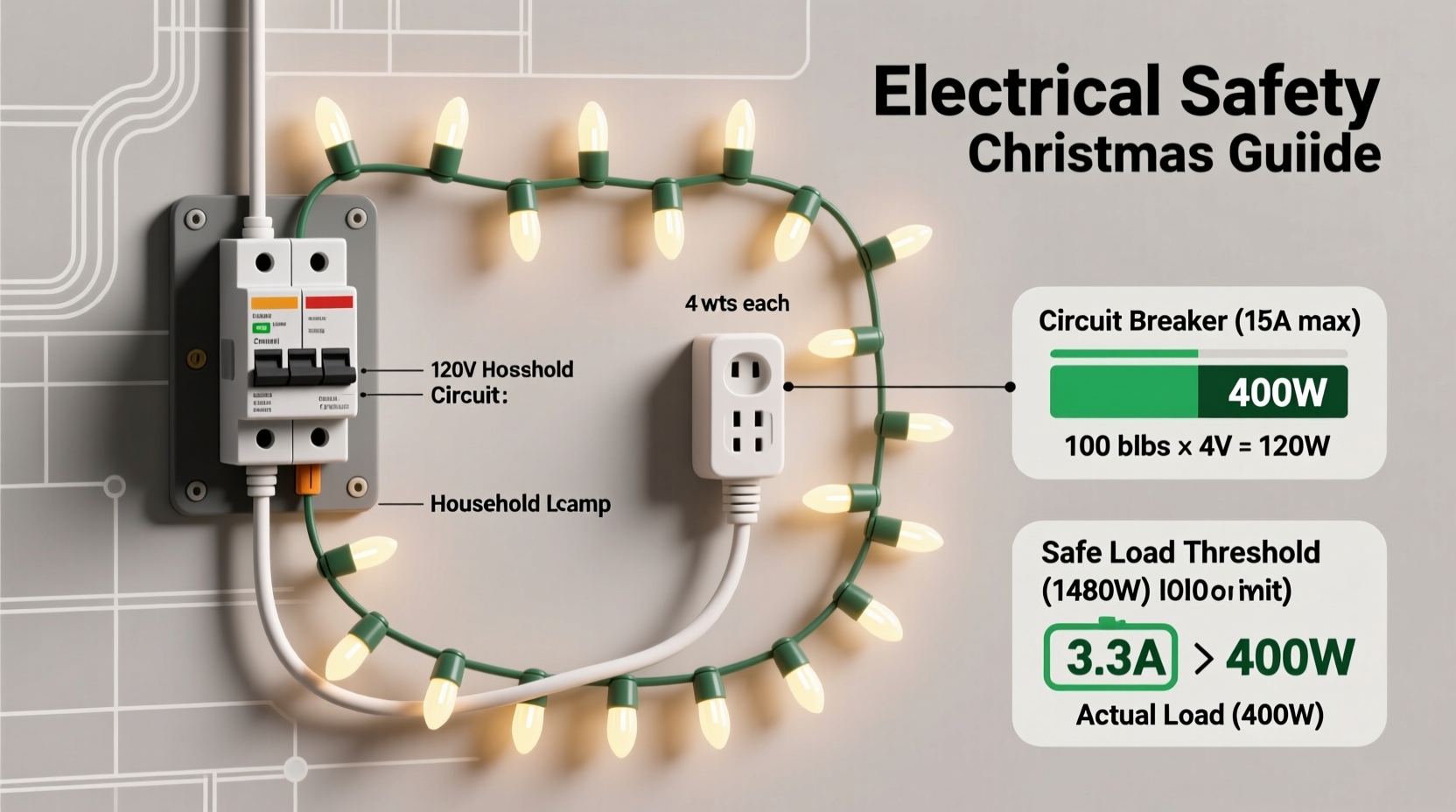
To calculate whether your Christmas lights are safe, you need to understand three key electrical terms:
- Wattage (W): A measure of power consumption. The total wattage of all connected devices determines how hard a circuit is working.
- Voltage (V): In North America, standard household circuits operate at 120 volts.
- Amperage (A): The flow of electric current. Circuits are protected by breakers that trip if amperage exceeds safe levels.
The relationship between these three is simple: Watts = Volts × Amps. If you know two values, you can calculate the third. For example, if you’re running 1,200 watts on a 120-volt circuit, the amperage draw is 10 amps (1,200 ÷ 120).
Most Christmas lights list their wattage per string or per 50-light set. LED strings typically use 2–7 watts, while incandescent sets can consume 25–50 watts each. The difference adds up quickly when connecting multiple strands.
How Many Lights Can You Safely Plug In?
The number of Christmas lights you can run on one circuit depends on the type of lights and their individual wattage. Here’s a comparison to help visualize safe load limits:
| Light Type | Average Watts per String | Max Strings on 15A Circuit (1,440W) | Max Strings on 20A Circuit (1,920W) |
|---|---|---|---|
| Mini Incandescent (50-light) | 40 W | 36 strings | 48 strings |
| LED Mini (100-light) | 5 W | 288 strings | 384 strings |
| C7 Incandescent (25-light) | 175 W | 8 strings | 11 strings |
| C9 LED (25-light) | 2.5 W | 576 strings | 768 strings |
Note that this assumes the entire circuit is dedicated to Christmas lights. In reality, other devices—outdoor outlets, refrigerators on shared kitchen circuits, or indoor lamps—may also be drawing power from the same circuit, reducing available capacity.
“Overloading a circuit with decorative lighting is one of the most common seasonal electrical issues we see. It’s not just about convenience—it’s a fire prevention issue.” — James Rutherford, Licensed Electrician & NFPA Contributor
Step-by-Step Guide to Calculating Your Christmas Light Load
Follow this process before plugging in any lights to ensure safety and reliability:
- Identify the circuit(s) you plan to use. Check your home’s breaker panel. Note whether it’s a 15-amp or 20-amp circuit. Labeling helps, but if labels are missing, turn off breakers one at a time to map which outlets and lights go dark.
- Determine available wattage. Multiply the amperage by 120 volts, then take 80% of that number:
- 15A circuit: 15 × 120 = 1,800 × 0.8 = 1,440W available
- 20A circuit: 20 × 120 = 2,400 × 0.8 = 1,920W available
- Add up the wattage of all planned light strings. Check packaging or product specs. For older lights without labels, use a wattage meter (available at hardware stores) to measure actual draw.
- Account for other devices on the same circuit. If your outdoor outlet shares a circuit with garage tools or indoor lamps, subtract their usage. A space heater (1,500W) alone could max out a 15A circuit even without lights.
- Distribute loads across multiple circuits. Use extension cords (rated for outdoor use) to plug lights into different circuits. Avoid daisy-chaining too many strings—most manufacturers limit connections to 3–5 sets for incandescents and up to 40+ for LEDs.
- Test before full deployment. Turn everything on for at least 30 minutes. Feel outlets and cords for warmth—a sign of overloading. If the breaker trips, reduce the load immediately.
Common Mistakes That Lead to Tripped Breakers
Even well-intentioned decorators make errors that strain electrical systems. These are among the most frequent causes of holiday circuit failures:
- Daisy-chaining too many incandescent strings. Older mini-lights often allow only 3–5 sets to be connected end-to-end. Exceeding this risks overheating wires and exceeding outlet capacity.
- Using indoor-rated lights outdoors. Indoor-only cords aren’t designed for moisture and temperature changes, increasing resistance and failure risk.
- Ignoring shared circuits. Plugging lights into an outlet that powers a refrigerator or sump pump can overload the circuit when combined loads peak.
- Using undersized extension cords. Long runs require thicker gauge cords (e.g., 14-gauge or lower number). Thin cords (18-gauge) overheat under high loads.
- Mixing old and new lights on the same circuit. Vintage incandescent sets draw far more power than modern LEDs. Combining them without recalculating load leads to surprises.
Real Example: The Overloaded Porch Display
Consider Sarah, a homeowner in Ohio who loves elaborate holiday decorations. She installed 12 strands of C7 incandescent lights (each 175W), two inflatables (each 300W), and a motorized sleigh display (250W) all plugged into a single outdoor outlet. Total load: (12 × 175) + (2 × 300) + 250 = 2,950 watts.
The outlet was on a 15-amp circuit (max safe load: 1,440W). Within minutes of turning everything on, the breaker tripped. After calling an electrician, she learned her display was drawing over twice the safe limit. The solution? Split the load: move six C7 strings and one inflatable to a 20-amp garage circuit, replace half the incandescents with LED equivalents, and use a heavy-duty extension cord. The new total: ~950W on each circuit—well within safe limits.
Checklist: Safe Christmas Lighting Setup
Before flipping the switch on your holiday display, run through this checklist:
- ✅ Verified circuit amperage (15A or 20A) at the breaker panel
- ✅ Calculated total wattage of all lights and decorations
- ✅ Confirmed 80% rule is followed (≤1,440W on 15A, ≤1,920W on 20A)
- ✅ Used only outdoor-rated extension cords and lights
- ✅ Avoided daisy-chaining beyond manufacturer limits
- ✅ Distributed heavy loads across multiple circuits
- ✅ Tested system for 30+ minutes with no tripping or overheating
- ✅ Installed GFCI protection for outdoor outlets (required by code)
Frequently Asked Questions
Can I mix LED and incandescent lights on the same circuit?
Yes, as long as the total wattage stays within the circuit’s safe limit. However, be cautious—incandescent bulbs draw significantly more power. Mixing types requires careful calculation to avoid overload.
Do LED lights really make that much of a difference?
Yes. LED Christmas lights use up to 90% less energy than incandescent ones. A typical LED string uses 5–10 watts versus 40–50 watts for incandescents. This allows you to run many more strings safely and reduces both electrical load and energy bills.
Why does my breaker trip only at night when I turn the lights on?
This often means other high-draw appliances (like heaters, ovens, or dryers) are running simultaneously, pushing the circuit past its limit when lights are added. Try staggering appliance use or moving lights to a dedicated circuit.
Conclusion: Light Up Safely and Smartly
Your holiday lights should bring joy—not electrical emergencies. By understanding wattage limits, calculating your total load, and distributing power wisely across circuits, you can create a dazzling display without risking a tripped breaker or fire hazard. Prioritize LED lighting for efficiency, respect manufacturer connection limits, and never assume an outlet is isolated. A few minutes of planning can save hours of troubleshooting—and protect your home.




 浙公网安备
33010002000092号
浙公网安备
33010002000092号 浙B2-20120091-4
Comments
No comments yet. Why don't you start the discussion?