
As the holiday season approaches, homes across the country begin their transformation into festive displays of twinkling lights and seasonal cheer. One of the most common — and potentially hazardous — oversights during this time is overloading electrical outlets with too many strands of Christmas lights. While it might seem harmless to plug in a few extra strings “just to make it brighter,” doing so without understanding your outlet’s wattage capacity can lead to tripped breakers, damaged wiring, or even fire risks.
Understanding how much wattage your outlet can safely manage isn’t just about technical knowledge — it’s a crucial safety practice. Most standard household circuits are designed for 15 or 20 amps at 120 volts, translating to 1,800 or 2,400 watts respectively. But how does that apply when you're stringing lights around your tree, draping them along gutters, or wrapping them around porch railings? This guide breaks down everything you need to know about wattage limits, light types, and smart power management to keep your holiday display dazzling — and safe.
Understanding Outlet Capacity and Circuit Limits
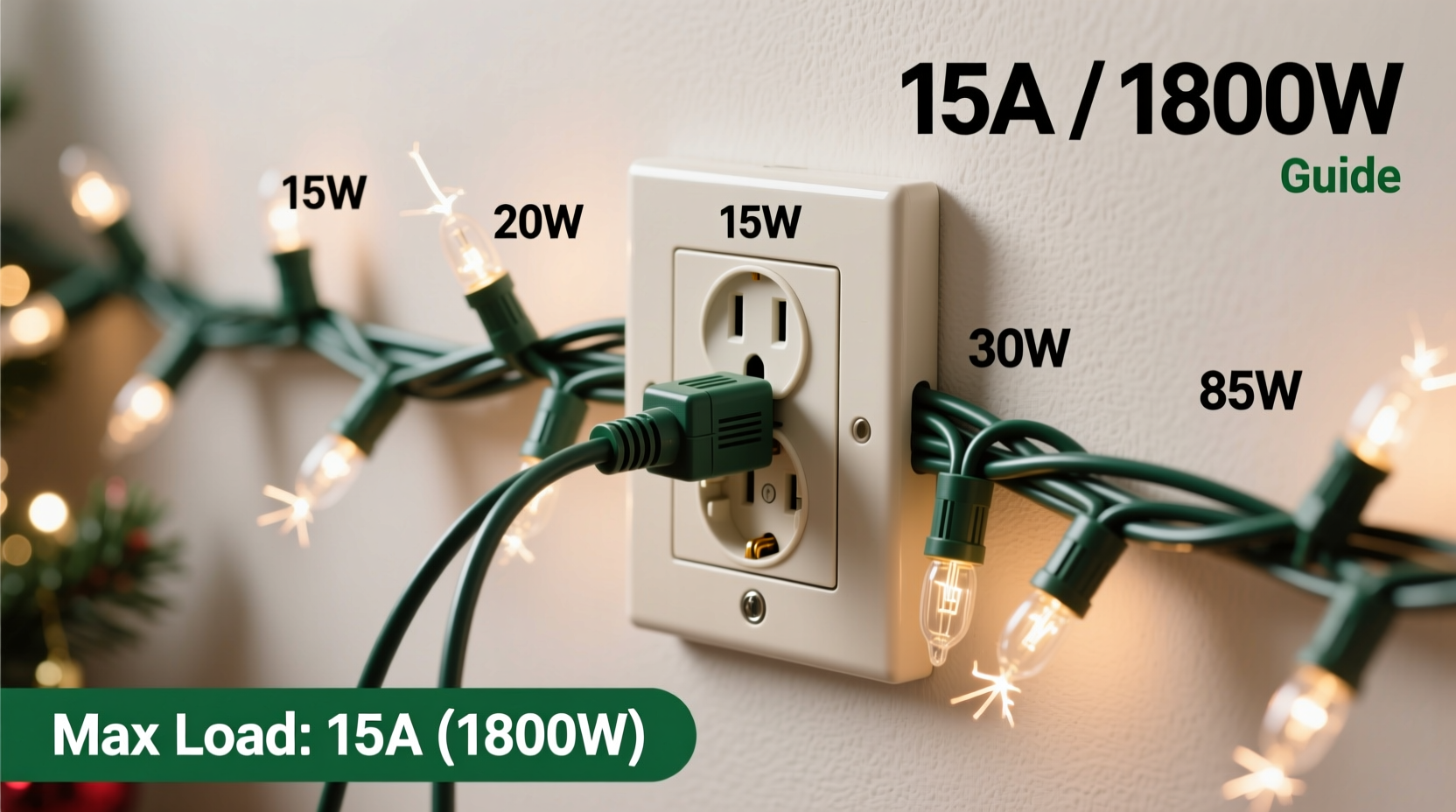
Before plugging in a single strand of lights, it's essential to understand what your home’s electrical system can actually handle. The average U.S. household uses a 120-volt alternating current (AC) system, with individual circuits protected by either a 15-amp or 20-amp circuit breaker. These breakers are designed to cut off power if the current exceeds safe levels, preventing overheating and potential fires.
To calculate maximum wattage:
Wattage = Volts × Amps
- 15-amp circuit: 120V × 15A = 1,800 watts
- 20-amp circuit: 120V × 20A = 2,400 watts
However, electrical codes recommend using only 80% of a circuit’s capacity for continuous loads (those lasting more than three hours), which includes holiday lighting. That means:
| Circuit Type | Max Continuous Wattage (80%) | Typical Use Case |
|---|---|---|
| 15-amp | 1,440 watts | Kitchen counter, living room outlets |
| 20-amp | 1,920 watts | Garage, dedicated lighting circuits |
This 80% rule is not optional advice — it’s a requirement under the National Electrical Code (NEC). Exceeding it increases resistance in wires, generating heat that insulation may not be able to handle over time.
How Much Power Do Christmas Lights Actually Use?
Not all Christmas lights consume the same amount of electricity. The wattage varies significantly based on bulb type, number of bulbs per strand, and technology (LED vs. incandescent). Knowing these differences helps you plan how many strings you can safely connect.
Incandescent Mini Lights
Traditional incandescent mini lights are bright and warm but notoriously inefficient. A typical 50-light strand consumes about 20–25 watts. Larger C7 or C9 bulbs used outdoors can draw 5–10 watts each. For example:
- 50-count mini lights: ~20 watts
- 100-count mini lights: ~40 watts
- C9 bulb (each): ~7 watts
LED Christmas Lights
LED lights use up to 90% less energy than incandescents. A 50-light LED strand typically uses only 2–4 watts. Even longer runs of 100 or 200 LEDs often consume less than 10 watts total. Their efficiency makes them ideal for large displays.
“LED technology has revolutionized holiday lighting — not just for aesthetics, but for safety. Lower wattage means fewer overloaded circuits and dramatically reduced fire risk.” — David Langford, Electrical Safety Consultant, NFPA Contributor
Calculating Total Load from Multiple Strings
When connecting multiple light strings, always add up the total wattage. For example:
- 10 strands of incandescent mini lights (40W each) = 400 watts
- 15 strands of LED mini lights (3W each) = 45 watts
- 20 C9 bulbs (7W each) = 140 watts
If you’re combining different types of lights on the same circuit, sum all wattages together. A porch display with 50 incandescent mini lights, 100 LED icicle lights, and 12 C9 bulbs would draw approximately:
20W + 6W + 84W = 110 watts — well within safe limits, but still requires monitoring if other devices share the circuit.
How Many Light Strings Can You Safely Plug Into One Outlet?
The number of strings you can plug in depends on both the outlet and the circuit it’s connected to. Remember: one outlet doesn’t equal one circuit. Multiple outlets in a room often share the same breaker.
Daisy-Chaining Limits
Manufacturers specify how many strands can be safely connected end-to-end (daisy-chained). For incandescent lights, this is usually 3–5 strands. For LEDs, it can be 20–50, depending on design and UL certification.
Exceeding daisy-chain limits creates excessive current draw through a single cord, increasing fire risk regardless of outlet capacity.
Real-World Example: Front Yard Display
Consider a homeowner decorating their front yard with:
- Two 25-light C9 strands (7W each × 50 bulbs = 350W)
- Six 100-light LED net lights (each 7W = 42W total)
- One animated inflatable (300W)
Total load: 350 + 42 + 300 = 692 watts
This fits comfortably under the 1,440-watt continuous limit of a 15-amp circuit — but only if no other devices (like timers, cameras, or doorbell systems) are drawing power from the same circuit. If the outlet also powers a porch light (60W) and a security camera (10W), the total becomes 762W — still acceptable, but cutting it close if additional items are added later.
Step-by-Step Guide to Safe Holiday Lighting Setup
Follow this practical sequence to ensure your display stays bright and safe throughout the season.
- Identify the circuit(s) serving your indoor and outdoor outlets. Turn off breakers one at a time to map which outlets go dark.
- Check labels on each light strand for wattage, amperage, and maximum connectable strings.
- Calculate total wattage for all planned lights on each circuit.
- Add existing loads (e.g., lamps, chargers, appliances) that share the circuit.
- Ensure total stays below 80% of circuit capacity (1,440W for 15A, 1,920W for 20A).
- Use heavy-duty extension cords rated for outdoor use if needed, and avoid running cords under rugs or through high-traffic areas.
- Plug major displays into GFCI outlets or use GFCI-protected power strips, especially outdoors.
- Install timers to limit operation to 6–12 hours per night, reducing heat buildup and energy use.
- Inspect monthly for frayed wires, loose connections, or flickering bulbs.
- Unplug when away or sleeping if not using a timer or smart controller.
Do’s and Don’ts of Powering Multiple Light Strings
| Do’s | Don’ts |
|---|---|
| Use LED lights to minimize wattage | Plug incandescent strings into overloaded power strips |
| Spread lights across multiple circuits | Daisy-chain more than manufacturer allows |
| Label outlets and circuits for easy reference | Run cords through closed doors or windows (can damage insulation) |
| Use surge protectors with indicator lights | Ignore buzzing, warmth, or discoloration at outlets |
| Test GFCI outlets monthly | Leave damaged or flickering strings in use |
FAQ: Common Questions About Outlet Wattage and Christmas Lights
Can I plug 10 strands of lights into one outlet?
Yes — if they’re LED and the total wattage stays under 1,440W. Ten 50-light LED strands (3W each) use only 30 watts. However, ten incandescent strands (40W each) would draw 400 watts — still safe, but reduce further if other devices are on the same circuit.
Why do my lights keep tripping the breaker?
This usually means the circuit is overloaded. Check total wattage, including non-light devices (tree fans, projectors, etc.). Also inspect for short circuits or ground faults, especially in older strands. Try redistributing lights to another circuit or upgrading to LEDs.
Is it safe to use a power strip for Christmas lights?
Only if the power strip is UL-listed, rated for the total load, and not daisy-chained with others. Never exceed the strip’s labeled wattage (usually 1,800W max). Avoid using basic multi-plug adapters — they lack overload protection.
Expert Checklist: Pre-Lighting Safety Review
- ✅ Confirm circuit amperage (15A or 20A)
- ✅ Calculate combined wattage of all lights
- ✅ Verify daisy-chain limits per strand
- ✅ Use outdoor-rated cords and connectors
- ✅ Test GFCI protection on exterior outlets
- ✅ Install a timer or smart plug
- ✅ Keep clearance around outlets and cords
- ✅ Have a fire extinguisher accessible indoors
Conclusion: Illuminate Safely, Celebrate Fully
The magic of Christmas lights comes not just from their glow, but from the care taken to enjoy them responsibly. By understanding wattage limits, choosing efficient LEDs, and respecting circuit capacities, you can create a stunning display without compromising safety. Electricity demands respect — especially during a season when emotion often overrides caution.
Your outlet’s wattage capacity isn’t a suggestion — it’s a boundary defined by physics and enforced by code. Work within it, plan ahead, and let your holiday spirit shine as brightly as your decorations. This year, make safety part of your tradition. Inspect every cord, calculate every connection, and celebrate knowing your family and home are protected.




 浙公网安备
33010002000092号
浙公网安备
33010002000092号 浙B2-20120091-4
Comments
No comments yet. Why don't you start the discussion?