
Traveling light or traveling smart—what does that really mean when it comes to choosing between a wheeled bag and a clutch? At first glance, the answer might seem obvious: wheels equal convenience, right? But dig deeper, and the reality becomes more nuanced. The ideal choice depends on your destination, travel style, physical ability, and even the time of day you’re moving through an airport. This isn’t just about weight—it’s about efficiency, accessibility, and long-term comfort.
A wheeled suitcase offers undeniable logistical advantages, especially for longer trips. Meanwhile, a clutch provides sleek minimalism and instant access to essentials. But ease of travel isn’t only about how much you carry—it’s about how smoothly you move from point A to B without strain, stress, or last-minute scrambling.
The Practical Realities of Wheeled Bags
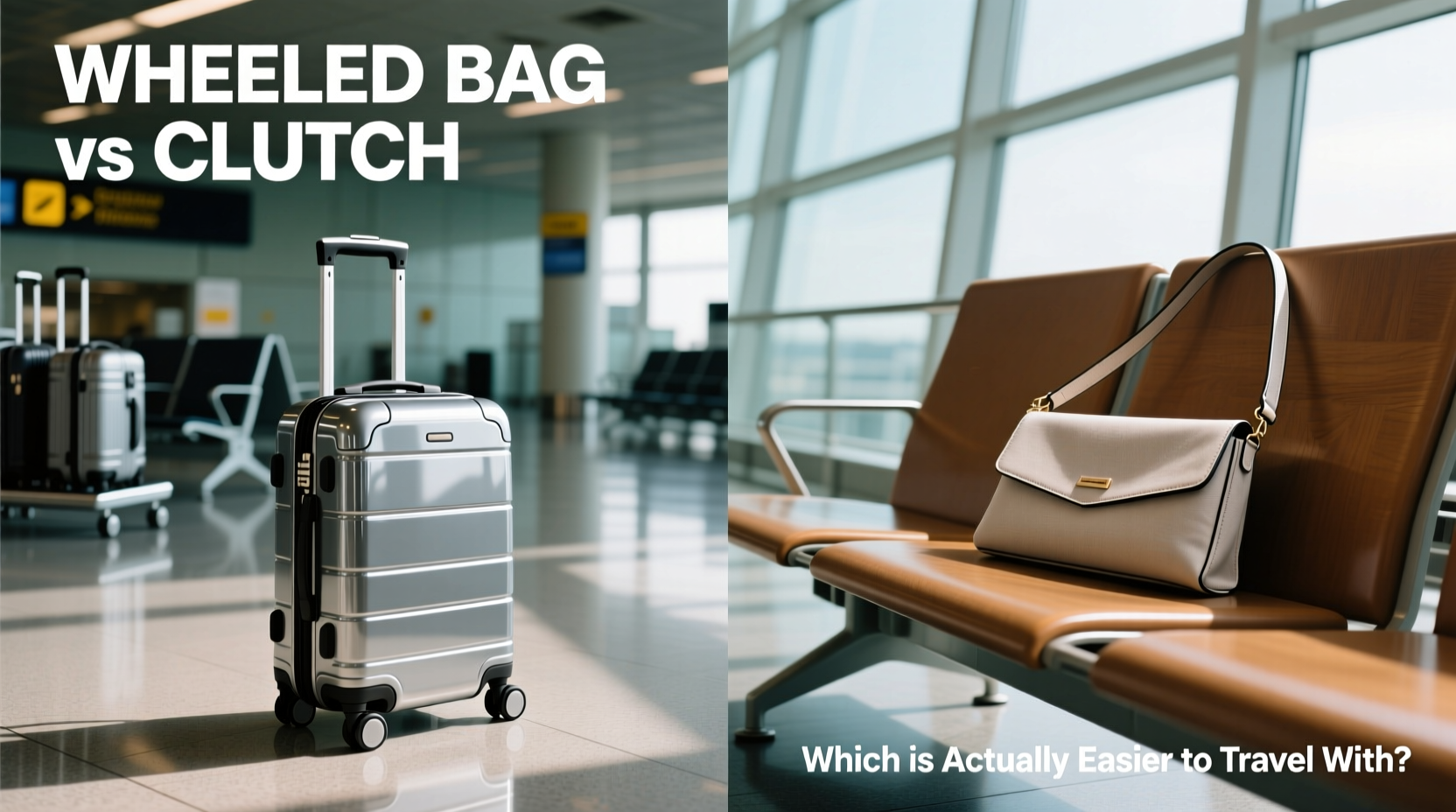
Wheeled luggage has become a staple in modern travel, and for good reason. Whether it’s a carry-on roller or a full-size checked suitcase, wheels reduce physical strain significantly. For anyone managing heavy items, mobility challenges, or tight layovers, a wheeled bag can be a game-changer.
Most rolling bags today feature dual spinner wheels, allowing 360-degree movement. This makes navigating crowded terminals, uneven sidewalks, and narrow airplane aisles far more manageable than dragging a single-wheeled case. High-quality materials like polycarbonate or ballistic nylon ensure durability, while thoughtful interior organization helps keep belongings secure and accessible.
Yet, wheels aren’t foolproof. They can fail, get stuck on grates or cobblestones, or require lifting during stairs or security checks. And if you're squeezing into a packed overhead bin, size limitations mean even a compact roller may not fit.
When Clutches Shine: Simplicity and Speed
A clutch, by contrast, represents the minimalist approach to travel. Typically handheld and small (under 10 x 7 inches), clutches are designed for carrying only the essentials: phone, wallet, passport, keys, and maybe a lipstick. They eliminate bulk and encourage intentional packing.
For short trips, city commutes, or airport-to-hotel shuttles, a clutch minimizes decision fatigue. There’s no need to worry about wheels, straps, or zippers snagging. You can tuck it under your arm, slip it into a coat pocket, or hold it securely while scanning boarding passes.
However, the trade-off is clear: zero capacity for expansion. Need a sweater, water bottle, or reading material? You’ll either carry them separately or go without. In rainy weather or cold climates, juggling a clutch while managing an umbrella becomes awkward at best.
“Efficiency in travel often comes down to friction reduction. A clutch removes mechanical failure points—but only if your needs are truly minimal.” — Jordan Lee, Travel Ergonomics Consultant
Comparative Breakdown: Wheeled Bag vs Clutch
| Feature | Wheeled Bag | Clutch |
|---|---|---|
| Capacity | High (15–45L depending on size) | Very low (~1–2L) |
| Mobility (flat surfaces) | Excellent | Fair (requires hand use) |
| Mobility (stairs/rough terrain) | Poor to moderate (lifting required) | Good (lightweight, easy to carry) |
| Security & Access | Multiple compartments, lockable zippers | Limited; quick access but less protection |
| Durability | Varies; wheels/handles prone to wear | Generally high (few moving parts) |
| Best For | Multi-day trips, business travel, family journeys | Day trips, airside transfers, minimalist commuters |
Real-World Scenario: Business Traveler in Europe
Consider Sarah, a consultant based in Berlin who travels weekly for client meetings across Western Europe. Her typical trip: Friday evening flight to Paris, Sunday return. She packs two outfits, toiletries, laptop, and presentation materials.
She used to carry a leather clutch with just her passport, cardholder, and phone. While stylish, she quickly realized she had no room for a charger, water bottle, or light jacket. On one occasion, rain caught her off guard—she ended up holding her clutch inside her jacket to keep it dry, making boarding difficult.
She switched to a compact 20-inch wheeled carry-on with a fold-out compartment for her tablet. Though slightly heavier, she rolls it effortlessly through Charles de Gaulle, stores it overhead, and uses the exterior pockets for quick-access items. When needed, she detaches a slim crossbody pouch from the suitcase—functionally serving as her “clutch” subset.
This hybrid strategy highlights a growing trend: combining the strengths of both worlds. The wheeled bag handles logistics; the mini clutch (or front pocket) delivers speed and elegance.
Choosing What Works for Your Journey
The question isn’t whether wheeled bags or clutches are objectively better—it’s which aligns with your specific travel context. Ask yourself:
- How many days am I traveling?
- Will I face stairs, cobblestones, or long walking distances?
- Do I need to carry electronics, liquids, or extra clothing?
- Am I traveling alone or with others who can share load?
- Is speed through security a priority?
If you're flying domestically for a weekend, staying at a hotel with immediate access, and value looking polished at all times, a clutch paired with airline-approved personal item dimensions might suffice—especially if you're checking another bag.
But if you're connecting through multiple hubs, walking miles in airports, or visiting cities with poor curb cuts and subway elevators, a wheeled bag drastically reduces fatigue and risk of injury.
Actionable Checklist: Picking Your Ideal Travel Companion
- ✅ Define trip duration and destination terrain (urban, mountainous, indoor-focused).
- ✅ List essential items you must carry on your person.
- ✅ Measure total volume needed (e.g., 5L+ suggests a bag beyond clutch size).
- ✅ Consider physical demands: Can you lift 15 lbs repeatedly?
- ✅ Evaluate airport layout: Does your terminal have escalators or elevators?
- ✅ Test carry options: Walk 100 meters with your candidate bag to assess comfort.
- ✅ Prioritize closure security: Zippers vs magnetic flaps matter in crowded spaces.
Frequently Asked Questions
Can I bring a clutch and a wheeled bag?
Absolutely—and many frequent flyers do. Airlines typically allow one carry-on and one personal item. A clutch qualifies as the personal item, giving you layered access: main storage in the roller, essentials in the clutch.
Isn’t a clutch easier at security checkpoints?
Yes, in some ways. You won’t need to fold or stow wheels, and smaller clutches can go straight into bins. However, if your clutch contains electronics, they still need to be removed. A well-organized wheeled bag with a TSA-friendly laptop sleeve can be just as efficient.
What if my wheeled bag breaks during travel?
It happens. Choose brands with replaceable wheels and carry a repair kit (duct tape, zip ties). Some travelers keep a foldable duffel in their roller as a backup. With a clutch, mechanical failure is nearly impossible—but so is adaptability.
Final Verdict: Function Over Form, Context Over Convention
In the end, the easier option depends entirely on what “easy” means to you. If ease means minimizing effort over distance and time, a wheeled bag wins for most trips over 24 hours. Its ability to carry more with less physical cost outweighs the occasional stair struggle.
But if ease means simplicity, elegance, and never worrying about wheel alignment, a clutch excels in short, controlled environments—like hopping on a regional train or attending a conference downtown.
The smartest travelers don’t choose one over the other permanently. They adapt. They might roll a compact spinner to the airport, then switch to a clutch once settled in a city. Or they attach a clutch-style pouch to their rolling bag for seamless transitions.




 浙公网安备
33010002000092号
浙公网安备
33010002000092号 浙B2-20120091-4
Comments
No comments yet. Why don't you start the discussion?