
In the heart of California’s Silicon Valley lies one of the world’s most prestigious institutions of higher learning—Stanford University. Its sprawling campus, innovative research culture, and global influence are well known. But behind its modern success is a deeply personal story rooted in grief, vision, and a commitment to public service. The university was not born from ambition alone, but from a profound loss that inspired one couple to transform sorrow into enduring educational opportunity.
The Founders: Leland and Jane Stanford
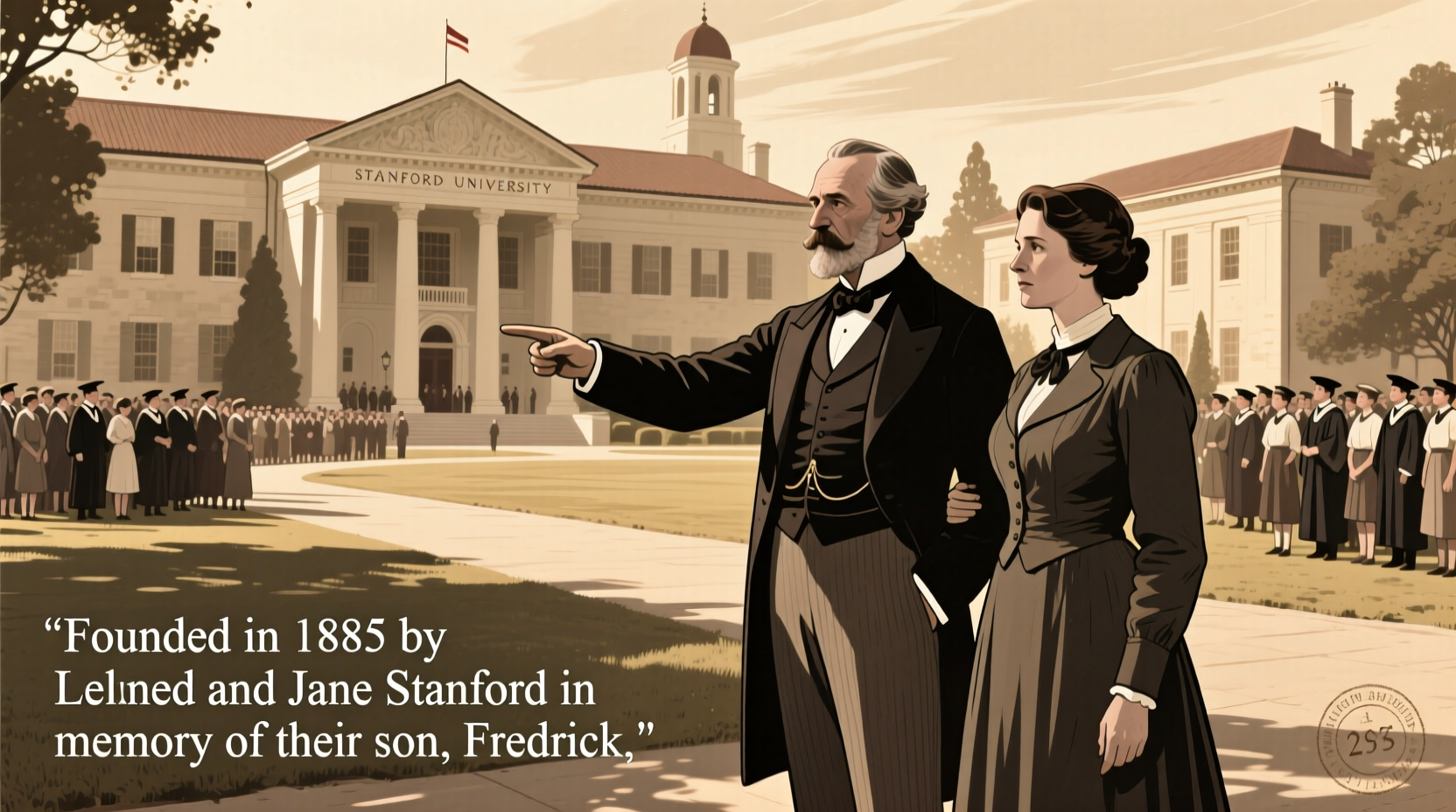
Stanford University was founded by Leland Stanford and his wife, Janet “Jane” Lathrop Stanford, in 1885. Leland Stanford was a prominent businessman and politician—former governor of California (1861–1863), U.S. Senator (1885–1893), and one of the “Big Four” railroad tycoons who built the Central Pacific Railroad as part of the First Transcontinental Railroad.
Jane Stanford played an equally vital role, though historically less recognized. She was deeply involved in the university’s planning, governance, and moral direction. After her husband’s death in 1893, she assumed full leadership, defending the institution during financial crises and ensuring its adherence to their original mission.
Their only child, Leland Stanford Jr., died of typhoid fever at age 15 while traveling in Europe in 1884. Devastated, the couple sought a way to honor his memory. Instead of building a monument or mausoleum, they chose a more transformative path: creating a university “to promote the public welfare” and prevent other families from suffering similar loss through ignorance and disease.
The Motivation: A Memorial Turned Mission
In their official grant of founding, dated November 11, 1885, the Stanfords declared their intent clearly:
“The knowledge and culture which it diffuses throughout the land shall open wider avenues to the advancement of the public good than any institution now in existence.” — Leland and Jane Stanford, Founding Grant of Stanford University
This statement reveals the depth of their purpose. They did not aim merely to create another elite college. Their goal was utilitarian and democratic: to advance practical knowledge, serve society, and remain accessible regardless of gender, race, or economic background—a radical idea for the time.
Unlike many universities of the era, Stanford admitted women from its opening day in 1891, with nearly half the first class being female. It also emphasized engineering, agriculture, and applied sciences over classical curricula, reflecting Leland’s belief in education that served real-world needs.
A Historical Timeline: From Vision to Reality
The journey from concept to operational university spanned several critical years. Here is a step-by-step look at key milestones:
- 1884: Leland Stanford Jr. dies in Florence, Italy. His parents vow to memorialize him through a lasting public institution.
- 1885: The Stanfords file the Founding Grant, officially establishing Leland Stanford Junior University.
- 1886: The site is chosen—the family’s Palo Alto stock farm becomes the campus grounds.
- 1887: David Starr Jordan, a biologist and educator, is appointed first president.
- 1891: Stanford University opens its doors to 555 students. Tuition is free; only minimal fees are charged.
- 1893: Leland Stanford dies. Jane assumes full control and defends the endowment against legal challenges.
- 1906: The San Francisco earthquake severely damages campus buildings. Reconstruction begins immediately under Jane’s oversight.
Jane Stanford’s determination during these early decades cannot be overstated. Following her husband’s death, the university faced lawsuits, political scrutiny, and financial strain. At one point, trustees proposed closing the school temporarily. Jane refused. She sold personal assets, reorganized management, and personally supervised rebuilding after the earthquake.
Educational Philosophy and Early Innovations
From the outset, Stanford broke conventions. Its motto, \"Die Luft der Freiheit weht\" (“The wind of freedom blows”), adopted from a German humanist tradition, signaled intellectual openness. The curriculum balanced liberal arts with practical training, anticipating the modern interdisciplinary model.
Key innovations included:
- Coeducation from day one
- No religious affiliation or mandatory chapel
- Emphasis on laboratory science and fieldwork
- Close ties between faculty and students
- Land grant-style focus on agriculture and mechanics
These choices positioned Stanford uniquely among American universities. While Harvard and Yale emphasized tradition and theology, Stanford embraced progress, utility, and inclusivity.
Challenges and Resilience: The Early Years
The university’s survival was never guaranteed. After Leland’s death, his estate became entangled in probate disputes. The Southern Pacific Railroad, once a source of wealth, faced antitrust litigation, threatening the endowment. In 1893, the U.S. Supreme Court ruled that portions of the railroad fortune could not be used for the university, forcing budget cuts.
Jane Stanford responded decisively. She took personal charge of finances, reduced administrative bloat, and even lived on campus to monitor operations. Her leadership preserved the institution’s independence and integrity.
“The danger is not that the university will die, but that it may become commonplace.” — Jane Stanford, in a letter to President Jordan, 1897
Her vigilance ensured that Stanford remained true to its founders’ ideals—not a mere replica of Eastern elites, but a new kind of American university shaped by Western optimism and innovation.
Legacy and Long-Term Impact
Today, Stanford stands as a global leader in technology, entrepreneurship, and research. It has produced Nobel laureates, tech pioneers, and leaders across fields. Yet its origin story remains one of humanity and compassion.
The decision to found a university in memory of a child might seem sentimental, but the Stanfords transformed personal tragedy into a powerful social investment. Their emphasis on usefulness, access, and freedom laid the groundwork for Stanford’s later role in shaping Silicon Valley.
Notably, early faculty like Frederick Terman—son of a Stanford professor and later dean of engineering—actively encouraged student startups. This culture of innovation, seeded in the university’s founding principles, eventually gave rise to companies like Hewlett-Packard, Google, and countless others.
Do’s and Don’ts: How Stanford’s Founding Principles Apply Today
| Principle | Do | Don't |
|---|---|---|
| Public Service | Design programs that address societal challenges (e.g., climate, health) | Prioritize prestige over community impact |
| Accessibility | Maintain need-blind admissions and robust financial aid | Create barriers based on wealth or background |
| Innovation | Encourage cross-disciplinary collaboration and risk-taking | Stick rigidly to traditional academic silos |
| Stewardship | Protect institutional independence and long-term vision | Sacrifice values for short-term funding or political favor |
Frequently Asked Questions
Why is Stanford called \"Leland Stanford Junior University\"?
The full legal name is Leland Stanford Junior University, named in memory of the couple’s son, Leland Stanford Jr. Though commonly known as Stanford University, the official name reflects its origin as a memorial.
Was Stanford always a top-tier university?
No. In its early decades, Stanford was respected but not elite. Its rise to global prominence accelerated after World War II, fueled by federal research funding, proximity to emerging tech industries, and strategic leadership in science and engineering.
How did the Stanford family’s wealth influence the university?
The initial endowment came almost entirely from Leland Stanford’s fortune, primarily derived from the Southern Pacific Railroad. While this provided crucial startup capital, it also created vulnerabilities when the railroad faced legal and financial troubles. Jane Stanford’s stewardship ensured the university survived these early storms.
Conclusion: A Legacy Built on Purpose
The founding of Stanford University was neither inevitable nor purely strategic. It emerged from grief, guided by a conviction that education should uplift society and honor human potential. Leland and Jane Stanford could have chosen any form of commemoration—but they chose one that multiplied benefit across generations.
Theirs is a reminder that great institutions often begin not with grand ambition, but with quiet resolve. Whether you’re an educator, student, or simply someone inspired by stories of impact, consider how personal values can shape public good. The next transformative idea—like Stanford itself—might begin not in a boardroom, but in a moment of reflection, loss, and hope.




 浙公网安备
33010002000092号
浙公网安备
33010002000092号 浙B2-20120091-4
Comments
No comments yet. Why don't you start the discussion?