
In the annals of American comedy, few moments are as perfectly orchestrated in absurdity and precision as the mirror scene from the 1933 film Duck Soup. Though the phrase “a duck unpacking” does not appear literally in the script, it has become a playful misquotation and cultural shorthand for the surreal, boundary-pushing humor of the Marx Brothers—particularly Groucho, Harpo, Chico, and Zeppo. The real magic lies not in literal ducks or luggage, but in the way the brothers turned logic on its head, using wordplay, visual gags, and anarchic timing to dismantle social norms and cinematic expectations alike.
The so-called “duck unpacking” moment refers most directly to the famous mirror sequence in Duck Soup, where Harpo, disguised as Groucho’s reflection, mimics every move with uncanny accuracy—until he doesn’t. The illusion breaks down into chaos, a hallmark of Marxian comedy: order gives way to nonsense, and the audience is left laughing at the collapse of reality itself. This routine wasn’t just funny; it was revolutionary. To understand why, we must unpack the layers behind this masterpiece of comedic choreography.
The Mirror Scene: A Masterclass in Timing and Subversion
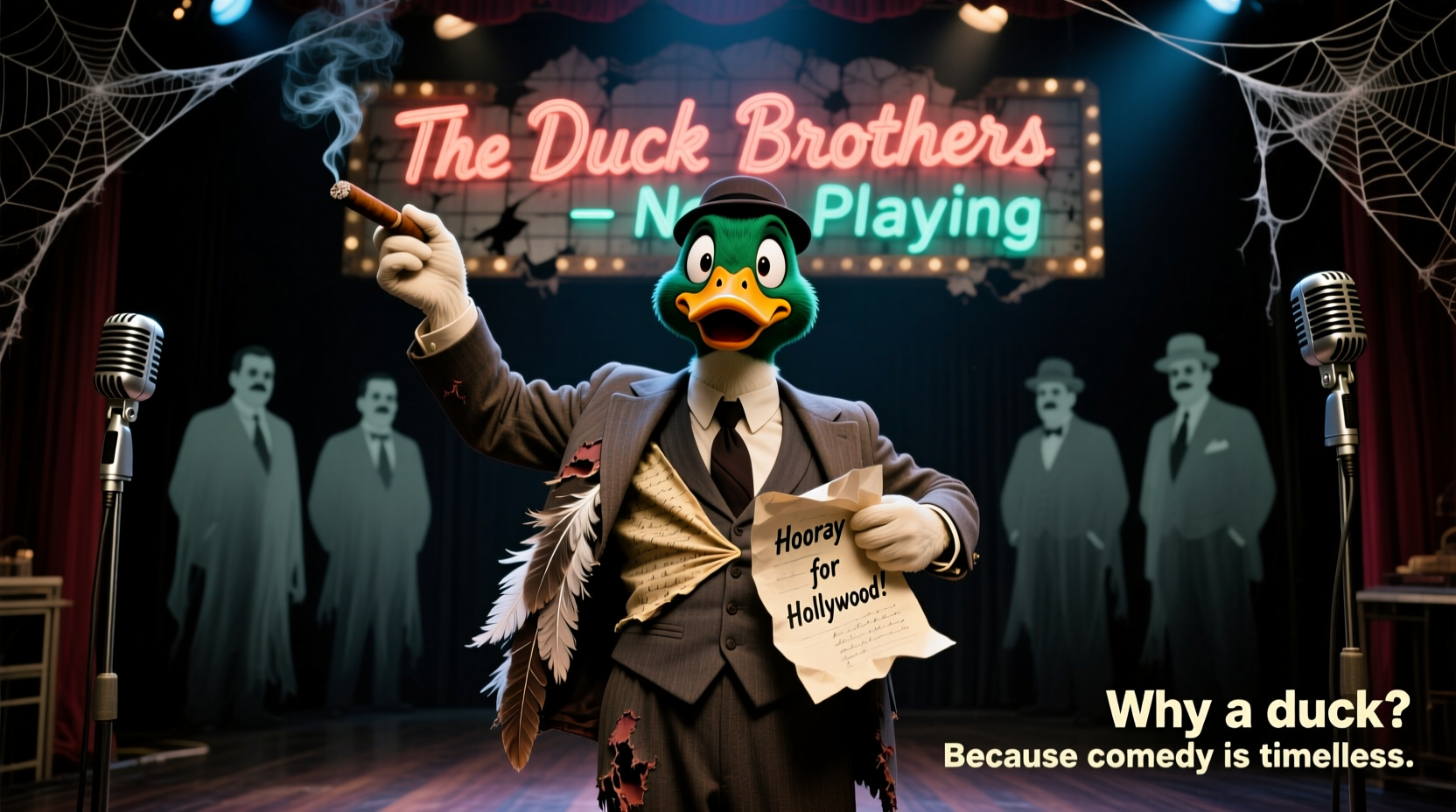
The mirror routine occurs when Pinky (Harpo) sneaks into Secretary Rufus T. Firefly’s (Groucho) office disguised as his French ambassador counterpart. To maintain the ruse, Harpo pretends to be Groucho’s reflection in a full-length mirror. For nearly three minutes, the two perform an intricate dance of mimicry—each gesture, eyebrow raise, and step mirrored with flawless synchronization. Then, subtly, the rules shift. Harpo begins to break pattern, performing actions Groucho hasn’t done, yet Groucho still reacts as if he sees them in the reflection.
This moment isn’t merely slapstick. It’s a calculated deconstruction of perception. The audience knows there’s no real mirror, yet the performance convinces us otherwise—until the joke turns inward. When Harpo adjusts his collar after Groucho has already turned away, or when he pulls a cigar out of thin air, the illusion fractures deliberately. The brothers aren’t just mocking diplomacy or politics—they’re mocking the very idea of consistency in narrative and visual logic.
“Comedy is simply a funny way of being serious.” — Peter Ustinov, actor and satirist
The Linguistic Absurdity: How “Why a Duck?” Became “Why a Duck Unpacking”
Long before internet memes distorted quotes for humor, the Marx Brothers were masters of linguistic sabotage. One of their most famous verbal exchanges comes from Animal Crackers (1930), where Groucho says:
Groucho: “You can tell a man by the company he keeps.”
Chico: “Yes? Well, I’ll tell you something, too. You can catch a lot of fish in the ocean.”
Groucho: “But you can’t catch tuna without fishing gear.”
Chico: “Why not?”
Groucho: “Because tuna don’t grow on trees.”
Chico: “Then how do you get ‘apple-tuna’?”
Groucho: “I don’t know. Why a duck?”
That final line—“Why a duck?”—is pure non sequitur brilliance. It has no logical connection, yet it lands because of delivery and rhythm. Over time, fans conflated this line with the mirror scene, morphing it into the mythical “Why a duck unpacking?”—a phrase that sounds like a surreal riddle but embodies the essence of Marxian humor: illogical premises treated with deadpan seriousness.
Breaking Down the Routine: A Step-by-Step Guide to the Chaos
The mirror scene unfolds in five distinct phases, each escalating the tension between order and disorder:
- Establishment of the Illusion: Harpo enters silently, positioning himself behind a painted mirror frame. Groucho begins moving, and Harpo mirrors him exactly.
- Perfect Synchronization: Every tilt of the head, hand gesture, and foot shuffle is replicated. The audience is convinced by the precision.
- Subtle Rule-Breaking: Harpo starts making small deviations—adjusting his hat when Groucho hasn’t, or stepping sideways without cause.
- Escalation of Nonsense: Groucho begins reacting to actions Harpo performs independently. He scratches his back because Harpo does—even though Harpo isn’t his reflection anymore.
- Complete Collapse: Props appear out of nowhere (cigars, cups), characters interact across the “mirror,” and logic dissolves entirely.
This progression mirrors the structure of great absurdist theater: start with a believable premise, then slowly peel away the rules until nothing makes sense—and yet, the audience laughs harder than ever.
Cultural Impact and Legacy: Why This Routine Still Matters
The Marx Brothers didn’t invent slapstick, but they refined it into high art. Their routines influenced generations of comedians—from Mel Brooks and Woody Allen to contemporary acts like Key & Peele and Flight of the Conchords. The mirror scene, in particular, has been referenced, homaged, and parodied countless times.
Notable examples include:
- The mirror duel in The Lady in the Lake (1947), inspired by the same concept.
- A similar gag in Laurel and Hardy’s “Tit for Tat” (1935).
- Modern reinterpretations in Mr. Bean and Borat, where physical mimicry leads to escalating confusion.
What sets the Marx version apart is the lack of explanation. There’s no wink to the camera, no narrative justification. The brothers commit fully to the bit, treating the impossible as mundane. That commitment is what makes the routine timeless.
Expert Insight: What Scholars Say About the Marx Method
“The Marx Brothers operated in a universe governed not by physics or grammar, but by emotional truth and comic rhythm. When Harpo ‘mirrors’ Groucho, we believe it because the timing is perfect—not because it’s plausible.” — Dr. Rebecca Simon, Professor of Film Comedy, NYU Tisch School of the Arts
Academic analysis often frames the Marx Brothers as proto-Dadaists—artists who rejected rationalism in favor of spontaneity and shock. In this light, “a duck unpacking” becomes a metaphor for any act of creative rebellion against structure. The phrase may not exist in the script, but it captures the spirit: taking something ordinary (unpacking) and assigning it to something absurd (a duck), all delivered with straight-faced confidence.
Do’s and Don’ts of Appreciating Classic Comedy Routines
| Do | Don't |
|---|---|
| Watch scenes multiple times to catch subtle physical gags | Expect modern pacing—older films rely on buildup |
| Pay attention to timing and silence—comedy lives in pauses | Dismiss wordplay as outdated; puns were central to Marx humor |
| Consider the historical context—many jokes targeted authority figures | View the films solely as silly entertainment; they’re politically charged |
| Appreciate the craftsmanship behind long, unbroken takes | Compare them directly to today’s sketch comedy—they operate differently |
Mini Case Study: The Failed Remake Attempt
In 1990, a stage adaptation of Duck Soup attempted to recreate the mirror scene using modern technology—a projected digital mirror. While technically impressive, audiences found it less funny. Why? Because the illusion relied on machinery, not human skill. The original worked because viewers knew it was two men standing inches apart, flawlessly coordinating movements. The vulnerability and precision made it magical. The remake removed the risk, and with it, much of the humor.
This case illustrates a key principle: in physical comedy, authenticity trumps spectacle. The Marx Brothers succeeded because they performed their own stunts, timed their pauses, and trusted the audience to follow them into madness.
Frequently Asked Questions
Did the Marx Brothers really use a real mirror in the scene?
No. The “mirror” was a painted frame with no glass. Harpo stood beside Groucho, matching his movements through rehearsed choreography. No editing tricks or camera illusions were used.
Who came up with the mirror routine?
The bit originated in the Marx Brothers’ vaudeville days. It evolved over years of live performance before being perfected for Duck Soup. Directors Leo McCarey and Sam Wood helped refine the cinematic version.
Is “Why a duck unpacking?” a real quote?
No. It’s a fan-created mashup of “Why a duck?” from Animal Crackers and the mirror scene’s absurd energy. While not authentic, it reflects how audiences remember the tone of their humor.
Conclusion: Keep the Madness Alive
The so-called “duck unpacking” routine is more than a misquoted line or a viral clip. It’s a symbol of comedic innovation—where timing, trust, and total disregard for logic collide to create something transcendent. The Marx Brothers didn’t just make people laugh; they challenged how laughter could be constructed.
Whether you're a film student, a comedy writer, or simply someone who appreciates well-timed silliness, studying this routine offers invaluable lessons in rhythm, subversion, and fearless creativity. So next time you hear someone say “Why a duck unpacking?”, smile—you’re witnessing the echo of a revolution in humor.




 浙公网安备
33010002000092号
浙公网安备
33010002000092号 浙B2-20120091-4
Comments
No comments yet. Why don't you start the discussion?