
In recent years, artificial intelligence has rapidly evolved from a futuristic concept into a practical tool accessible to nearly everyone—including students. While AI-powered platforms like chatbots, essay generators, and homework solvers offer convenience and efficiency, many schools have responded by imposing outright bans on their use. These restrictions are not arbitrary; they stem from deep concerns about academic integrity, learning outcomes, and the long-term development of critical thinking skills. Understanding the rationale behind these bans—and their broader implications for education—is essential for educators, parents, and students alike.
The Rise of AI in Student Workflows
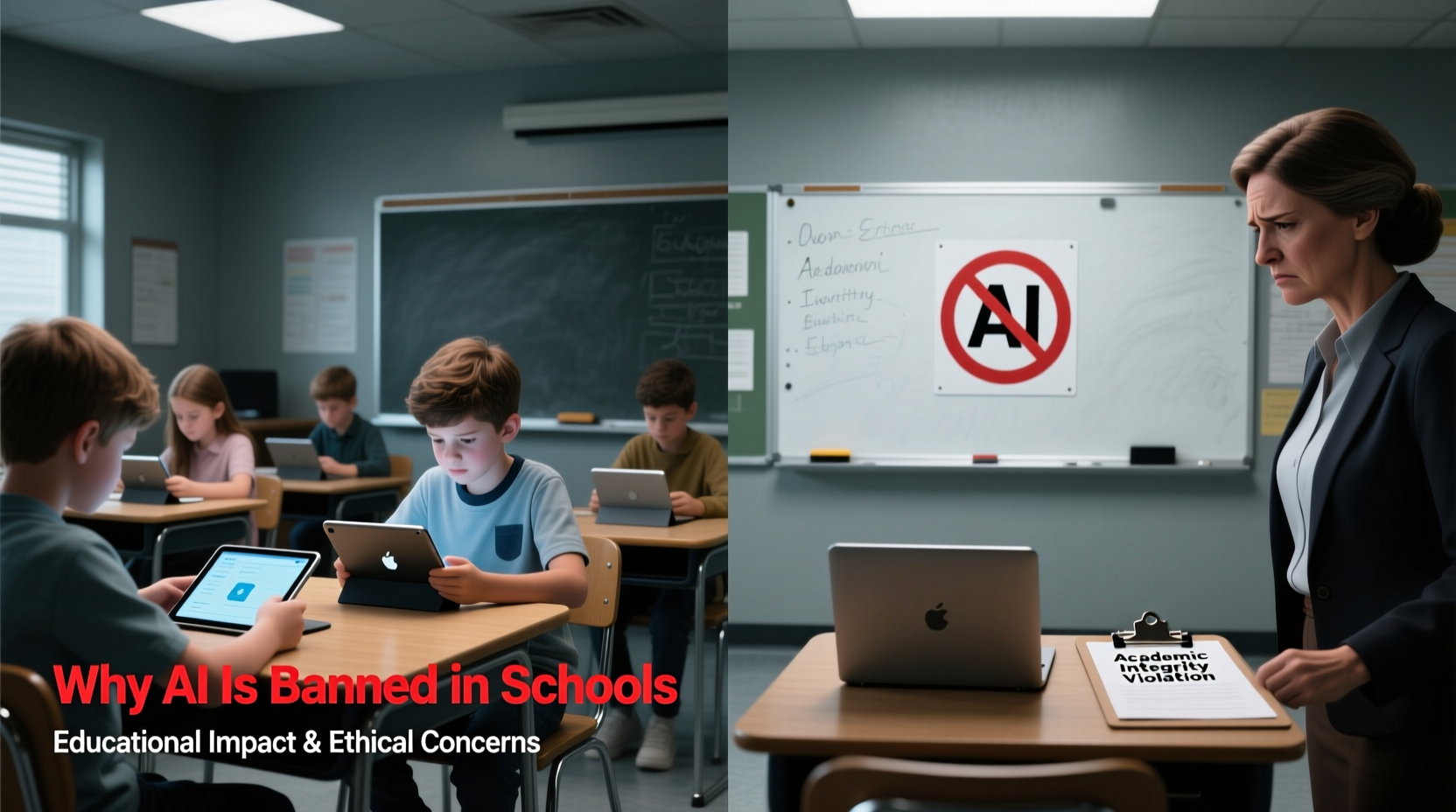
AI tools such as ChatGPT, Gemini, and Jasper have become increasingly popular among students seeking help with writing assignments, solving math problems, or summarizing complex texts. These tools can generate coherent essays in seconds, debug code, and even mimic individual writing styles. For time-strapped students, the appeal is obvious: faster results with minimal effort. However, this ease of access has led to widespread misuse, prompting schools to take action.
According to a 2023 survey by the Stanford Cyber Policy Center, over 58% of high school students admitted using AI to complete homework at least once. While some used it responsibly—for brainstorming or editing—many relied on it to bypass the learning process entirely. This shift has raised alarms about what students might lose when machines do the intellectual heavy lifting.
Primary Reasons AI Is Banned in Schools
Schools across the U.S., Europe, and parts of Asia have implemented policies restricting or prohibiting AI use in classrooms and assessments. The decision to ban AI is typically driven by several interconnected concerns:
- Academic Dishonesty: When students submit AI-generated work as their own, it constitutes plagiarism. Unlike traditional cheating, AI-produced content is often undetectable by standard plagiarism software, making enforcement difficult.
- Erosion of Critical Thinking: Writing an essay isn’t just about producing text—it’s about organizing thoughts, constructing arguments, and refining ideas. Relying on AI shortcuts this cognitive development.
- Unequal Access: Not all students have equal access to premium AI tools or reliable internet, creating disparities in who benefits from these technologies.
- Data Privacy Risks: Many AI platforms collect user inputs, raising concerns about student data being stored, analyzed, or shared without consent.
- Undermining Assessment Validity: If teachers cannot trust that submitted work reflects a student’s actual ability, grades and evaluations lose meaning.
Educational Impact: Short-Term Gains vs. Long-Term Consequences
On the surface, AI appears to enhance productivity. Students finish assignments faster, correct grammar instantly, and gain quick summaries of dense material. But beneath this efficiency lies a troubling trade-off: diminished skill acquisition.
Research from the University of California, Irvine found that students who regularly used AI for writing showed significantly weaker development in argumentation and analytical reasoning over a semester compared to peers who wrote independently. Similarly, a study published in *Nature Human Behaviour* (2024) concluded that overreliance on automation reduces metacognitive awareness—the ability to reflect on one’s own thinking.
“Just because a student can produce a perfect five-paragraph essay with AI doesn’t mean they understand how to build one themselves. We risk creating a generation fluent in output but illiterate in process.” — Dr. Linda Chen, Cognitive Scientist at MIT
Case Study: Lincoln High School’s AI Experiment
In early 2023, Lincoln High School in Portland piloted a program allowing limited AI use in English and social studies classes. Teachers instructed students to use AI only for outlining and revising drafts, not for generating full essays. After one semester, results were mixed. While engagement increased and drafting speed improved, teachers noticed a decline in originality and depth of analysis. One sophomore admitted, “I stopped trying to come up with my own thesis because the AI gave me three good ones right away.” By year-end, the school revised its policy, reinstating stricter limits on AI during formal assessments.
Do’s and Don’ts of AI Use in Education
| Scenario | Do | Don't |
|---|---|---|
| Homework Help | Use AI to clarify concepts or check grammar | Rely on AI to write entire answers |
| Research Projects | Leverage AI to summarize sources or suggest keywords | Cite AI-generated content as factual without verification |
| Exam Preparation | Generate practice questions or flashcards | Depend solely on AI explanations without textbook review |
| Classroom Discussions | Prepare talking points with AI assistance | Pretend AI-generated opinions are your own insights |
Toward a Balanced Approach: A Step-by-Step Framework
Banning AI outright may seem like the safest option, but it risks ignoring its potential as a learning aid. A more sustainable solution involves structured integration. Here’s a step-by-step model schools can adopt:
- Define Clear Policies: Establish what constitutes acceptable vs. prohibited AI use in different subjects and assignments.
- Educate Students on Ethics: Offer workshops on digital responsibility, citation of AI use, and the value of independent thinking.
- Train Educators: Equip teachers with detection tools and pedagogical strategies to design AI-resistant assessments (e.g., oral defenses, process journals).
- Integrate AI Literacy: Include AI ethics and functionality in the curriculum, similar to media or information literacy.
- Monitor and Adapt: Regularly assess the impact of AI policies and adjust based on student outcomes and technological changes.
Frequently Asked Questions
Can schools detect if a student used AI to write an essay?
Some AI detection tools exist—like Turnitin’s AI indicator or GPTZero—but they are imperfect. They analyze writing patterns and flag likely machine-generated text, but false positives and negatives are common. Ultimately, detection is not foolproof, which is why many schools focus on prevention through clear guidelines and assignment design.
Is it ever okay for students to use AI?
Yes, when used ethically and transparently. For example, using AI to brainstorm ideas, improve sentence structure, or translate text can be beneficial—if the final work reflects the student’s understanding and effort. The key is disclosure and maintaining academic ownership.
Will AI eventually replace teachers?
No. While AI can support instruction, it lacks empathy, adaptability, and the human connection essential to effective teaching. Its role should be supplementary, not substitutive. Great educators don’t just deliver information—they inspire, challenge, and mentor.
Conclusion: Reclaiming Learning in the Age of Automation
The debate over AI in schools isn’t really about technology—it’s about values. What kind of learners do we want to cultivate? Students who excel at copying outputs, or those who develop resilience, creativity, and deep understanding? Banning AI may address immediate threats to academic integrity, but the long-term solution lies in redefining how we teach and assess in an era of instant answers.
Schools must move beyond fear-based restrictions and instead foster a culture of responsible innovation. By teaching students not just how to use AI, but when *not* to, we empower them to think critically, act ethically, and grow into capable, independent thinkers. The future of education depends not on rejecting AI, but on mastering its place within genuine learning.




 浙公网安备
33010002000092号
浙公网安备
33010002000092号 浙B2-20120091-4
Comments
No comments yet. Why don't you start the discussion?