
The night sky stretches across the cosmos like a vast ocean of stars—billions upon billions of them, each potentially hosting planets capable of supporting life. Given this staggering scale, the question arises: if the universe is so large and old, why haven’t we found any sign of intelligent extraterrestrial civilizations? This contradiction lies at the heart of the Fermi Paradox, a riddle that continues to challenge scientists, philosophers, and space enthusiasts alike. While many assume alien life must exist somewhere, compelling arguments suggest otherwise. This article explores the scientific reasoning behind why aliens may not be real, examines NASA’s official position, and unpacks the implications of one of astronomy’s most enduring mysteries.
The Fermi Paradox: Where Is Everybody?
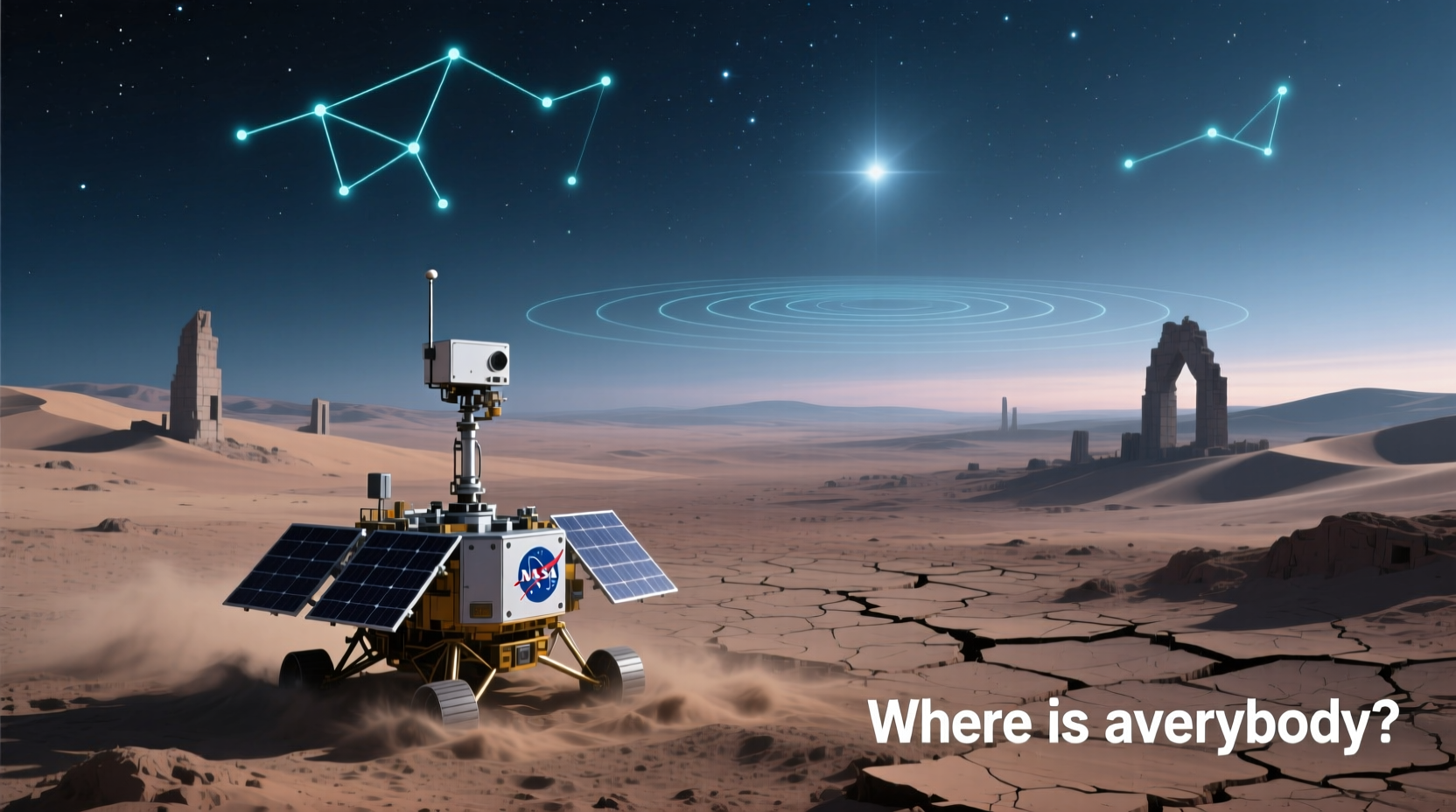
In 1950, physicist Enrico Fermi famously asked over lunch, “Where is everybody?” His simple question cut to the core of a growing contradiction. By mid-century, astronomers had already begun to grasp the immensity of the universe. With hundreds of billions of galaxies, each containing billions of stars, the probability of Earth being the only planet with life seemed vanishingly small. Yet, despite decades of observation and technological advancement, no definitive evidence of alien life—intelligent or otherwise—has ever been found.
The Fermi Paradox highlights this disconnect between high probability estimates for extraterrestrial life and the lack of observable evidence. If even a fraction of habitable planets developed intelligent life, some civilizations should have achieved interstellar travel or left detectable signals long before humans evolved. And yet, the cosmos remains silent.
“Extraordinary claims require extraordinary evidence.” — Carl Sagan
Sagan’s famous maxim underscores the rigor required in evaluating claims about alien life. To date, no such evidence has met the threshold of scientific validation. The silence isn't just absence—it’s data.
NASA’s Position on Extraterrestrial Life
NASA does not claim that aliens are real. Instead, its approach is methodical, research-driven, and grounded in empirical science. The agency actively searches for biosignatures—chemical indicators of past or present life—on Mars, Europa, Enceladus, and exoplanets. However, it maintains a clear distinction between speculation and discovery.
Dr. Thomas Zurbuchen, former associate administrator for NASA’s Science Mission Directorate, stated: “We’re not claiming we’ve found life. We’re saying we’ve found ingredients and environments where life could potentially exist.” This cautious language reflects NASA’s commitment to peer-reviewed science over sensationalism.
NASA funds missions like the James Webb Space Telescope (JWST) and Mars rovers specifically to gather data on planetary conditions and atmospheric compositions. These efforts aim to answer whether life *could* exist elsewhere—not to confirm that it already does.
Potential Explanations for the Great Silence
Scientists have proposed numerous solutions to the Fermi Paradox. Some suggest intelligent life is extremely rare; others argue that advanced civilizations inevitably destroy themselves. Below are several leading hypotheses:
- Rarity of Life: Despite favorable conditions, abiogenesis—the emergence of life from non-living matter—might be an exceedingly rare event.
- The Great Filter: There may be one or more evolutionary barriers so difficult to overcome that almost no species reaches interstellar capability. This filter could lie in our past (e.g., development of complex cells) or ahead (e.g., self-destruction via nuclear war or AI).
- Short Window of Detectability: Civilizations may only broadcast detectable signals for brief periods before shifting to encrypted or low-emission technologies.
- Isolation by Distance: Even at light speed, communication across thousands of light-years would take millennia, making real-time contact impractical.
- Zoo Hypothesis: Advanced beings might be aware of us but choose not to interfere, treating Earth as a protected observation zone.
Each of these theories implies that intelligent alien life either doesn’t exist—or exists in forms and locations beyond our current detection methods.
Why Aliens Might Not Be Real: A Scientific Perspective
While pop culture treats alien visitation as inevitable, science demands testable predictions and falsifiable models. To date, no hypothesis confirming alien existence has passed rigorous scrutiny. Consider the following points:
- No Physical Evidence: Despite millions of hours of sky monitoring, no spacecraft, artifacts, or biological samples of extraterrestrial origin have been verified.
- Lack of Technosignatures: SETI (Search for Extraterrestrial Intelligence) has scanned thousands of stars for artificial radio signals. None have been conclusively linked to alien intelligence.
- Anthropocentric Bias: Humans tend to project their own behaviors onto the cosmos, assuming other civilizations would explore, communicate, or expand similarly.
- Statistical Misinterpretation: High numbers of exoplanets do not equate to high probabilities of intelligent life. Habitable does not mean inhabited.
Moreover, recent discoveries reinforce Earth’s uniqueness. Plate tectonics, a large moon stabilizing climate, a protective magnetic field, and a Jupiter-like planet shielding against asteroid impacts—all contribute to long-term habitability. The confluence of these factors may be exceptionally rare.
| Factor | Role in Supporting Life | Observed Elsewhere? |
|---|---|---|
| Stable Star | Provides consistent energy without extreme flares | Rare among M-dwarf systems |
| Liquid Water | Essential solvent for biochemistry | Indirect evidence on moons like Europa |
| Oxygen-Rich Atmosphere | Supports complex metabolism | Not confirmed on any exoplanet |
| Planetary Magnetic Field | Shields atmosphere from solar wind | Unknown for most exoplanets |
Case Study: The Wow! Signal and the Illusion of Discovery
In 1977, the Big Ear radio telescope at Ohio State University detected a strong narrowband radio signal lasting 72 seconds. Labeled the “Wow! Signal” after the note scribbled on the printout, it matched expectations for an artificial transmission from deep space. For decades, it fueled speculation about alien contact.
Yet follow-up observations failed to detect the signal again. No repeating pattern, no source triangulation, and no corroborating data emerged. In 2017, researchers proposed a natural explanation: hydrogen line emissions amplified by a passing comet. Though debated, this illustrates how easily anomalies can be misinterpreted as evidence of aliens.
The Wow! Signal remains unexplained—but absence of disproof is not proof. It exemplifies the danger of mistaking curiosity for confirmation.
Checklist: Evaluating Claims About Alien Life
When encountering reports of UFO sightings or potential alien signals, use this checklist to assess credibility:
- ✅ Was the observation made under controlled, repeatable conditions?
- ✅ Has the data been published in a peer-reviewed scientific journal?
- ✅ Are alternative explanations (instrument error, atmospheric phenomena) ruled out?
- ✅ Does the claim rely on anecdotal testimony or verifiable instrumentation?
- ✅ Is the source affiliated with a recognized scientific institution?
Applying this framework quickly separates speculative headlines from legitimate inquiry.
Frequently Asked Questions
Has NASA ever confirmed the existence of aliens?
No. NASA has not confirmed the existence of extraterrestrial life. While it investigates environments where life could exist, all findings remain inconclusive and strictly within the bounds of scientific exploration.
Could UFOs be alien spacecraft?
Unidentified Flying Objects (UFOs), now termed UAPs (Unidentified Anomalous Phenomena), refer only to objects whose nature is unknown. Unknown does not mean extraterrestrial. Most UAPs are eventually explained as drones, balloons, or atmospheric effects. No UAP has been verified as alien technology.
If aliens aren’t real, why does the government study UAPs?
Government agencies monitor UAPs primarily for national security reasons—not because they believe they are aliens. Identifying unknown aerial threats, ensuring airspace safety, and understanding sensor performance are key drivers, not astrobiology.
Conclusion: Embracing Uncertainty in the Search for Truth
The question of whether aliens are real remains unanswered—but the absence of evidence is itself meaningful. The Fermi Paradox challenges us not to accept easy answers, but to refine our understanding of life, intelligence, and the universe. NASA’s measured, evidence-based approach offers a model for how to explore profound questions without succumbing to myth or misinformation.
For now, the simplest explanation—that intelligent alien life does not exist, or is so rare it may as well not—is consistent with available data. That doesn’t mean we should stop looking. On the contrary, it means we should look harder, with better tools and clearer minds.




 浙公网安备
33010002000092号
浙公网安备
33010002000092号 浙B2-20120091-4
Comments
No comments yet. Why don't you start the discussion?