
Shyness is a common experience that touches nearly everyone at some point. It’s that familiar knot in your stomach before speaking up in a meeting, the hesitation before joining a group conversation, or the urge to avoid eye contact in public spaces. While occasional shyness is normal, persistent discomfort in social situations can affect relationships, career growth, and personal well-being. Understanding why you're shy isn't about labeling yourself—it's about gaining insight into your emotional patterns so you can respond with intention, not avoidance.
Shyness stems from a mix of biological predispositions, early life experiences, and ongoing social feedback. It’s not a flaw, but rather a response shaped over time. By exploring its roots and learning effective coping strategies, it’s possible to reduce its impact and cultivate greater ease in everyday interactions.
The Psychology Behind Shyness
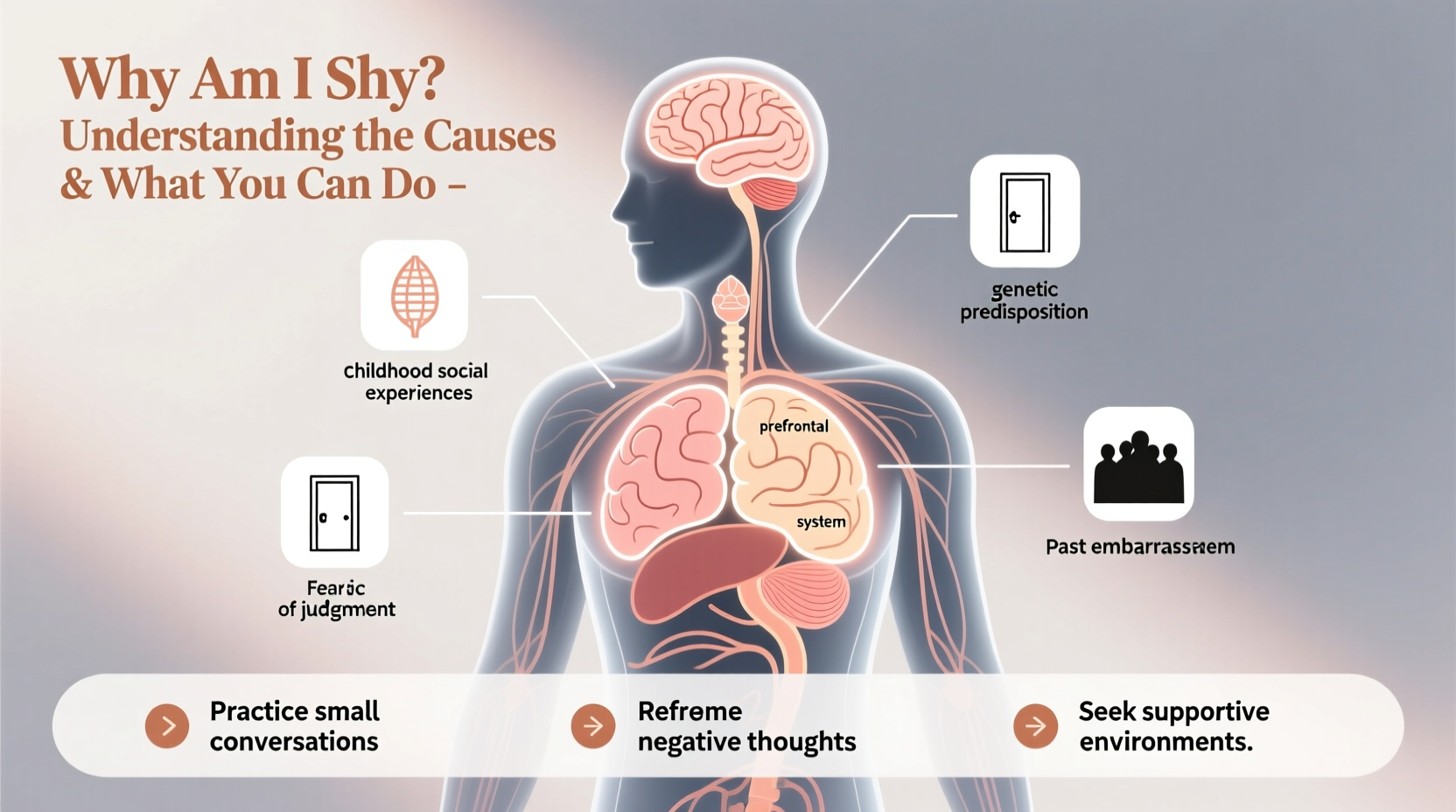
At its core, shyness is a form of social anxiety—typically mild—that arises when we anticipate judgment or rejection in social settings. Unlike introversion, which is about energy preference (introverts recharge alone), shyness involves fear of negative evaluation. You might be extroverted and still feel shy in certain contexts.
Research shows that shyness activates the same neural circuits involved in threat detection. The amygdala—the brain’s alarm system—can become hyper-responsive in shy individuals, interpreting neutral social cues as potentially dangerous. This doesn’t mean there’s anything wrong with your brain; it simply means your internal safety monitor is highly tuned.
“Shyness isn’t weakness. It’s often a sign of deep sensitivity and awareness—an asset when channeled constructively.” — Dr. Lena Torres, Clinical Psychologist and Social Behavior Researcher
Common Causes of Shyness
Shyness rarely has a single cause. Instead, it develops through a combination of factors that interact over time:
- Genetics: Studies on twins suggest that up to 30% of shyness may be hereditary. If one or both parents are shy, children are more likely to exhibit similar tendencies.
- Early Environment: Overprotective parenting, lack of social exposure during childhood, or critical caregivers can reinforce self-consciousness.
- Learned Experiences: Embarrassing moments—such as being laughed at during a school presentation—can create lasting associations between social interaction and discomfort.
- Cultural Norms: In cultures that value modesty and restraint, shyness may be reinforced as a virtue, making assertiveness feel unnatural.
- Social Media Influence: Constant comparison to curated online personas can heighten self-doubt and amplify fears of not measuring up.
Practical Strategies to Manage Shyness
Overcoming shyness isn’t about becoming someone else—it’s about expanding your comfort zone gradually and building confidence through small, repeated actions. Here are proven techniques:
1. Practice Exposure Gradually
Start with low-stakes social interactions—asking a barista how their day is going, complimenting a coworker, or saying hello to a neighbor. Each small interaction trains your brain to tolerate uncertainty without catastrophe.
2. Reframe Negative Thoughts
Shyness is often fueled by assumptions like “They’ll think I’m awkward” or “I’ll say something stupid.” Challenge these thoughts by asking: What’s the evidence? What’s a more balanced perspective?
3. Focus on Others, Not Yourself
When you shift attention outward—listening intently, asking questions, noticing others’ expressions—you reduce self-monitoring, which lessens anxiety.
4. Use Behavioral Rehearsal
Practice conversations in front of a mirror or with a trusted friend. Rehearsing simple dialogues (e.g., introducing yourself) reduces the fear of the unknown.
5. Adopt Confident Body Language
Even if you don’t feel confident, acting “as if” helps. Stand tall, make gentle eye contact, and speak clearly. Your body language influences your mental state.
Step-by-Step Guide to Building Social Confidence
- Week 1–2: Awareness & Observation
Track when and where you feel shy. Note physical sensations (blushing, trembling) and thoughts (“I don’t belong here”). - Week 3–4: Micro-Interactions
Initiate three brief social exchanges per week—greeting a colleague, thanking a cashier by name, commenting on the weather with a stranger. - Week 5–6: Expand Comfort Zones
Attend a small gathering or join a low-pressure group activity (book club, hobby class). Set a goal: “I will speak at least once.” - Week 7–8: Reflect & Reinforce
Review progress. Celebrate attempts, not just outcomes. Ask: What went better than expected?
Do’s and Don’ts of Managing Shyness
| Do | Don’t |
|---|---|
| Prepare conversation starters in advance for social events | Avoid all social situations to prevent discomfort |
| Use positive self-talk: “I’m learning, and that’s okay” | Ruminate on past interactions after they happen |
| Set realistic goals: “Speak once in the meeting” | Expect immediate transformation or complete ease |
| Seek supportive environments with patient people | Compare your progress to outgoing peers |
Real Example: From Shyness to Self-Assurance
Maya, a 28-year-old graphic designer, avoided team meetings for years, fearing her ideas would sound naive. She often stayed quiet, even when she had valuable input. After realizing her silence was limiting her career, she began using small exposure exercises—first sharing one comment per meeting, then volunteering to lead a minor project update.
She practiced breathing techniques before speaking and rehearsed key points with a mentor. Within six months, her contributions were recognized, and she was invited to present at a company-wide event. “I still get nervous,” she says, “but now I know it doesn’t have to stop me.”
Frequently Asked Questions
Is shyness the same as social anxiety disorder?
No. Shyness is a personality trait or temporary state, while social anxiety disorder is a clinical condition marked by intense fear, avoidance, and significant impairment in daily functioning. If shyness causes extreme distress or interferes with work or relationships, professional support may be needed.
Can adults overcome lifelong shyness?
Yes. Neuroplasticity allows the brain to adapt at any age. With consistent practice and self-compassion, long-standing patterns of shyness can be reshaped. Therapy, especially cognitive behavioral therapy (CBT), has strong evidence for effectiveness.
Should I try medication for shyness?
Medication is generally not prescribed for typical shyness. However, in cases of diagnosed social anxiety disorder, doctors may recommend SSRIs or beta-blockers in combination with therapy. Always consult a healthcare provider before considering medication.
Conclusion: Taking the Next Step
Understanding why you’re shy is the first act of empowerment. It transforms an invisible barrier into a navigable challenge. You don’t need to become the loudest person in the room—authentic connection comes from presence, not performance.
Start small. Be patient. Recognize courage not as the absence of fear, but as action despite it. Every time you choose to engage, you rewire your relationship with social space. Progress isn’t linear, but each step builds momentum.




 浙公网安备
33010002000092号
浙公网安备
33010002000092号 浙B2-20120091-4
Comments
No comments yet. Why don't you start the discussion?