
Look up at the night sky, or examine images from deep space telescopes, and one thing becomes immediately clear: planets are round. Whether it’s Earth, Jupiter, or a distant exoplanet light-years away, celestial bodies in our universe tend to form into spheres. But why? What universal force ensures that planets aren’t shaped like cubes, pyramids, or irregular asteroids? The answer lies in the interplay of gravity, mass, and time — fundamental forces that govern the structure of matter on a cosmic scale.
The spherical shape of planets isn’t a coincidence; it’s an inevitable result of physics. Understanding this phenomenon reveals not only how planets form but also what distinguishes them from smaller objects in space.
The Role of Gravity in Shaping Celestial Bodies
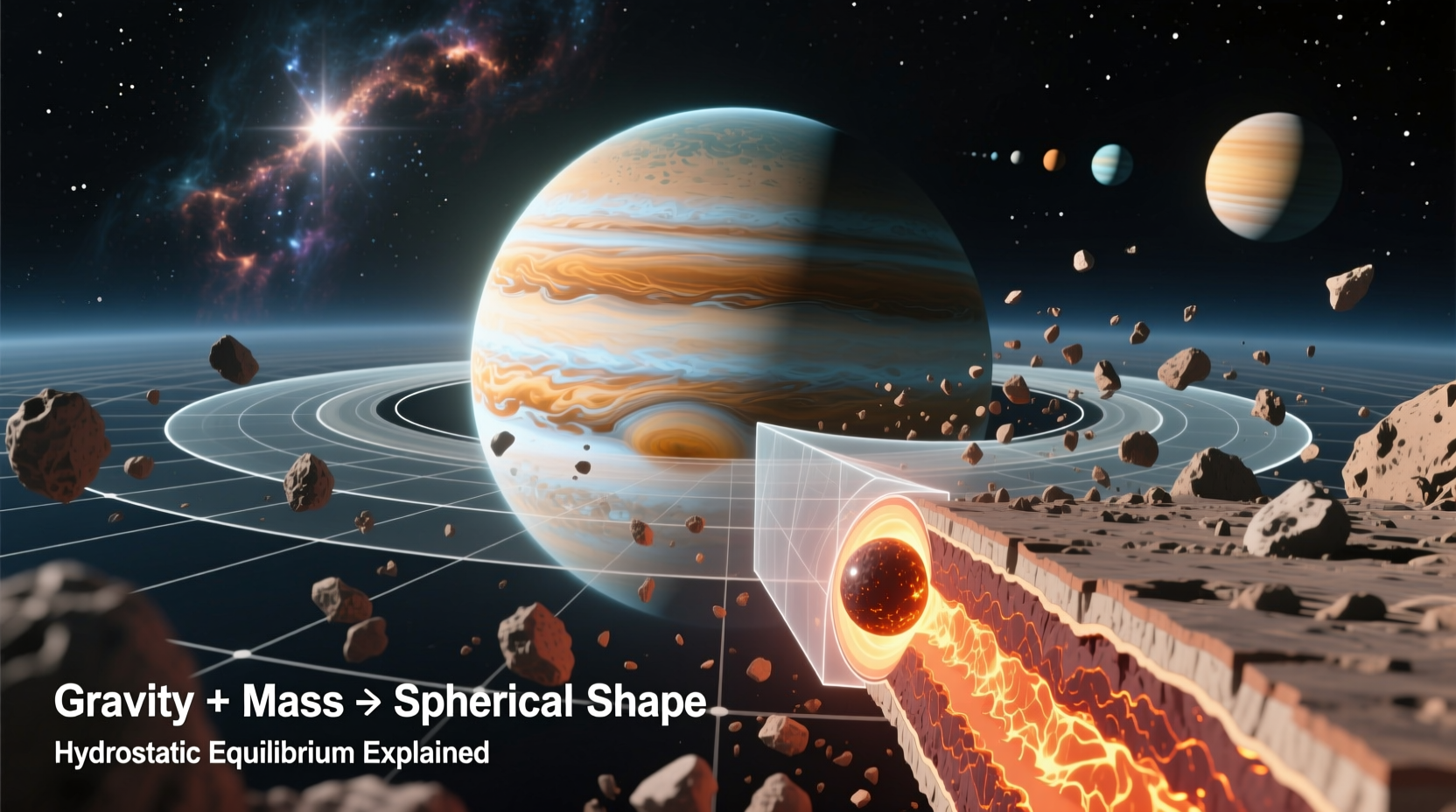
Gravity is the primary architect of planetary form. Every object with mass exerts a gravitational pull toward its center. For small objects — like meteoroids or asteroids under 500 kilometers in diameter — this force is too weak to overcome the rigidity of their rocky or metallic structures. These bodies often remain lumpy and irregular because their internal strength resists gravitational compression.
However, once an object reaches a critical mass — typically around 600 kilometers in diameter for icy bodies and slightly more for rocky ones — gravity becomes dominant. At this point, the inward pull is strong enough to deform the material, molding it into a shape where every point on the surface is as close as possible to the center of mass. That shape is a sphere.
This process is known as gravitational self-attraction. Over millions of years, accumulating debris in a protoplanetary disk clumps together, increasing in mass until gravity takes over. The body begins to compress under its own weight, smoothing out peaks and valleys until hydrostatic equilibrium is achieved — a state where pressure and gravity balance to maintain a nearly spherical form.
Hydrostatic Equilibrium: The Key to Planetary Roundness
Hydrostatic equilibrium is the physical condition that defines when a celestial body becomes round. It occurs when the force of gravity pulling inward is balanced by the pressure of the material pushing outward. In stars, this balance involves hot plasma; in planets, it’s rock, ice, or metallic layers responding to immense pressure.
For a planet, achieving hydrostatic equilibrium means that the body has sufficient mass for gravity to overcome rigid body forces. This allows the planet to \"flow\" into a spherical shape over geological timescales, much like how water forms a droplet in zero gravity. Even solid rock behaves plastically under extreme pressure and over long durations.
Not all round objects are planets, though. Dwarf planets like Pluto and Ceres also exhibit hydrostatic equilibrium, which is one of the criteria the International Astronomical Union (IAU) uses to classify such bodies. In contrast, smaller moons or asteroids — such as Mars’ moon Phobos — remain irregularly shaped because they lack the necessary mass.
“Gravity doesn’t care about your shape — it only cares about your mass. Given enough of it, everything becomes round.” — Dr. Elena Rodriguez, Astrophysicist at Caltech
Why Aren’t All Round Objects Perfect Spheres?
If gravity pulls equally in all directions, why do some planets bulge at the equator? The answer lies in rotation.
Planets spin on their axes, and this rotation generates centrifugal force — an apparent force pushing material outward from the axis of rotation. This effect is strongest at the equator and weakest at the poles, causing many planets to become oblate spheroids: slightly flattened at the poles and bulging at the equator.
Earth, for example, is about 43 kilometers wider at the equator than from pole to pole. Jupiter, which spins much faster (a day lasts just under 10 hours), exhibits a far more pronounced bulge — its equatorial diameter is roughly 7% larger than its polar diameter.
| Planet | Equatorial Diameter (km) | Polar Diameter (km) | Difference |
|---|---|---|---|
| Earth | 12,756 | 12,714 | 42 km |
| Jupiter | 142,984 | 133,708 | 9,276 km |
| Mars | 6,792 | 6,752 | 40 km |
The degree of flattening depends on three main factors: rotational speed, density, and size. Faster rotation increases equatorial bulge, while denser materials resist deformation more effectively.
Exceptions and Edge Cases: When Roundness Breaks Down
Not every large object in space is perfectly round. Some dwarf planets and moons show slight deviations due to tidal forces or incomplete relaxation into equilibrium. For instance, Saturn’s moon Iapetus has a prominent equatorial ridge, yet it remains overall spherical due to its mass.
Smaller bodies like comets and asteroids defy roundness entirely. Comet 67P/Churyumov–Gerasimenko, visited by the Rosetta spacecraft, resembles a rubber duck — two lobes connected by a narrow neck. Its low mass means gravity was never strong enough to reshape it into a sphere.
There’s also a transitional zone between irregular shapes and roundness. Scientists estimate that icy bodies become round at diameters above 400 km, while rocky bodies need closer to 600 km. This difference arises because ice is less rigid than rock and deforms more easily under gravity.
Checklist: What Determines if a Space Object Becomes Round?
- ✅ Mass large enough for gravity to dominate structural strength
- ✅ Material composition that allows plastic deformation under pressure
- ✅ Sufficient age to allow gravitational reshaping over time
- ✅ Rotation rate that doesn’t disrupt equilibrium excessively
- ✅ Absence of disruptive external forces (e.g., collisions, tidal stretching)
Frequently Asked Questions
Are all planets perfectly round?
No. Most planets are best described as oblate spheroids — slightly flattened at the poles and bulging at the equator due to rotation. True geometric spheres are rare in nature.
Can a planet be cube-shaped?
No. A cube-shaped planet would be gravitationally unstable. Corners and edges would experience stronger downward pull than faces, causing them to collapse inward until a rounded shape is achieved.
Why are small moons and asteroids not round?
They lack sufficient mass for gravity to overcome the mechanical strength of their materials. Without strong enough gravity, these bodies retain irregular shapes from impacts and uneven accretion.
Real-World Example: The Case of Haumea
One of the most intriguing examples in our solar system is Haumea, a dwarf planet in the Kuiper Belt. Unlike most round bodies, Haumea is shaped like an elongated ellipsoid — think of a stretched rugby ball. This unusual form results from its extremely rapid rotation: one full spin every 4 hours.
Despite its distorted shape, Haumea is considered to be in hydrostatic equilibrium. Its high spin rate stretches it along the equator, but gravity still dominates internal forces enough to maintain a smooth, predictable shape rather than a jagged one. This makes Haumea a unique case of how rotation can modify — but not prevent — gravitational rounding.
Conclusion: Embracing the Cosmic Pull Toward Roundness
The roundness of planets is not arbitrary; it is a direct consequence of the laws of physics playing out across vast scales of time and space. From the slow accumulation of dust and gas in a young solar system to the relentless pull of gravity shaping molten rock into spheres, planetary formation is a story of equilibrium and transformation.
Understanding why planets are round deepens our appreciation of the universe’s underlying order. It reminds us that even the most distant worlds obey the same principles that shape our daily reality. Next time you gaze at the full moon or study a globe, remember: roundness is nature’s way of saying, “Everything settles toward the center.”




 浙公网安备
33010002000092号
浙公网安备
33010002000092号 浙B2-20120091-4
Comments
No comments yet. Why don't you start the discussion?