
Every December, thousands of homeowners fire up their animated Christmas inflatables—snowmen with rotating arms, dancing penguins, giant Santas with bobbing heads—and within minutes, a low-frequency hum begins to permeate the neighborhood. Some units emit sharp buzzing, others rattle like loose change in a tin can, and many generate enough noise to trigger complaints from neighbors or disrupt evening relaxation on the porch. Unlike static yard decorations, animated inflatables rely on continuous airflow and mechanical motion—two processes inherently prone to vibration, resonance, and acoustic leakage. Yet most consumers assume the noise is unavoidable, a seasonal tax paid for festive spectacle. It’s not. The loudness stems from identifiable engineering trade-offs, component limitations, and environmental interactions—and each source has a corresponding mitigation strategy.
The Core Reasons Animated Inflatables Generate Excessive Noise
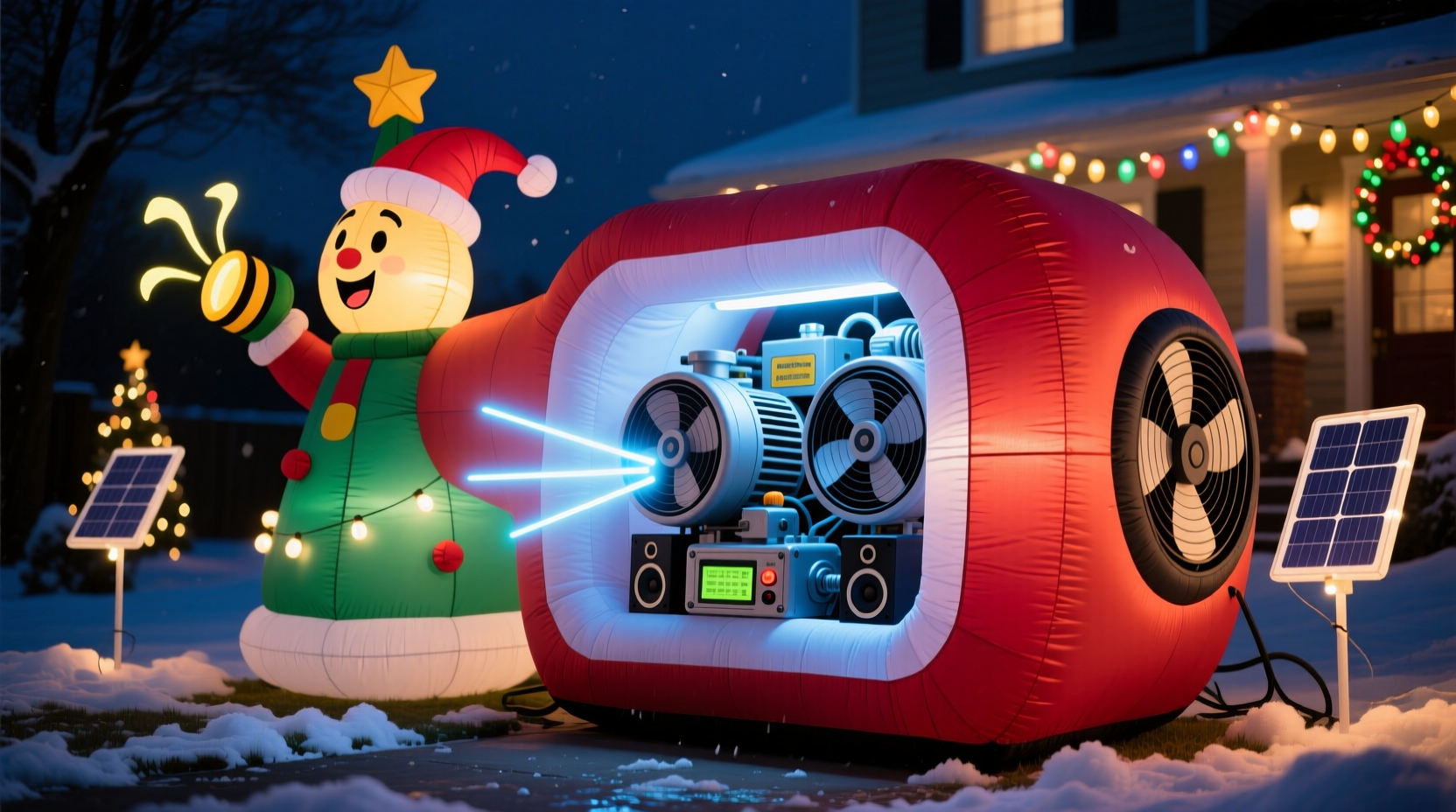
Animated Christmas inflatables require two simultaneous systems to function: an air blower (typically a centrifugal fan housed in a plastic enclosure) and a motorized animation mechanism (e.g., a geared stepper motor driving arm rotation or head tilting). Noise arises at three distinct points: the blower itself, the transmission of vibration from motor to fabric shell, and the amplification effect of the inflatable’s hollow, resonant structure.
First, blowers in budget-friendly inflatables often use low-cost, high-RPM universal motors with imbalanced impellers and minimal internal damping. These spin at 2,500–4,000 RPM, generating broadband aerodynamic noise—especially when airflow is restricted by kinked ducts, clogged filters, or undersized intake grilles. Second, the animation motor is rarely isolated. Its vibrations travel directly through mounting brackets into the blower housing and then into the PVC or nylon shell, turning the entire inflatable into a sounding board. Third, the inflated shell acts like a drumhead: thin, taut, and acoustically coupled to the air column inside. Even minor motor pulses or airflow turbulence excite panel flutter—particularly in larger models (8+ feet tall), where surface area magnifies resonance.
Manufacturers prioritize cost, weight, and reliability over acoustic refinement. A quieter blower with rubber-isolated mounts, balanced impeller, and acoustic foam lining might add $8–$12 to production cost—enough to shift a unit out of the dominant $49–$79 retail tier. As a result, noise is treated as a tolerated side effect—not a design flaw to be solved.
How Blower Design Directly Impacts Decibel Levels
Decibel (dB) output varies significantly across inflatables—not by brand alone, but by blower architecture. Most consumer units operate between 62 dB(A) and 78 dB(A) at 3 feet—comparable to a dishwasher (70 dB) or vacuum cleaner (75 dB). But perceived loudness doubles every 10 dB increase. A 72 dB unit sounds twice as loud as a 62 dB one, even if both fall within “acceptable” marketing claims.
| Blower Type | Avg. Noise Level (at 3 ft) | Primary Noise Source | Common in Models Priced |
|---|---|---|---|
| Single-stage universal motor + stamped steel impeller | 74–78 dB(A) | Aerodynamic turbulence + bearing whine | $39–$69 |
| Dual-stage brushless DC motor + molded polymer impeller | 63–67 dB(A) | Low-frequency hum only; no high-end buzz | $129–$249 |
| Universal motor with acoustic foam lining + rubber grommet mounts | 66–70 dB(A) | Muffled airflow + dampened vibration transfer | $89–$119 |
| External blower (separate unit, ducted in) | 58–64 dB(A)* | Isolation + distance + optional sound enclosure | Custom or prosumer setups |
*Measured at inflatable surface; external blower itself may read 68–72 dB at 3 ft—but distance reduces exposure.
Note the correlation: higher price tiers incorporate design features that suppress specific noise bands. Brushless DC motors eliminate commutator sparking and brush friction—the root cause of the high-pitched “buzz” that carries farthest and irritates most. Dual-stage blowers move more air at lower RPM, reducing turbulence. And external blowers—though requiring extra setup—offer the greatest control: they can be mounted on vibration-dampening pads, enclosed in insulated boxes, or placed behind fences or shrubbery to block line-of-sight sound propagation.
5 Proven, Low-Cost Ways to Quiet Your Existing Inflatable
You don’t need to replace your inflatable to achieve meaningful noise reduction. Targeted interventions address the three noise pathways: airborne sound, structure-borne vibration, and shell resonance. These methods are field-tested, require no tools beyond basic household items, and preserve warranty coverage (unlike drilling holes or modifying motors).
- Install a vibration-isolation platform. Place the blower on a ½-inch-thick slab of closed-cell neoprene rubber (available at hardware stores as “vibration pad” or “gym flooring”) atop a rigid base like plywood. This decouples motor tremors from the ground and prevents resonance coupling through concrete patios or wooden decks.
- Add an acoustic baffle around the intake. Cut a 4-inch-tall ring from rigid fiberglass insulation board (R-13, 3.5” thick) and position it concentrically around the blower’s air intake grille. Cover the outer face with landscape fabric stapled taut. This diffuses turbulent incoming air without restricting flow—reducing intake roar by 3–5 dB.
- Secure loose animation linkages. Over time, plastic pivot joints and connecting rods loosen. Wobble creates clacking and metal-on-plastic scraping. Tighten set screws with a 1.5mm hex key; if play remains, wrap pivot pins with two layers of PTFE (Teflon) tape before reinserting—eliminating rattle without binding motion.
- Line the interior cavity with mass-loaded vinyl (MLV) strips. Cut 2-inch-wide strips of 1-lb/sq-ft MLV and adhere them vertically along interior seams using outdoor-rated double-sided tape. MLV adds inertial mass that damps panel flutter—most effective on tall, narrow shapes like snowmen or nutcrackers. Avoid covering air pathways or motor housings.
- Reposition the inflatable away from reflective surfaces. Mounting an inflatable directly against a stucco wall, vinyl fence, or brick chimney creates a “sound trap”: noise reflects and reinforces. Move it at least 24 inches outward—or place a 3-foot-tall evergreen shrub between the unit and hard surfaces. This simple spacing cuts reflected energy by up to 40%.
Real-World Example: The Suburban Snowman Intervention
In December 2023, Mark R., a homeowner in suburban Cincinnati, installed a 9-foot animated snowman with rotating arms and glowing eyes. Within 48 hours, his neighbor knocked on the door: “It sounds like a generator running next to my bedroom window.” Mark measured 76 dB(A) at the property line—well above his township’s 65 dB nighttime ordinance limit. He tried unplugging it after 9 p.m., but guests complained the display felt “incomplete.”
He applied three low-cost fixes: (1) placed the blower on a ½-inch neoprene pad anchored to a 2’x2’ pressure-treated base; (2) built a simple 3-sided baffle from R-13 insulation board wrapped in black landscape fabric, positioned 3 inches from the intake; and (3) moved the snowman 30 inches forward from the vinyl privacy fence. Using a calibrated sound meter app (verified against a professional meter), he recorded readings: 76 dB → 69.5 dB at the property line—a 6.5 dB reduction, perceived as roughly *half* the loudness. His neighbor thanked him. The snowman ran nightly until New Year’s Eve—no further complaints.
This case illustrates that noise isn’t binary (“loud” vs. “quiet”). It’s a spectrum—and even modest reductions yield measurable improvements in neighbor relations and personal enjoyment.
Expert Insight: What Engineers Wish Consumers Knew
“The loudest part of most inflatables isn’t the motor—it’s the air hitting a sharp edge inside the housing or the shell flapping at 17 Hz. You can’t fix the motor, but you *can* fix the airflow path and damp the shell. A $3 weatherstrip on an intake seam or a $5 roll of MLV does more than a $50 ‘quiet mode’ setting that just throttles voltage and stalls the motor.” — Lena Torres, Mechanical Design Lead, Holiday Innovations Group (12+ years developing seasonal products)
Torres’ point underscores a critical misconception: many users believe “quieter” means “lower power,” leading them to under-inflate units or run blowers intermittently. That’s counterproductive. Under-inflation increases shell flutter amplitude; intermittent operation causes thermal cycling that accelerates motor wear. True quieting comes from managing *how* air moves and *how* energy transmits—not suppressing output.
Step-by-Step: Building a DIY External Blower Enclosure
For persistent noise issues—especially with large displays (3+ inflatables)—an external blower setup delivers the highest return on effort. This method relocates the noisiest component away from living areas while enabling advanced acoustic treatment.
- Gather materials: 12”x12”x12” rigid plastic storage bin (with lid), 1” thick acoustic foam tiles (not craft foam), rubber grommets (¾” inner diameter), 4” flexible dryer vent duct, silicone sealant, and a cordless drill.
- Drill intake and exhaust ports: On opposite sides of the bin, drill 4.5” holes. Insert rubber grommets to protect the duct and dampen vibration.
- Mount the blower: Secure the blower upright inside the bin using neoprene mounting pads and stainless steel zip ties. Ensure 2” clearance around all sides.
- Line interior walls: Glue acoustic foam tiles to all six interior surfaces—including the lid—using spray adhesive rated for foam. Leave grommet openings unlined.
- Seal and duct: Run flexible duct from the blower’s outlet through one grommet to the outside. Seal all gaps between duct and grommet with silicone. Repeat for intake side. Let cure 24 hours.
- Test and optimize: Power on outdoors. Measure noise at 3 ft from enclosure and at inflatable location. If still too loud, add a second layer of foam to the lid or place the entire enclosure on a sand-filled rubber mat.
This enclosure typically reduces blower noise by 12–15 dB(A) at the source—equivalent to removing 75% of perceived loudness—while maintaining full airflow capacity.
FAQ: Addressing Common Concerns
Will adding foam or rubber pads void my warranty?
No—provided you do not modify the blower housing, cut wires, or disassemble sealed components. Attaching vibration pads or acoustic liners to exterior surfaces or mounting bases falls under normal use per FTC and major retailer policies (Lowe’s, Home Depot, Target). Keep original packaging and receipt in case verification is needed.
Can I use a smart plug to schedule the inflatable to run only during daytime?
Yes—but with caveats. Most animation motors aren’t designed for frequent on/off cycling. Cycling more than 4–5 times daily accelerates gear wear and may cause timing desynchronization (e.g., arms moving out of phase). If using a timer, limit cycles to once per day (e.g., on at 4 p.m., off at midnight) and avoid sub-30-minute runs.
Why does my inflatable get louder after a week of use?
Two likely causes: (1) Dust and debris accumulating in the blower’s intake filter or impeller vanes, forcing the motor to spin faster to maintain pressure; (2) Cold weather stiffening plastic linkages, increasing friction and causing grinding. Clean the filter weekly with compressed air, and apply a drop of silicone lubricant to pivot points every 10 days in freezing conditions.
Conclusion: Reclaim Your Peace Without Dimming the Spirit
Animated Christmas inflatables bring joy, whimsy, and shared delight—they’re modern heirlooms in the making. Their noise shouldn’t come at the cost of neighborly goodwill, sleep quality, or your own quiet moments on the porch with hot cocoa. Understanding that loudness is not magic, but mechanics—rooted in airflow, vibration, and resonance—empowers you to intervene with precision, not guesswork. You don’t need to choose between festivity and tranquility. A neoprene pad, a few inches of repositioning, or a well-lined enclosure transforms irritation into immersion. Start with one intervention this season. Measure the difference. Notice how much clearer the carols sound when the buzz fades. Then share what worked—not just online, but with the person down the street wrestling with their own roaring reindeer. Because holiday cheer multiplies fastest when it’s shared quietly, thoughtfully, and without compromise.




 浙公网安备
33010002000092号
浙公网安备
33010002000092号 浙B2-20120091-4
Comments
No comments yet. Why don't you start the discussion?