
Birds fill the skies with song each morning, but as dusk falls, a different kind of silence often descends—one punctuated by tension and caution. Among the many creatures that shape avian behavior, few evoke as much fear as the owl. While some birds sing boldly during the day, they become quiet, alert, and evasive at night, especially when an owl is near. This instinctual wariness isn't random; it's rooted in millions of years of evolutionary adaptation. Understanding why birds are afraid of owls reveals deep insights into predator-prey relationships, communication systems, and survival strategies across species.
The Predator-Prey Dynamic: Owls as Nocturnal Hunters
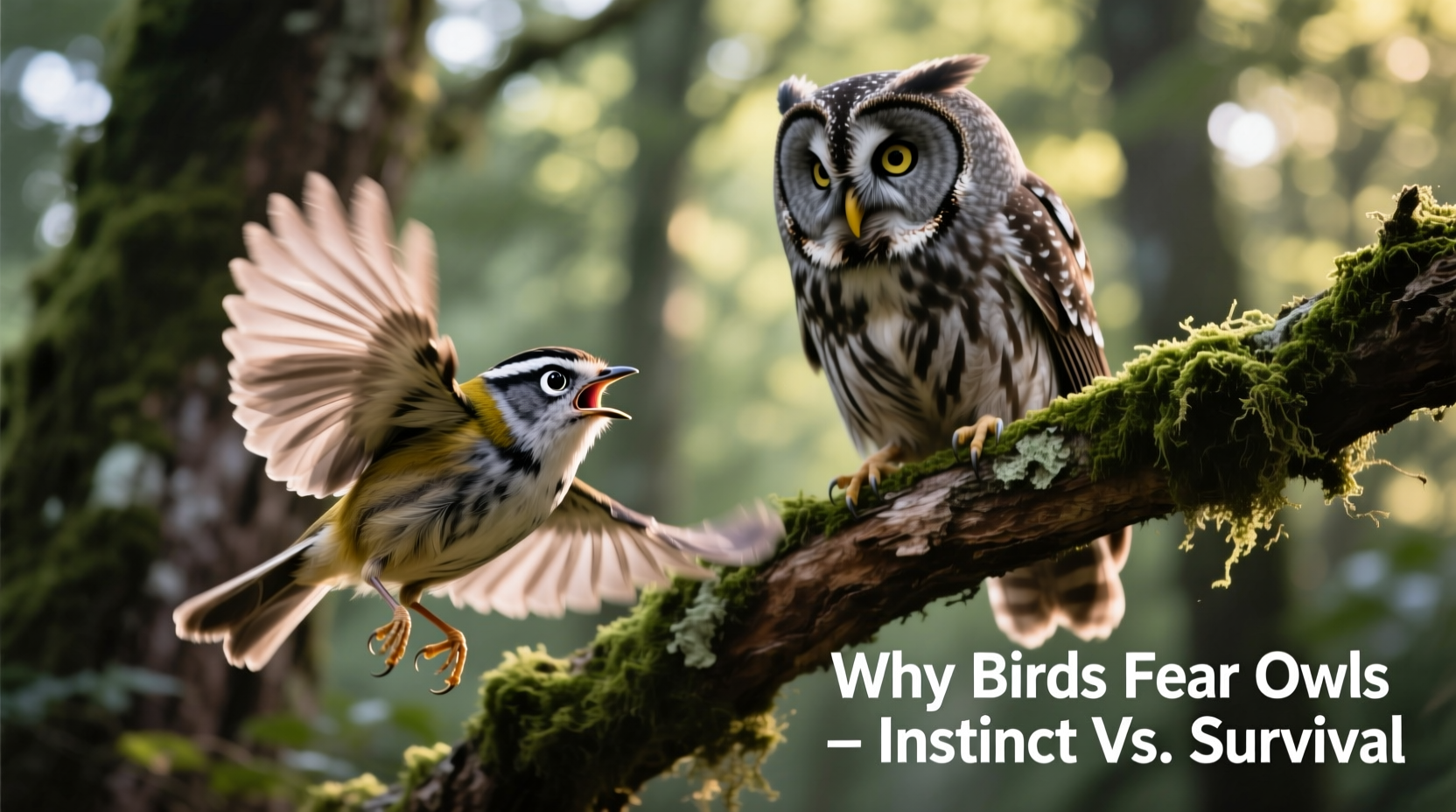
Owls are apex nocturnal predators, uniquely adapted to hunt under the cover of darkness. Their silent flight, enabled by specialized feather structures that dampen sound, allows them to approach prey undetected. With forward-facing eyes providing exceptional depth perception and asymmetrical ear placements for pinpointing sounds, owls can locate small animals—even in complete darkness. Many common backyard birds, such as sparrows, finches, and doves, are potential prey for larger owl species like the Great Horned Owl or Barred Owl.
This predatory efficiency creates a powerful selection pressure on smaller birds. Those individuals most attuned to owl presence—through sight, sound, or behavioral cues—were more likely to survive and pass on their genes. Over generations, this has led to deeply ingrained fear responses even in birds that have never encountered an owl firsthand.
Mobbing Behavior: When Fear Turns to Defense
One of the most striking examples of bird response to owls is mobbing behavior. When a group of small birds detects an owl, they often gather around it, calling loudly and diving in quick bursts. Species like chickadees, jays, and blackbirds engage in this collective harassment not out of aggression, but as a defensive strategy.
Mobbing serves several purposes:
- Drawing attention to the predator, potentially alerting other birds and reducing surprise attacks.
- Driving the owl away from nesting areas or feeding grounds.
- Teaching younger birds to recognize threats through social learning.
Interestingly, research shows that mobbing calls contain specific information about the threat level. For example, chickadees modify their “chick-a-dee” call based on predator size and danger—adding more “dees” when facing a small, agile predator like a pygmy owl, which poses a greater risk than a larger, slower one.
“Mobbing is not just noise—it’s sophisticated communication. Birds assess risk, coordinate responses, and teach each other through these vocalizations.” — Dr. Lauren Pharr, Avian Behavioral Ecologist, University of Montana
Evolutionary Roots of Fear: Innate vs. Learned Responses
The fear birds exhibit toward owls stems from both genetic programming and learned experience. Some studies suggest that certain fear responses are innate. In controlled experiments, young birds raised in captivity with no exposure to predators still show heightened alertness when presented with owl shapes or recordings of owl calls.
However, learning plays a critical role too. Nestlings observe adult reactions and begin associating specific cues—such as the hoot of a Great Horned Owl—with danger. This dual mechanism ensures that even if an individual escapes early predation, its offspring remain vigilant.
Moreover, birds use environmental context to modulate their fear. A daytime sighting of a roosting owl may trigger cautious observation rather than panic, whereas hearing an owl call at night often results in immediate silence and concealment. This flexibility highlights the sophistication of avian cognition and threat assessment.
Visual and Auditory Triggers That Elicit Fear
Birds rely heavily on sensory input to detect threats. Owls possess several features that make them particularly alarming:
| Sensory Cue | Effect on Prey Birds | Biological Reason |
|---|---|---|
| Large, forward-facing eyes | Perceived as direct threat; triggers freeze response | Resembles focused predation stance |
| Hooting calls at night | Causes flock dispersal and silence | Indicates active hunting nearby |
| Sudden movement in low light | Triggers flight or hiding | Limited night vision in most small birds |
| Upright posture and stillness | Increases suspicion and vigilance | Typical ambush predator behavior |
Even artificial representations—such as plastic owls placed in gardens—can temporarily deter birds, although effectiveness diminishes over time as birds learn the decoy poses no real threat. This habituation underscores the importance of actual movement and unpredictability in maintaining fear.
Real-World Example: The Robin’s Dilemma at Dusk
Consider a common American Robin feeding in a suburban yard late in the evening. As light fades, the robin becomes increasingly alert. Suddenly, a distant hoot echoes—a Barred Owl has claimed territory nearby. Within seconds, the robin stops foraging, cocks its head, and scans the trees. It then flies silently to a dense thicket, where it remains motionless for nearly 20 minutes.
This scenario illustrates multiple aspects of owl-induced fear: auditory detection, rapid behavioral shift from feeding to hiding, and preference for sheltered locations. The robin doesn’t know whether the owl is close, but the cost of being wrong is death. Thus, the safest strategy is immediate caution—even if it means going hungry for a while.
How Bird Communities Adapt to Owl Presence
In ecosystems with stable owl populations, bird communities develop complex spatial and temporal adaptations. Some species alter their activity patterns, becoming strictly diurnal to avoid overlap with nocturnal hunters. Others choose nesting sites strategically—placing nests in thorny bushes or high in dense foliage to reduce accessibility.
Additionally, mixed-species flocks often form during dawn and dusk hours, increasing collective vigilance. One bird spotting an owl can warn the entire group, improving overall survival odds. These cooperative behaviors demonstrate how fear of a single predator can influence broader ecological interactions.
Checklist: Signs Your Backyard Birds May Be Reacting to Owls
- Sudden silence in the evening or early morning
- Unusual clustering or agitated chattering in trees
- Disappearance of small birds near wooded areas at night
- Presence of molted feathers or pellets under large trees (possible owl roost)
- Birds avoiding feeders after dark, even with lighting
Frequently Asked Questions
Do all birds fear owls?
No—not all birds fear owls equally. Larger birds like crows and hawks may confront or harass owls, especially during breeding season. However, most small passerines—especially songbirds under 10 inches in length—exhibit strong fear responses due to their vulnerability as prey.
Can birds distinguish between dangerous and harmless owls?
Yes, birds can differentiate between owl species and contexts. For instance, a perched Screech Owl at dusk elicits a stronger reaction than a distant Great Gray Owl. Birds also learn over time which individuals or locations pose real threats, adjusting their behavior accordingly.
Will installing a fake owl keep birds away?
Possibly—for a short time. Fake owls may deter birds initially, but most species quickly recognize them as non-threatening unless the decoy is moved regularly and includes motion elements like reflective eyes or swiveling heads.
Conclusion: Respecting Nature’s Balance
The fear that birds feel toward owls is not irrational—it’s a finely tuned survival mechanism shaped by evolution. From silent flight to haunting calls, every aspect of an owl’s biology reinforces its role as a feared nocturnal hunter. Yet this dynamic isn’t just about fear; it’s about balance. Predators like owls help regulate bird populations, prevent overgrazing of vegetation by herbivorous species, and maintain ecosystem health.
For birdwatchers, gardeners, and nature enthusiasts, recognizing these behaviors offers a deeper appreciation of wildlife intelligence and interdependence. Instead of trying to eliminate owls from yards, consider supporting coexistence—providing safe roosting spots for small birds while respecting the natural role of predators.




 浙公网安备
33010002000092号
浙公网安备
33010002000092号 浙B2-20120091-4
Comments
No comments yet. Why don't you start the discussion?