
The term “blueprint” is so deeply embedded in modern language that we often use it metaphorically — to describe any detailed plan or strategy. But few people today know that the word originated from a literal, chemical printing process that produced documents with white lines on a blue background. This method revolutionized engineering, architecture, and construction in the 19th century. Understanding why they’re called blueprints requires a journey into the history of document reproduction, chemistry, and industrial innovation.
The Birth of a Reproduction Revolution
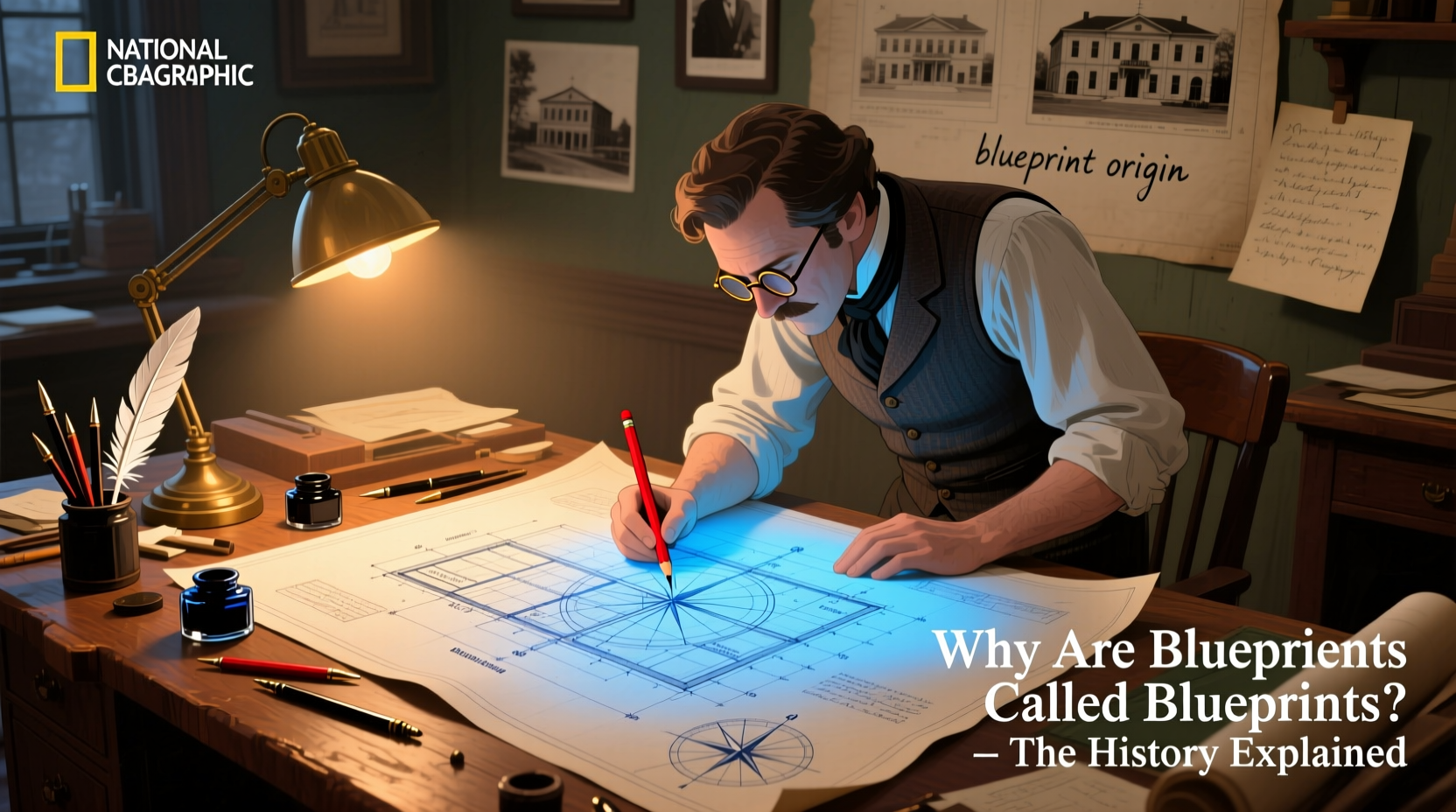
Before the mid-1800s, copying technical drawings was a laborious and error-prone task. Architects and engineers had to manually trace or redraw plans, which was time-consuming and prone to inaccuracies. As industrialization accelerated, the demand for fast, reliable duplication of complex diagrams grew rapidly — especially in fields like civil engineering, railroad development, and factory design.
The breakthrough came in 1842 when Sir John Herschel, British scientist and astronomer, discovered the light-sensitive properties of ammonium iron(III) citrate and potassium ferricyanide. When exposed to ultraviolet light, these chemicals reacted to form an insoluble blue compound known as Prussian blue (ferric ferrocyanide). This reaction formed the basis of what would become the blueprinting process.
Herschel didn’t invent blueprints for mass use; he developed the cyanotype process primarily for reproducing notes and botanical illustrations. However, by the 1870s, engineers and architects realized its potential for duplicating technical drawings quickly and cheaply.
How the Blueprint Process Worked
The traditional blueprinting method followed a precise sequence:
- An original drawing was made on translucent tracing paper or cloth using ink or pencil.
- This original was placed over a sheet of paper coated with a mixture of ammonium iron(III) citrate and potassium ferricyanide.
- The two sheets were secured together in a frame and exposed to sunlight or another UV source.
- Where the lines of the drawing blocked the light, the coating remained unexposed and could be washed away.
- In the areas where light passed through (the blank parts of the drawing), the chemical reaction created a deep blue pigment.
- The print was then rinsed in water to stop the reaction, leaving a permanent image: white lines on a blue background.
This process allowed multiple identical copies to be made quickly, each highly legible and durable. The high contrast between the white lines and blue background made details easy to read, even under poor lighting conditions on construction sites.
Why “Blueprint”? The Name Explained
The answer lies in the unmistakable color of the final product. Because the entire background turned blue except where the drawing blocked the light, the resulting document was literally blue — hence, a “blueprint.” The name stuck not just because of appearance, but because it distinguished this new, standardized method from older, inconsistent copying techniques.
Interestingly, the term evolved beyond its literal meaning. By the early 20th century, “blueprint” began being used figuratively to refer to any detailed plan — whether for building a house, launching a business, or organizing a political campaign. This linguistic shift reflects how central the concept became to structured planning across disciplines.
A Timeline of Blueprint Technology
Here’s how blueprinting evolved over time:
| Year | Milestone |
|---|---|
| 1842 | Sir John Herschel discovers the cyanotype process. |
| 1870s | Blueprinting adopted widely in engineering and architecture. |
| Early 1900s | Blueprints become standard in construction industries worldwide. |
| Mid-20th century | Diazotype prints (white-on-blue or blue-on-white) begin replacing traditional blueprints. |
| 1990s–2000s | Digital CAD systems make paper prints largely obsolete. |
| Today | “Blueprint” survives as a metaphor for planning and design. |
The Decline of Physical Blueprints
Despite their dominance for over a century, traditional blueprints began fading in the latter half of the 20th century. New technologies offered faster, more flexible alternatives:
- Diazotyping: Used ammonia-developed prints on diazo-coated paper, producing either blue lines on white paper or white lines on blue — cheaper and less messy than wet-process blueprints.
- Photocopying: Xerography allowed direct black-and-white reproduction without chemical baths or UV exposure.
- Computer-Aided Design (CAD): Digital drafting eliminated the need for physical copies altogether, enabling real-time collaboration and instant revisions.
By the 1990s, most architectural firms had transitioned to digital workflows. Today, building information modeling (BIM) software allows teams to simulate entire structures in 3D, complete with material specs, timelines, and cost estimates — far beyond what any paper blueprint could offer.
“Blueprints were the first scalable system for sharing technical knowledge accurately. They laid the foundation — quite literally — for modern infrastructure.” — Dr. Alan Prescott, Historian of Industrial Technology
Mini Case Study: The Brooklyn Bridge and Early Blueprint Use
When construction began on the Brooklyn Bridge in 1870, engineers faced unprecedented complexity in designing suspension cables, anchorages, and caissons. The Roebling family, who led the project, relied heavily on reproduced drawings to coordinate work between New York and Pennsylvania factories.
Though some records were still hand-copied, the later phases of the bridge’s construction coincided with the rise of blueprinting. Engineers used cyanotype prints to distribute updated schematics to foremen, ironworkers, and inspectors. These consistent, legible copies helped prevent costly errors during assembly — proving the value of standardized documentation in large-scale projects.
Modern Equivalents and Best Practices
While physical blueprints are rare today, the principles behind them remain vital. Clarity, consistency, and accessibility in design documentation are more important than ever. Here's how professionals can uphold the legacy of the blueprint in digital environments:
Checklist: Ensuring Clear Technical Documentation Today
- Use standardized layer names and color codes in CAD software.
- Include revision stamps and change logs on all shared files.
- Export PDFs with hyperlinked tables of contents for easy navigation.
- Store backups in cloud-based platforms with access controls.
- Conduct regular team reviews to catch discrepancies early.
Frequently Asked Questions
Are blueprints still used today?
Not in the original chemical sense. Most construction projects now use digital models and electronic PDFs. However, the term \"blueprint\" persists colloquially to refer to construction plans, regardless of format.
Can you still make traditional blueprints?
Yes, but only through specialty processes or historical reenactments. Some artists and educators use cyanotype paper for demonstrations, but it’s no longer practical for commercial engineering.
Why did blueprints use white lines on blue instead of blue lines on white?
The chemistry dictated the result. Light created the blue pigment; only the areas shielded by the ink lines stayed white. Later diazo prints reversed this, offering blue lines on white paper, which many found easier to read and annotate.
Legacy of the Blueprint
The blueprint may be obsolete as a technology, but its impact endures. It democratized access to technical information, enabled mass infrastructure development, and introduced the idea that plans should be reproducible, accurate, and shareable. In a world of digital dashboards and virtual reality walkthroughs, the core purpose remains unchanged: to turn abstract ideas into actionable, coordinated reality.
Moreover, the word “blueprint” continues to symbolize foresight and preparation — whether in business strategy, personal goals, or policy-making. That semantic longevity is perhaps the greatest testament to its historical significance.




 浙公网安备
33010002000092号
浙公网安备
33010002000092号 浙B2-20120091-4
Comments
No comments yet. Why don't you start the discussion?