
The term \"limey\" is a colloquial nickname often used—sometimes playfully, sometimes pejoratively—to refer to people from the United Kingdom. While today it might be heard in casual banter between Americans and Brits, its roots run deep into maritime history, medical science, and imperial logistics. Far from being a random insult, “limey” emerged from one of the most significant public health breakthroughs in naval history: the fight against scurvy.
To understand why Brits are called \"limeys,\" we must sail back to the 18th century, when long sea voyages were deadly not because of storms or battles, but due to a silent killer lurking in the ship’s hold—vitamin C deficiency.
The Scurvy Crisis at Sea
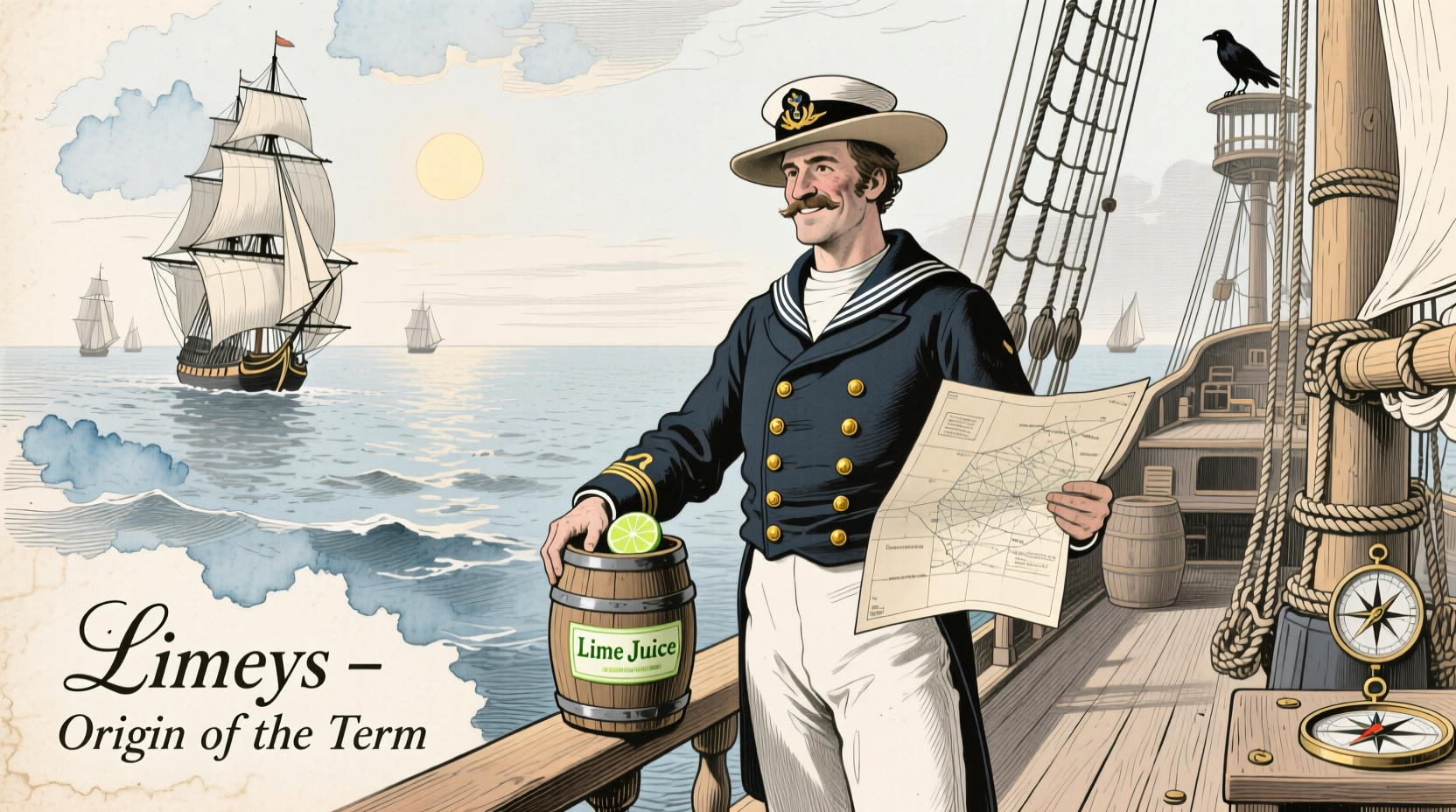
For centuries, scurvy was the scourge of sailors. On long voyages with no access to fresh food, crew members would develop swollen gums, loose teeth, joint pain, and eventually internal bleeding—all symptoms of vitamin C deficiency. Entire crews could be incapacitated, and death rates on transoceanic journeys were staggering.
In the 1740s, British Royal Navy surgeon James Lind conducted one of the first controlled medical experiments in history. He tested various remedies on sailors suffering from scurvy and found that those given citrus fruits—particularly lemons and oranges—recovered dramatically faster than others. His findings, published in 1753 in A Treatise of the Scurvy, laid the foundation for a nutritional revolution at sea.
Despite Lind’s evidence, it took decades for the Royal Navy to adopt citrus as standard issue. By the turn of the 19th century, however, the Admiralty finally mandated that all British sailors receive daily rations of lemon juice. This policy drastically reduced scurvy rates and gave the British fleet a critical edge in endurance and readiness during prolonged campaigns.
From Lemon Juice to Lime Juice: A Costly Switch
While Lind’s original experiments used lemons, the British Navy later switched to limes—primarily from Caribbean colonies like Dominica and Jamaica. Why? Economics and empire.
By the mid-19th century, Britain had established strong colonial holdings in the West Indies, where limes grew abundantly. Lemons, by contrast, were mostly imported from Mediterranean regions outside direct British control. Limes were cheaper, more readily available within the imperial supply chain, and thus became the citrus of choice for naval rations.
This shift meant that British sailors were now consuming lime juice instead of lemon juice. And while both contain vitamin C, limes have slightly less—and crucially, the method of distribution weakened their potency. The juice was often preserved in alcohol (to prevent spoilage) and stored in barrels lined with copper, which degraded the vitamin C content over time. Still, even diluted, the regular intake provided enough protection to keep scurvy largely at bay.
“Sailors didn’t care if it was lemon or lime—they cared that it kept them alive. But the name stuck because of what came out of the bottle.” — Dr. Helen Prescott, Maritime Medical Historian
How ‘Lime Juice Men’ Became ‘Limeys’
It was American sailors and merchants who first coined the term. In the 19th century, U.S. and British ships frequently interacted in global trade routes and naval ports. Observing that British seamen received daily lime rations, American sailors began referring to them mockingly as “lime-juicers.” Over time, this evolved into the shortened, derisive nickname “limey.”
The term initially applied only to British sailors, not civilians. But as British emigration increased in the late 1800s and early 1900s—especially to Australia, Canada, New Zealand, and the United States—the label followed. Settlers from Britain were sometimes called “limeys” by locals, extending the term beyond the navy to British nationals in general.
In some contexts, particularly in Australia and New Zealand, “limey” carried a mildly xenophobic tone, reflecting tensions between local populations and newly arrived British immigrants perceived as privileged or culturally out of touch. Today, however, the word is often used humorously or affectionately, stripped of much of its original sting.
Timeline of the Term 'Limey'
- 1747: James Lind conducts his famous scurvy experiment aboard HMS Salisbury.
- 1795: The Royal Navy officially begins issuing lemon juice to sailors.
- 1860s: Transition from lemons to limes due to colonial supply advantages.
- 1870s–1880s: American sailors begin using “lime-juicer” as slang for British sailors.
- Early 1900s: Term spreads to refer to British people abroad, especially in Commonwealth countries.
- Mid-20th Century: “Limey” appears in war films and literature, often used by U.S. soldiers to refer to British allies.
- Today: Mostly informal or humorous; rarely offensive unless contextually charged.
Modern Usage and Cultural Perception
Nowadays, “limey” is far more likely to appear in a buddy-cop movie or a pub joke than in serious discourse. In pop culture, it's often used to highlight the transatlantic banter between Americans and Brits. For example, in wartime films, a gruff U.S. Marine might call his British counterpart a “limey,” underscoring camaraderie through mild ribbing.
Still, sensitivity varies. In post-colonial nations, the term can occasionally evoke historical power imbalances. Older generations in Australia or New Zealand may recall it being used dismissively toward British migrants. Context matters: among friends, it’s harmless; in tense discussions about identity or heritage, it might raise eyebrows.
| Era | Usage | Tone |
|---|---|---|
| 1800–1870 | British sailors receiving lemon/lime juice | Neutral/Descriptive |
| 1880–1920 | American sailors use “limey” for British counterparts | Slightly Mocking |
| 1940s (WWII) | U.S. troops refer to British allies as “limeys” | Familiar, Camaraderie-Based |
| 1960s–Present | Used in media, immigration contexts, casual speech | Mostly Humorous or Neutral |
Frequently Asked Questions
Does “limey” refer to all British people?
Originally, it referred specifically to British sailors due to their lime juice rations. Over time, it broadened to include British nationals in general, especially those living abroad. However, it’s not commonly used in the UK itself to describe the population.
Are limes better than lemons for preventing scurvy?
No. Lemons actually contain more vitamin C than limes. Additionally, the preservation methods used for lime juice in the 19th century reduced its effectiveness. The switch to limes was driven more by colonial economics than medical superiority.
Is calling someone a “limey” offensive today?
It depends on context and intent. Among friends or in light-hearted settings, it’s usually seen as playful. In formal or sensitive conversations—especially involving national identity or colonial history—it can be considered outdated or mildly disrespectful.
Conclusion: More Than Just a Nickname
The story of “limey” is not merely about a quirky insult. It’s a window into naval innovation, imperial logistics, and the slow triumph of science over superstition. Behind every sip of lime juice issued to a sailor was a battle against disease, a commitment to crew welfare, and an unspoken advantage that helped maintain British naval dominance for over a century.
Today, the term endures as a linguistic fossil—a reminder of how everyday health practices can shape cultural identity and even spawn international nicknames. Whether you chuckle at it, cringe at it, or explain it to a curious friend, “limey” carries with it the weight of history, the tang of citrus, and the resilience of those who sailed under the Union Jack.




 浙公网安备
33010002000092号
浙公网安备
33010002000092号 浙B2-20120091-4
Comments
No comments yet. Why don't you start the discussion?