
At first glance, a floating soap bubble might seem like nothing more than a fleeting burst of color and whimsy. But beneath its shimmering surface lies a profound demonstration of physical laws in action. Whether drifting across a backyard or clinging to a wand, nearly all free-floating soap bubbles form perfect spheres. This consistent shape isn't random—it's dictated by fundamental principles of physics, chemistry, and energy optimization. Understanding why bubbles are round reveals how nature favors efficiency, balance, and minimal effort.
The Role of Surface Tension
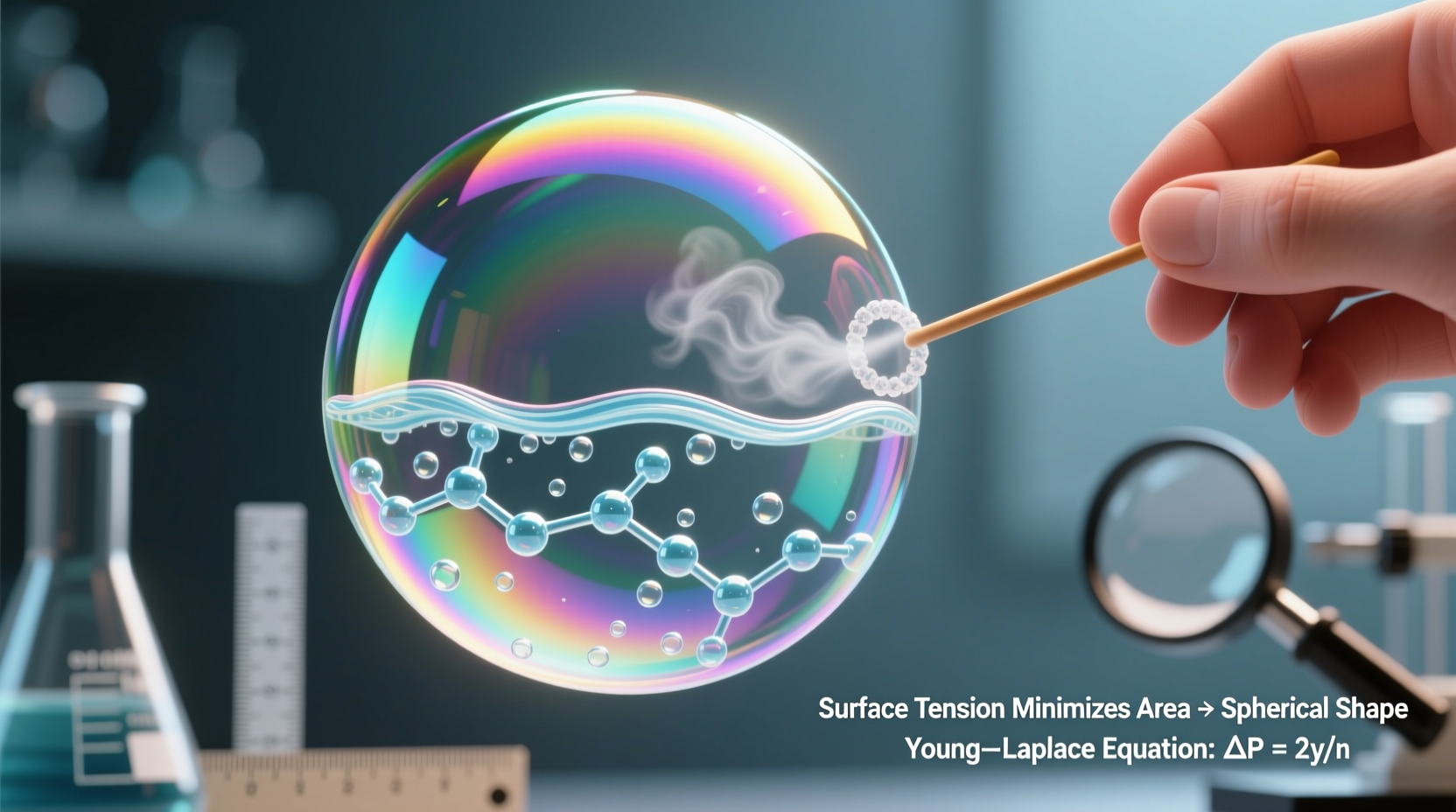
Surface tension is the primary force shaping a soap bubble. It arises from the cohesive forces between liquid molecules—in this case, water molecules in the soapy film. Water molecules attract one another strongly, especially at the surface where there are no molecules above them to balance the pull. This creates a kind of \"skin\" that resists external forces.
When you blow a bubble, the soap solution forms a thin film stretched around a pocket of air. The soap molecules reduce the natural surface tension of pure water just enough to stabilize the film, preventing it from collapsing instantly. Still, the remaining surface tension pulls uniformly inward, attempting to minimize the surface area for a given volume of air inside.
This inward pull acts equally in all directions, naturally forming a sphere—the geometric shape with the smallest possible surface area for a given volume. No corners, no edges, just smooth curvature in every direction.
Energy Efficiency and the Laws of Physics
Nature consistently seeks the lowest energy state. In the case of bubbles, the system achieves this by minimizing surface energy, which is directly proportional to surface area. A cube-shaped bubble would have significantly more surface area than a sphere enclosing the same volume, meaning higher energy and instability.
Mathematically, this principle is described by the isoperimetric inequality, which states that among all shapes with a given volume, the sphere has the smallest surface area. Because surface tension works to reduce surface area, the bubble evolves toward a spherical form almost instantly after formation.
This behavior isn’t limited to soap bubbles. It appears in celestial bodies (planets and stars), water droplets in microgravity, and even biological cells under certain conditions. The drive toward spherical symmetry is universal when surface forces dominate over other influences like gravity or external pressure.
Why Not Other Shapes?
You may have seen bubbles in non-spherical forms—clusters, tubes, or cubes—but these only occur under constrained conditions. For example, when multiple bubbles join together, their walls meet at precise angles (typically 120 degrees) to maintain equilibrium, as described by Plateau’s laws. These rules govern how soap films intersect to minimize total surface area across complex structures.
A single free-floating bubble, however, has no such constraints. With uniform internal pressure and equal outward push against the inward pull of surface tension, symmetry prevails—and symmetry, in three dimensions, means a sphere.
“The sphere is nature’s way of saying ‘this is the most efficient way to contain space.’ Bubbles show us that simplicity often wins.” — Dr. Lena Torres, Fluid Dynamics Researcher, MIT
What Happens When Bubbles Pop?
The fragility of a soap bubble underscores the delicate balance it maintains. The thin film—often less than a micron thick—is vulnerable to evaporation, temperature changes, dust particles, and vibrations. Once punctured or destabilized, the surface tension rapidly collapses the structure.
Interestingly, the pop itself follows predictable patterns. High-speed photography shows that when a bubble bursts, the hole expands outward in a circular wave due to isotropic tension. The entire film then retracts quickly into droplets, again driven by surface forces seeking lower energy configurations.
This process highlights an essential truth: while the bubble exists in a metastable state, any disruption tips the balance, and the system returns to a simpler, lower-energy form—liquid droplets rather than an extended film.
Creating Non-Spherical Bubbles: A Step-by-Step Guide
While free-floating bubbles are always round, you can experimentally create non-spherical shapes using frames or clusters. Here’s how:
- Prepare a strong bubble solution: Mix 1 cup distilled water, 2 tablespoons dish soap, and 1 tablespoon glycerin. Let it sit overnight for best results.
- Create wire frames: Bend pipe cleaners or thin metal wire into shapes like cubes, pyramids, or tetrahedrons.
- Dip the frame: Submerge the entire frame into the solution and slowly lift it out. A soap film will span each face.
- Blow carefully: Gently blow into one opening to inflate a bubble within the frame. You’ll see flat or curved surfaces meeting at 120-degree angles.
- Observe Plateau’s laws: Notice how films always meet in threes along edges, and vertices involve four junctions at ~109.5 degrees—the same geometry found in foams and biological tissues.
This hands-on activity illustrates that while individual bubbles remain spherical locally, interconnected systems distribute tension across shared surfaces, leading to fascinating polyhedral patterns.
Real-World Applications of Bubble Science
The study of bubbles extends far beyond childhood fun. Engineers and scientists apply foam and film physics in diverse fields:
- Architecture: Tensile structures like stadium roofs use principles derived from soap films to achieve strength with minimal material.
- Medicine: Microbubbles are used in ultrasound imaging to enhance contrast and deliver targeted therapies.
- Environmental Engineering: Foam fractionation removes pollutants from wastewater by capturing contaminants on bubble surfaces.
- Materials Science: Researchers design lightweight, strong foams for insulation and impact absorption based on bubble packing efficiency.
Even in art and design, the organic elegance of bubble formations inspires sculptures, lighting, and digital modeling techniques.
Do’s and Don’ts of Bubble Observation
| Do | Don’t |
|---|---|
| Use distilled water to avoid impurities that weaken films | Blow too hard—gentle airflow preserves film integrity |
| Add glycerin or corn syrup to slow evaporation | Touch bubbles with dry hands—they rupture on contact |
| Observe in still, humid air for longer-lasting bubbles | Expose solutions to direct sunlight—heat accelerates popping |
| Experiment with different wands and shapes | Expect perfect spheres in turbulent or windy conditions |
Frequently Asked Questions
Can bubbles be other shapes if I use a square wand?
No—not if they're free-floating. Even if you blow a bubble through a square wand, once it detaches, it becomes spherical. While attached, surface tension balances with the wand’s edges, allowing non-round shapes. But once airborne, only the sphere minimizes energy.
Why do some bubbles look colorful?
The colors come from thin-film interference. Light waves reflect off both the outer and inner surfaces of the soap film. Depending on the film thickness and viewing angle, certain wavelengths interfere constructively (appearing bright) while others cancel out. As the film thins before popping, the colors shift dynamically.
Are all bubbles round in zero gravity?
Yes—even more perfectly so. In microgravity environments like the International Space Station, bubbles form near-perfect spheres because gravitational distortion is eliminated. Scientists use these conditions to study fluid dynamics without Earth’s interference.
Conclusion: Embrace the Sphere
The roundness of a soap bubble is not mere coincidence but a powerful testament to nature’s preference for efficiency and equilibrium. From the molecular cohesion of water to the universal laws of geometry, every aspect of a bubble’s shape tells a story of balance and optimization. By observing something as simple as a floating sphere, we gain insight into forces that shape everything from cells to stars.
Next time you see a bubble drift by, take a moment to appreciate the invisible physics at play. And if you’re feeling inspired, grab a wand, mix up a batch of solution, and explore the science yourself. The world of bubbles is small, fragile, and profoundly beautiful.




 浙公网安备
33010002000092号
浙公网安备
33010002000092号 浙B2-20120091-4
Comments
No comments yet. Why don't you start the discussion?