
Cats are known for their curiosity, agility, and occasional bursts of inexplicable panic. One viral internet trend has captured global attention: placing a cucumber behind a cat while it eats, only to watch it leap in terror. While these videos often generate laughs, they raise serious questions about feline psychology. Why are cats scared of cucumbers? Is it the shape, the color, or something deeper rooted in their evolutionary past? The answer lies not in the vegetable itself, but in how cats perceive sudden changes in their environment.
Feline fear responses are complex and instinct-driven. Understanding them requires looking beyond the surface-level humor of viral pranks and into the biological and psychological mechanisms that govern cat behavior. This article explores the real reasons behind this reaction, debunks common myths, and offers practical guidance for responsible pet ownership.
The Startle Response: It’s Not About the Cucumber
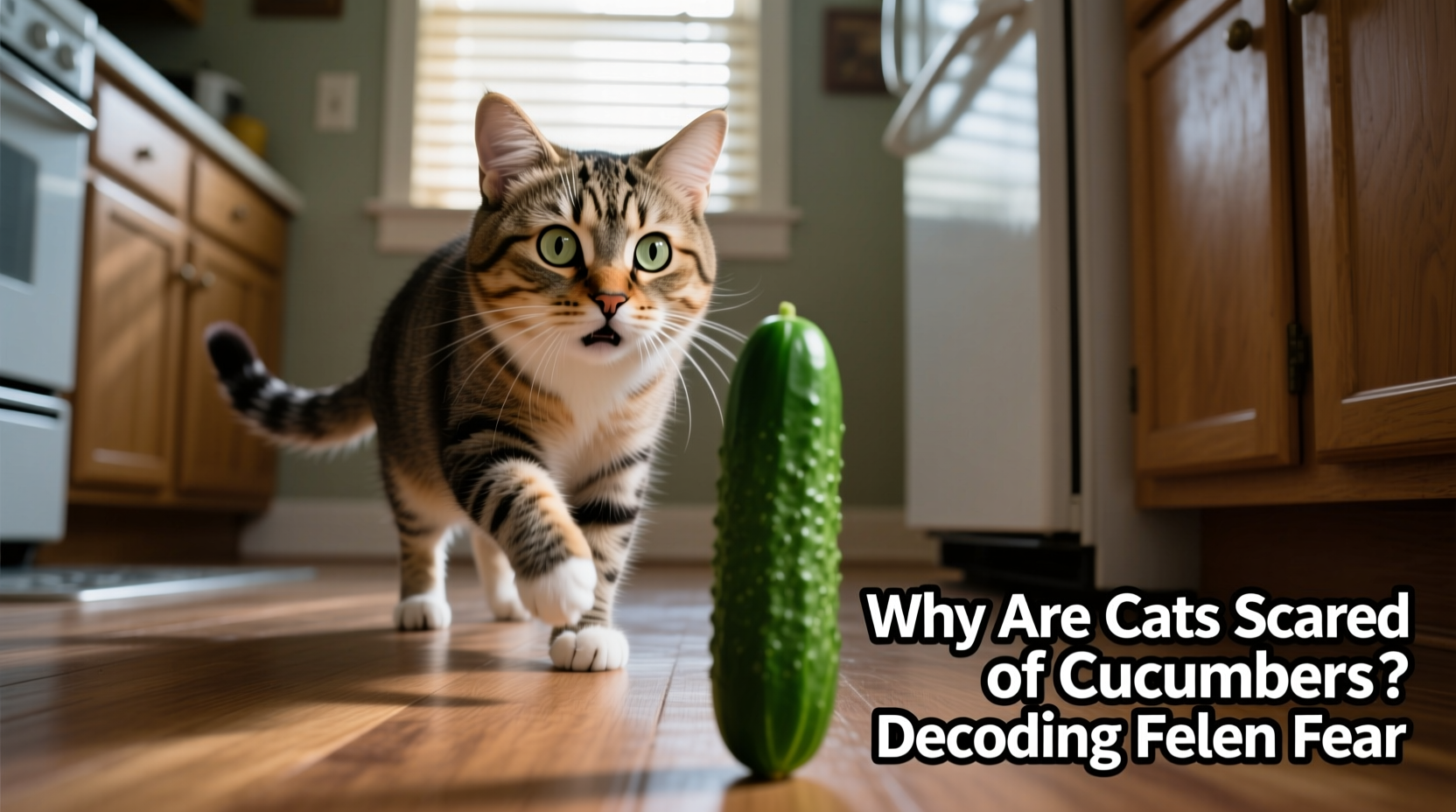
The dramatic leap cats exhibit when encountering a cucumber isn’t specific to the object. What matters is the element of surprise. Cats are hardwired to detect movement and changes in their surroundings. A cucumber placed silently behind a feeding cat mimics the stealthy approach of a predator—such as a snake. From the cat’s perspective, an unfamiliar object appearing out of nowhere triggers a primal flight response.
This reaction is governed by the amygdala, the part of the brain responsible for processing fear and threat detection. When a cat turns and sees something unexpected near its vulnerable rear, especially during a focused activity like eating, its survival instincts take over. The result is an explosive burst of energy designed to put distance between itself and the perceived danger.
Evolutionary Roots of Feline Fear
To understand why cats react so strongly, we must consider their ancestry. Domestic cats evolved from desert-dwelling wildcats that relied on vigilance to survive. In the wild, hesitation could mean death. Predators such as snakes, birds of prey, and larger mammals often rely on ambush tactics. A motionless green object on the ground may visually resemble a coiled serpent—especially when encountered unexpectedly.
Dr. Sarah Thompson, a veterinary ethologist at the Feline Behavior Institute, explains:
“Cats don’t fear cucumbers per se. They fear the violation of environmental predictability. Their brains interpret sudden, silent intrusions as potential threats—a survival mechanism refined over thousands of years.” — Dr. Sarah Thompson, Veterinary Ethologist
This sensitivity to change is also why cats may react strongly to new furniture, vacuum cleaners, or even plastic bags rustling nearby. The key factor is not the object’s identity, but its unexpected presence in a familiar space.
Common Misconceptions About the “Cucumber Prank”
The popularity of cucumber prank videos has led to widespread misunderstanding. Some believe cats hate the smell or color of cucumbers, while others think it's a learned behavior. However, scientific observation contradicts these assumptions.
- Myth: Cats are afraid of the smell of cucumbers.
Reality: There is no evidence that cucumbers emit a scent that repels cats. Most cats show no reaction when smelling a cucumber directly. - Myth: The green color triggers fear.
Reality: Cats have limited color vision and are more sensitive to motion and contrast than hue. - Myth: The prank is harmless fun.
Reality: Sudden stress can cause physical injury (e.g., jumping off counters), elevated heart rate, and long-term behavioral issues.
Do’s and Don’ts: Managing Your Cat’s Environment
| Do’s | Don’ts |
|---|---|
| Introduce new objects gradually and under calm conditions | Surprise your cat with hidden items |
| Maintain consistent routines for feeding and play | Make sudden changes to furniture layout without supervision |
| Provide safe spaces (e.g., cat trees, enclosed beds) | Use fear reactions for entertainment or social media content |
| Observe body language for signs of stress (flattened ears, tail flicking) | Ignore repeated signs of anxiety or avoidance behavior |
A Real-Life Scenario: Luna’s Kitchen Panic
Luna, a 3-year-old domestic shorthair, lived in a quiet apartment with her owner, Mark. One morning, Mark decided to clean under the kitchen table while Luna was eating. Afterward, he left a rolled-up yoga mat standing vertically behind her food bowl. When Luna finished eating and turned around, she saw the dark, upright shape and bolted, knocking over a vase in the process.
Confused, Mark reviewed the security footage and realized the yoga mat resembled a large animal crouching behind her. Over the next few days, Luna avoided the kitchen entirely. Only after removing the mat and reintroducing the space with treats and gentle encouragement did she return to normal behavior.
This case illustrates that any object—not just cucumbers—can trigger fear if it appears suddenly in a context where the cat feels exposed. The emotional impact lasted well beyond the initial scare.
How to Build a Stress-Free Home for Your Cat
Cats thrive on predictability. Creating a secure environment involves understanding their sensory world and minimizing unpredictable disruptions. Follow this step-by-step guide to reduce fear triggers:
- Assess high-activity zones: Identify where your cat eats, sleeps, and grooms. These are vulnerable moments.
- Introduce changes slowly: If you need to move furniture or add decor, do it incrementally over several days.
- Use positive reinforcement: Pair new objects with treats or playtime to create positive associations.
- Provide escape routes: Ensure your cat has access to elevated perches or hiding spots in every room.
- Monitor body language: Learn the subtle signs of discomfort—dilated pupils, twitching tail, freezing—and respond by removing the stressor.
Frequently Asked Questions
Can repeated scares affect my cat’s health?
Yes. Chronic stress in cats can lead to urinary tract issues, gastrointestinal problems, overgrooming, and weakened immunity. Frequent activation of the fight-or-flight response disrupts hormonal balance and overall well-being.
Will my cat ever stop being jumpy?
While some cats are naturally more cautious, most can become more confident with a stable environment and positive experiences. Early socialization and mental enrichment play key roles in building resilience.
Are certain breeds more prone to fear reactions?
Generally, shy or reserved breeds like Siamese or Turkish Vans may be more sensitive to environmental changes. However, individual temperament varies widely, regardless of breed.
Conclusion: Respect the Instinct, Protect the Bond
The viral fascination with cats and cucumbers reveals more about human behavior than feline psychology. What some see as comedy, experts recognize as a moment of genuine distress. Behind every startled leap is an animal acting on ancient instincts honed for survival.
As cat owners, we have a responsibility to foster trust, not exploit vulnerability. By understanding the roots of feline fear, we create homes where our pets feel safe, respected, and loved. Replace pranks with patience, and you’ll deepen the bond you share with your companion.




 浙公网安备
33010002000092号
浙公网安备
33010002000092号 浙B2-20120091-4
Comments
No comments yet. Why don't you start the discussion?