
Walk into any holiday lighting aisle in late October, and you’ll be met with a dazzling array of bulb shapes: tiny conical C6s, slender candle-style C7s and C9s, wide-angled G12 globes, sleek T5 tubes, and even novelty shapes like snowflakes or stars. At first glance, it may seem like pure aesthetic whim—yet every shape is the result of decades of engineering trade-offs between optical performance, thermal management, electrical efficiency, material cost, and installation practicality. Understanding *why* bulbs differ—and what those differences actually mean for your display—isn’t just trivia. It’s the difference between a warm, even glow that lasts three seasons and a string that flickers, overheats, or looks sparse on your roofline.
The Physics Behind the Form: How Shape Influences Light Output
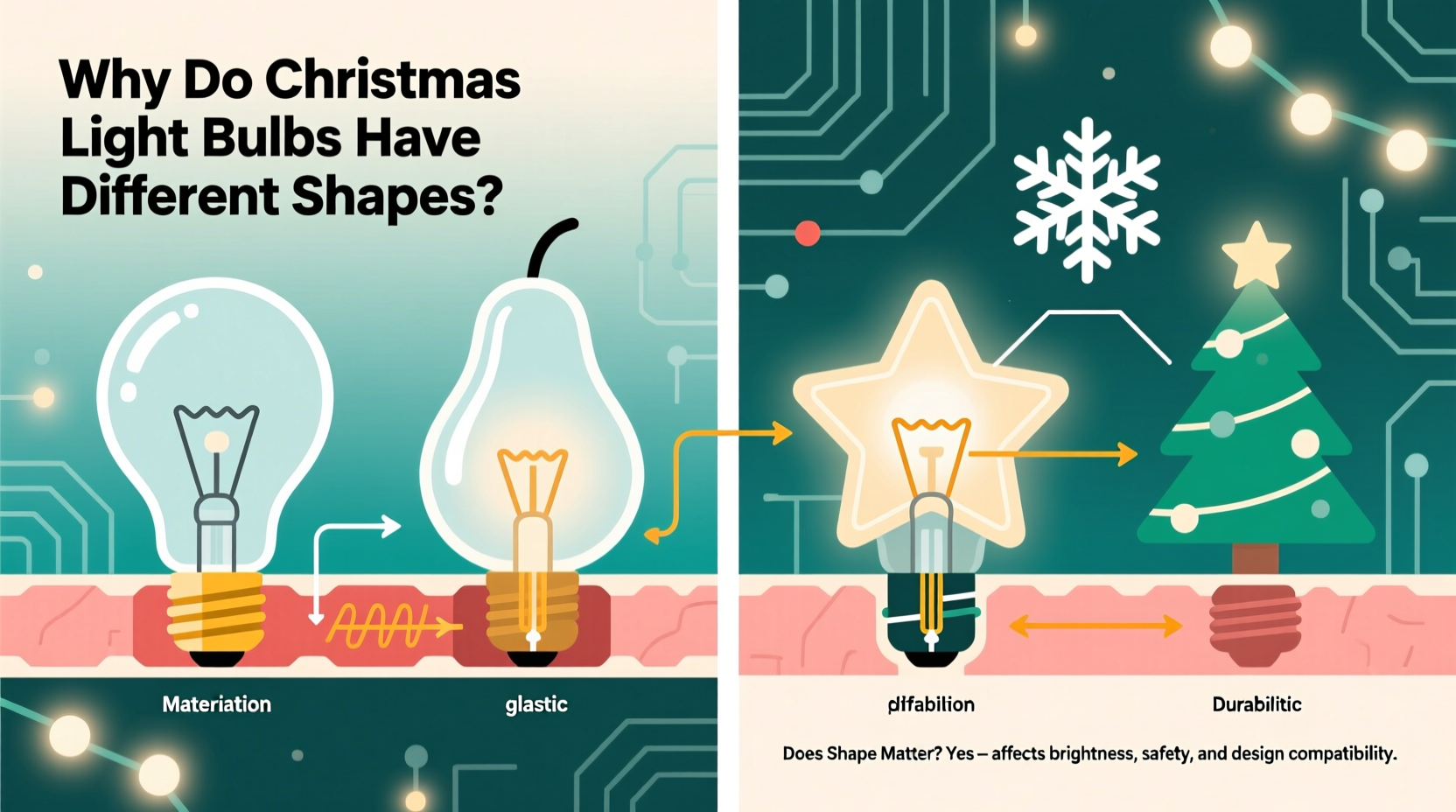
Bulb shape isn’t decorative window dressing—it’s optical architecture. The curvature, surface area, and internal geometry of a bulb directly govern how light exits the filament or LED chip, how heat dissipates, and how evenly that light spreads across a surface.
Incandescent bulbs rely on a tungsten filament heated to ~2,700 K. Its light radiates omnidirectionally—but without careful shaping, much of that light gets trapped inside the bulb or reflected backward. A conical C6 bulb, for example, has a narrow 6 mm base and a tapered body that directs more light forward, making it ideal for tight clusters on wreaths or garlands where side glare would be distracting. In contrast, a spherical G25 (25 mm diameter) bulb emits light more uniformly in all directions—a trait prized for indoor mantle displays where ambient fill matters more than directional focus.
With LEDs, the physics shifts but the principle holds. Most LED “bulbs” aren’t true bulbs at all—they’re plastic lenses molded over surface-mount diodes (SMDs). A flat-topped T5 tube uses a diffusing polycarbonate lens to scatter light along its entire length, eliminating hot spots. A faceted C9 LED mimics the classic candle silhouette not for nostalgia alone: its angled facets refract light outward at precise angles, increasing lateral throw by up to 40% compared to a smooth round equivalent—critical when illuminating wide eaves or tall columns.
A Historical Timeline: From Edison to Energy-Efficient Design
The evolution of bulb shape tracks closely with lighting technology and consumer demand:
- 1895–1920s (Early Incandescents): Hand-blown glass bulbs were inherently irregular. The first standardized “C” (candle) shape emerged to mimic gaslight flames—primarily for indoor parlor lamps and early tree lights. Consistency was low; shape served symbolism more than function.
- 1930s–1950s (Mass Production Era): Glass-blowing automation enabled precise C6, C7, and C9 dimensions. The C7 (7/8-inch tip diameter) became dominant for indoor trees; its compact size allowed dense wrapping without bulk. The larger C9 (1-1/8-inch) gained favor outdoors due to better weather resistance and visibility at distance.
- 1960s–1990s (Plastic & Miniature Boom): Injection-molded plastic replaced glass for mini-lights. The M5 (5 mm) and later M5.5 shapes prioritized durability and lower voltage tolerance (2.5V per bulb), enabling longer, safer strings. Their small, rounded profile reduced wind resistance on outdoor displays.
- 2000s–Present (LED Revolution): Shape became a thermal and optical tool. Early LED retrofits used “bulb-shaped” plastic shells to fit existing sockets—but modern designs integrate optics directly: frosted lenses for diffusion, prismatic surfaces for beam control, and asymmetric profiles (like the “flat-front” F5) to minimize backlight spill on dark facades.
Shape vs. Application: A Practical Decision Framework
Selecting the right bulb isn’t about preference alone—it’s matching form to function. Below is a comparison of common shapes, their technical strengths, and real-world best-use cases:
| Bulb Type | Typical Dimensions | Key Optical Trait | Ideal Application | Limitation to Note |
|---|---|---|---|---|
| C6 | 6 mm tip, 18 mm length | Narrow forward throw (~90° beam) | Indoor trees, wreaths, garlands—where density and subtle sparkle matter | Poor coverage on wide surfaces; easily obscured by foliage |
| C7 | 7 mm tip, 25 mm length | Balanced omnidirectional output | Medium-height outdoor trees, porch railings, covered patios | Can appear undersized on large architectural features |
| C9 | 11 mm tip, 35 mm length | Wide-angle dispersion (120°+), high lumen output | Rooftops, gutters, large shrubs, commercial façades | Higher wattage per bulb; may require heavier-duty wiring |
| M5 / M5.5 | 5–5.5 mm diameter, 12–14 mm length | Uniform 360° emission, low-profile | Dense indoor displays, net lights, curtain effects | Limited throw distance; best within 6 feet of viewer |
| G12 / G25 | 12–25 mm diameter, spherical | True omnidirectional, soft shadow edge | Indoor mantles, stair railings, dining table centerpieces | Not rated for wet locations; fragile in wind or ice |
| T5 / T5.5 | 5–5.5 mm diameter, 30–50 mm length | Linear emission along axis; minimal side spill | Architectural outlines (windows, doors), linear hedges, modern minimalist displays | Requires precise alignment; gaps visible if spacing inconsistent |
Real-World Case Study: The Chicago Brownstone Upgrade
When architect Lena Ruiz redesigned holiday lighting for her 1898 Chicago brownstone, she initially chose traditional C7 incandescents for the front porch columns—prioritizing vintage charm over performance. Within two weeks, half the bulbs had burned out, and the warm white (2700K) appeared muddy against the limestone facade. She consulted a lighting technician who recommended switching to C9 LED bulbs with a frosted, wide-angle lens and a slightly cooler 3000K color temperature.
The change transformed the display. The wider beam angle ensured even illumination from base to capital, eliminating dark bands. The higher lumen output (120 lm vs. 65 lm for C7) cut through Chicago’s gray December light. Crucially, the C9’s larger surface area dissipated heat more effectively—extending lifespan from 3,000 to over 25,000 hours. As Lena noted: “I thought shape was about nostalgia. Turns out, it was about physics I’d been ignoring.”
Expert Insight: Engineering Meets Tradition
“Bulb shape is the silent interface between electricity and human perception. A C9 isn’t ‘bigger’ just to be seen farther—it’s sized so thermal mass prevents LED junction temperatures from exceeding 85°C under sustained operation. A G25 globe isn’t ‘softer’ by accident—the sphere’s uniform curvature creates predictable light falloff that our eyes read as ‘gentle,’ not ‘dim.’ Shape is never arbitrary. It’s calculated empathy.” — Dr. Aris Thorne, Lighting Physicist, Illuminating Engineering Society (IES)
What You Can Do Today: A 5-Step Selection Checklist
Before buying your next string of lights, run through this actionable checklist:
- ✓ Measure the surface: For linear applications (gutters, railings), calculate total length and divide by desired spacing (e.g., 6” for C9s, 4” for M5s). This tells you how many bulbs you’ll need—and whether shape supports even coverage.
- ✓ Identify the viewing distance: Under 10 feet? C6 or G12 works. Over 20 feet? Prioritize C9 or T5 for throw and definition.
- ✓ Check your power source: Older transformers or dimmers may not handle the inrush current of dense LED strings—even if wattage seems compatible. C9 LEDs often draw less *per-bulb* but more *per-string* than M5s; verify amperage limits.
- ✓ Assess environmental exposure: Wind-prone roofs favor low-drag shapes (M5, T5). Wet locations demand bulbs with IP44 rating or higher—many C6/C7 plastic variants lack adequate sealing.
- ✓ Audit your existing hardware: Not all C7 sockets accept C9 bulbs—even if they physically fit. Verify base type (E12 candelabra vs. E17 intermediate) and socket depth before assuming interchangeability.
FAQ: Clearing Up Common Misconceptions
Does bulb shape affect energy consumption?
Directly? No—wattage is determined by the LED chip or filament, not the outer lens. Indirectly? Yes. A poorly shaped lens can waste light (e.g., reflecting it backward into the socket), forcing you to install more bulbs—or brighter ones—to achieve the same perceived brightness. That increases total system wattage. Efficient optics (like prismatic C9 lenses) deliver more usable lumens per watt.
Can I mix bulb shapes on one string?
Technically possible with some plug-and-play LED strings, but strongly discouraged. Different shapes often use different base types (E12 vs. E17), voltage drops, and thermal profiles. Mixing risks uneven brightness, premature failure of weaker links, and voided warranties. If variety is desired, use separate circuits or professionally wired custom strings.
Why do some “C9” bulbs look nothing like candles?
“C9” is now a dimensional standard—not a shape mandate. The original candle shape persists for tradition, but manufacturers produce C9-sized bulbs in conical, spherical, rectangular, and even flat-panel forms. What defines a C9 is its 1-1/8-inch maximum diameter and E17 base—not its silhouette. Always verify specs, not just naming conventions.
Conclusion: Shape Is Strategy, Not Style
Bulb shape matters—not because it makes your display “prettier” in an abstract sense, but because it determines how effectively light reaches the eye, how long the fixture survives seasonal stress, and how thoughtfully your design communicates intention. A C6 isn’t “cute”; it’s precision-engineered for intimacy and density. A C9 isn’t “bold”; it’s calibrated for reach and resilience. When you choose based on physics—not just Pinterest—you stop decorating and start designing. You gain control over ambiance, reduce long-term replacement costs, and create displays that feel intentional rather than assembled.
This holiday season, pause before grabbing the familiar box off the shelf. Read the spec sheet. Consider the surface, the distance, the weather, and the story you want the light to tell. Then choose—not the shape you recognize, but the shape that works. Your display will shine brighter, last longer, and resonate deeper.




 浙公网安备
33010002000092号
浙公网安备
33010002000092号 浙B2-20120091-4
Comments
No comments yet. Why don't you start the discussion?