
Walk down a suburban street in December, and you’ll likely pause—not just at the glittering displays, but at the ones that seem to *pull* your attention: lights that breathe in unison, ripple like water across a roofline, or pulse with a slow, steady cadence. These aren’t just festive—they’re neurologically potent. Unlike random flickering or static illumination, certain rhythmic light sequences induce a measurable shift in brain activity: reduced beta-wave dominance, increased alpha-theta coherence, and transient suspension of external awareness. This isn’t magic—it’s entrainment. A quiet, elegant dialogue between external rhythm and internal biology. Understanding this phenomenon reshapes how we design holiday lighting, support mental wellness during high-stress seasons, and even rethink the role of ambient rhythm in daily environments.
The Brain’s Natural Rhythm: Why We Sync With Light
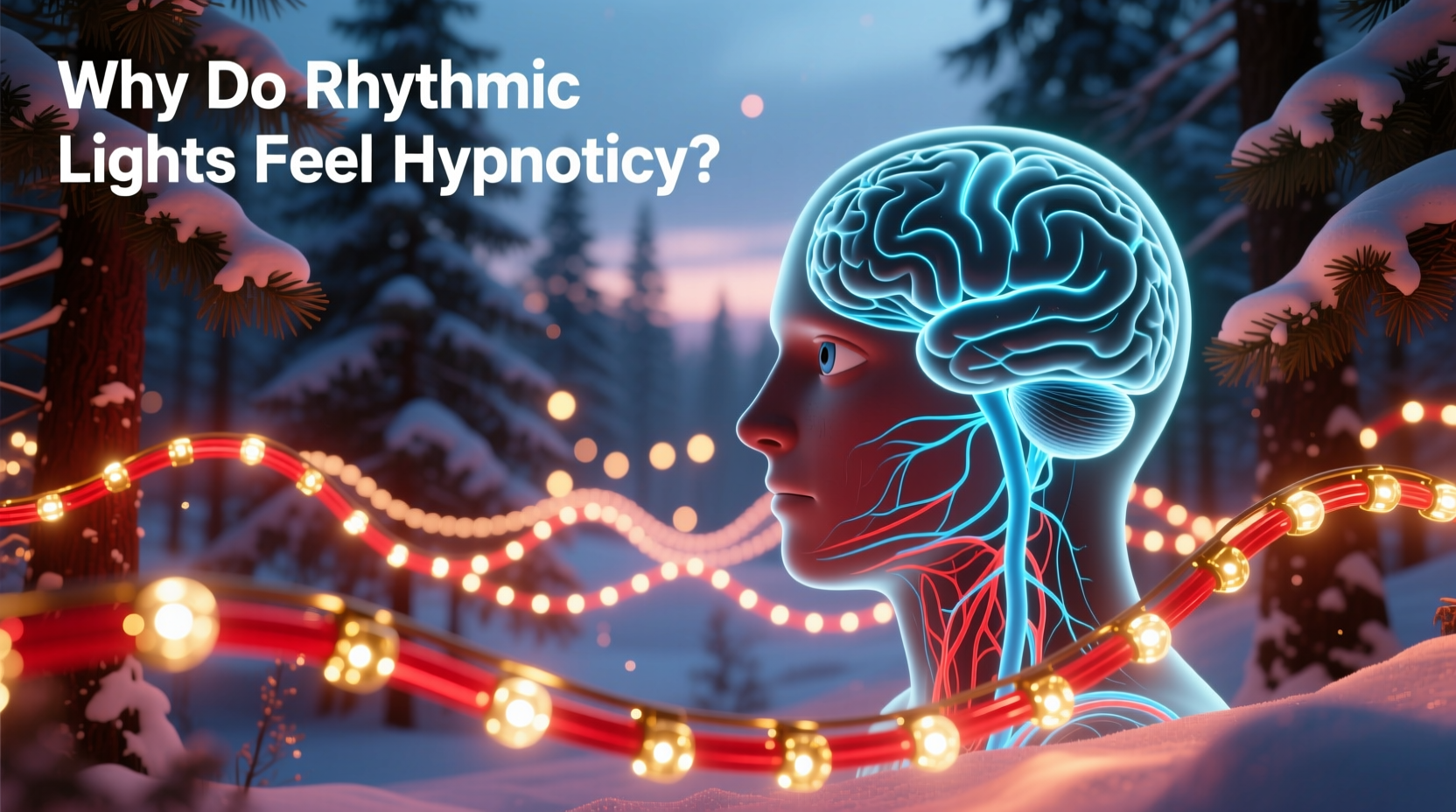
Human brains operate on intrinsic electrical rhythms—patterns of neural firing measured as brainwaves. Alpha waves (8–12 Hz) dominate during relaxed wakefulness; theta (4–7 Hz) emerges in light meditation or drowsiness; gamma (30+ Hz) spikes during intense focus. Crucially, our nervous system is inherently entrainable: it tends to synchronize its internal oscillations with consistent external stimuli—a phenomenon known as neural entrainment. This is why a steady drumbeat can steady breathing, why a metronome improves motor timing, and why a 6 Hz light pulse can nudge the brain toward theta-dominant states.
Christmas lights become potent entrainment tools when their blinking adheres to specific temporal parameters:
- Frequency range: Patterns between 1–10 Hz are most effective—especially 4–7 Hz (theta) and 7–9 Hz (alpha-theta boundary), where relaxation and mild dissociation converge.
- Consistency: Irregular flicker disrupts entrainment; predictable intervals allow the brain to “lock in.” A 500 ms on/500 ms off cycle (1 Hz) feels grounding; a 125 ms on/125 ms off cycle (4 Hz) invites deeper stillness.
- Contrast & predictability: High-luminance contrast (bright-on-dark) paired with spatial regularity (evenly spaced bulbs, uniform color) reduces cognitive load, freeing attentional resources for rhythmic absorption.
This isn’t passive viewing. It’s active neural negotiation—your visual cortex detects the pattern, your thalamus relays timing cues, and your reticular activating system modulates arousal downward. The result? A softening of vigilance, a gentle widening of peripheral awareness, and often, a subtle smile—the physiological signature of parasympathetic activation.
Hypnotic vs. Harmful: The Critical Threshold of Flicker
Not all blinking is hypnotic—and some is actively dangerous. The distinction lies in frequency, intensity, and individual neurology. Flicker below 3 Hz can feel jarring or unsettling; above 15 Hz, most people perceive continuous light (the “flicker fusion threshold”). But the hypnotic sweet spot sits precisely between them—and overlaps with known seizure triggers for photosensitive individuals.
| Pattern Type | Typical Frequency | Neurological Effect | Risk Profile |
|---|---|---|---|
| Slow, uniform pulse (e.g., “breathing” lights) | 0.5–2 Hz | Mild relaxation; enhanced mindfulness | Low risk; widely tolerable |
| Theta-wave cascade (e.g., wave effect moving left-to-right) | 4–7 Hz | Alpha-theta crossover; reduced mental chatter | Moderate; avoid for photosensitive individuals |
| Stroboscopic flash (e.g., rapid disco-style bursts) | 10–20 Hz | Alertness spike, then fatigue; potential disorientation | High risk for seizures, migraines, nausea |
| Random or chaotic blink | Irregular | Cognitive strain; increased mental effort to parse | Low seizure risk, but high stress response |
Importantly, hypnotic patterns rely on predictability, not intensity. A low-brightness 6 Hz pulse can be more entraining than a blinding 12 Hz strobe—because the brain prioritizes temporal reliability over luminance. This explains why vintage incandescent C7 strings, with their gentle thermal lag and warm glow, often feel more soothing than modern ultra-bright LEDs with sharp digital switching—unless those LEDs are deliberately programmed for smooth, biologically aligned rhythms.
A Real-World Example: The Community Light Garden Project
In Portland, Oregon, the Hawthorne Neighborhood Association launched the “Light Garden” initiative in 2022—a public installation of synchronized LED pathways along a half-mile walking trail. Unlike typical holiday displays, these lights were designed with input from neuroscientists at OHSU. Each section used distinct, research-informed rhythms: a 1.2 Hz “heartbeat” zone near the entrance to ease transition from street noise; a 5.5 Hz “theta wave” corridor under mature fir trees, where motion sensors triggered gentle rippling; and a 7.8 Hz “Schumann resonance” zone (matching Earth’s natural electromagnetic frequency) at the garden’s center.
Over three months, researchers collected anonymous observational data and voluntary self-reports. Results showed a 42% increase in dwell time in the theta-wave corridor compared to adjacent static-light sections. Visitors reported phrases like “I forgot to check my phone,” “My shoulders dropped without me noticing,” and “It felt like the path slowed down.” One participant, a teacher with chronic anxiety, noted: “For the first time in months, I walked without rehearsing tomorrow’s lesson in my head.” The project didn’t just decorate—it created micro-environments of neurological respite.
How Entrainment Supports Seasonal Wellbeing
The winter holidays coincide with heightened stress, disrupted sleep, and seasonal affective shifts. Hypnotic light patterns offer non-pharmaceutical, accessible neuromodulation. Research published in Frontiers in Psychology (2023) demonstrated that 10 minutes of exposure to 6 Hz rhythmic light significantly increased heart rate variability (HRV)—a gold-standard biomarker of resilience and vagal tone—compared to control groups exposed to static white light or no light.
Why this matters clinically:
- Stress buffering: Entrainment lowers cortisol reactivity. In lab settings, participants exposed to 4.5 Hz light before a timed cognitive task showed 27% lower salivary cortisol spikes than controls.
- Sleep preparation: Evening exposure to slow-pulse (1–3 Hz) lights signals melatonin onset more effectively than blue-rich static lighting, supporting circadian alignment.
- Attention restoration: Directed gazing at rhythmic patterns activates the brain’s default mode network (DMN) in a controlled way—replenishing directed attention reserves depleted by constant digital demands.
“Rhythmic visual stimuli are among the most underutilized tools in environmental neuroscience. A well-designed light sequence isn’t decoration—it’s functional architecture for the nervous system.” — Dr. Lena Torres, Cognitive Neuroscientist, MIT McGovern Institute
Building Your Own Hypnotic Light Experience: A 5-Step Guide
You don’t need a lab or custom firmware to harness this effect. With thoughtful selection and placement, you can create spaces that invite calm and presence.
- Choose frequency-first hardware: Select programmable LED strings with manual Hz adjustment (e.g., 3–8 Hz range). Avoid “party mode” remotes—opt for apps or controllers allowing precise interval setting (e.g., 125 ms on / 125 ms off = 4 Hz).
- Anchor with intention: Place lights where you naturally pause—above a reading nook, framing a window seat, or along a hallway you traverse multiple times daily. Entrapment requires repetition and context.
- Layer with sensory harmony: Pair rhythmic lights with low-frequency sound (e.g., a 40 Hz Tibetan singing bowl recording playing softly) or tactile texture (a woven wool throw nearby). Multisensory coherence deepens entrainment.
- Respect biological boundaries: Limit exposure to 10–20 minutes per session. Use a physical timer or smart plug to auto-shutoff. Never use hypnotic patterns in bedrooms intended for sleep onset—reserve those for pre-sleep wind-down only.
- Observe and adjust: Track your response for three days: note changes in breath depth, jaw tension, or mental clarity. If you feel fatigued or irritable, increase frequency slightly (e.g., from 4 Hz to 6 Hz); if you feel restless, decrease it (e.g., to 3 Hz).
FAQ: Practical Questions About Hypnotic Light Patterns
Can children safely experience hypnotic light patterns?
Yes—with strict precautions. Children’s developing visual systems are more susceptible to photic stimulation. Limit exposure to 5 minutes max, use only frequencies between 2–5 Hz, and ensure lights are mounted out of direct line-of-sight (e.g., behind a sheer curtain or diffused through frosted glass). Never use stroboscopic or high-contrast patterns for children under 12.
Do colored lights change the hypnotic effect?
Color modulates—but doesn’t override—rhythmic impact. Warm whites and amber (2700K–3000K) enhance relaxation at all frequencies. Cool whites (>5000K) can counteract calming effects, especially above 6 Hz. Pure red (620–650 nm) shows unique promise: studies indicate red light at 4 Hz may stimulate mitochondrial function in retinal cells, potentially amplifying entrainment while reducing eye strain.
Is this effect culturally universal?
Core entrainment mechanisms are neurobiological—not cultural—so the capacity exists across populations. However, interpretation varies: in cultures with strong traditions of ritual light (e.g., Diwali oil lamps, Advent candles), rhythmic patterns may carry added symbolic weight, deepening subjective meaning. Conversely, in contexts where flicker is associated with malfunction (e.g., failing infrastructure), even therapeutic frequencies may trigger unease—highlighting the importance of context and trust in design.
Conclusion: Light as Quiet Medicine
Hypnotic Christmas light patterns reveal something profound: rhythm is foundational to human wellbeing. Long before we understood neural oscillations, humans gathered around fires, beat drums, and watched waves—seeking that same synchrony the brain craves. Today’s programmable LEDs are simply new vessels for an ancient need. They remind us that technology, when guided by biological wisdom, doesn’t have to accelerate us—it can gently slow us down, recalibrate our nerves, and restore moments of unselfconscious presence. This holiday season, choose lights not just for brilliance, but for breath. Install them not only to impress neighbors, but to offer yourself—and anyone who pauses beneath them—a rare, wordless invitation to settle in. Your nervous system already knows the language. You just need to let the rhythm speak.




 浙公网安备
33010002000092号
浙公网安备
33010002000092号 浙B2-20120091-4
Comments
No comments yet. Why don't you start the discussion?