
As holiday seasons roll around, homes across neighborhoods begin to glow with festive cheer—much of it thanks to strings of Christmas lights. While browsing for these seasonal staples, many shoppers notice a curious detail: not all light strands are the same length. Some stretch just 9 feet, while others extend to 25 feet or more. This variation isn’t random. Behind the scenes, multiple technical, practical, and regulatory factors determine why certain Christmas light strands are longer—or shorter—than others.
Understanding these differences goes beyond mere curiosity. It affects how safely and effectively you can decorate, what types of outlets you’ll need, and even how your lighting will perform over time. From voltage drop concerns to regional plug standards, the story behind strand length is one of engineering compromise, consumer demand, and evolving technology.
The Role of Electrical Safety and Voltage Drop
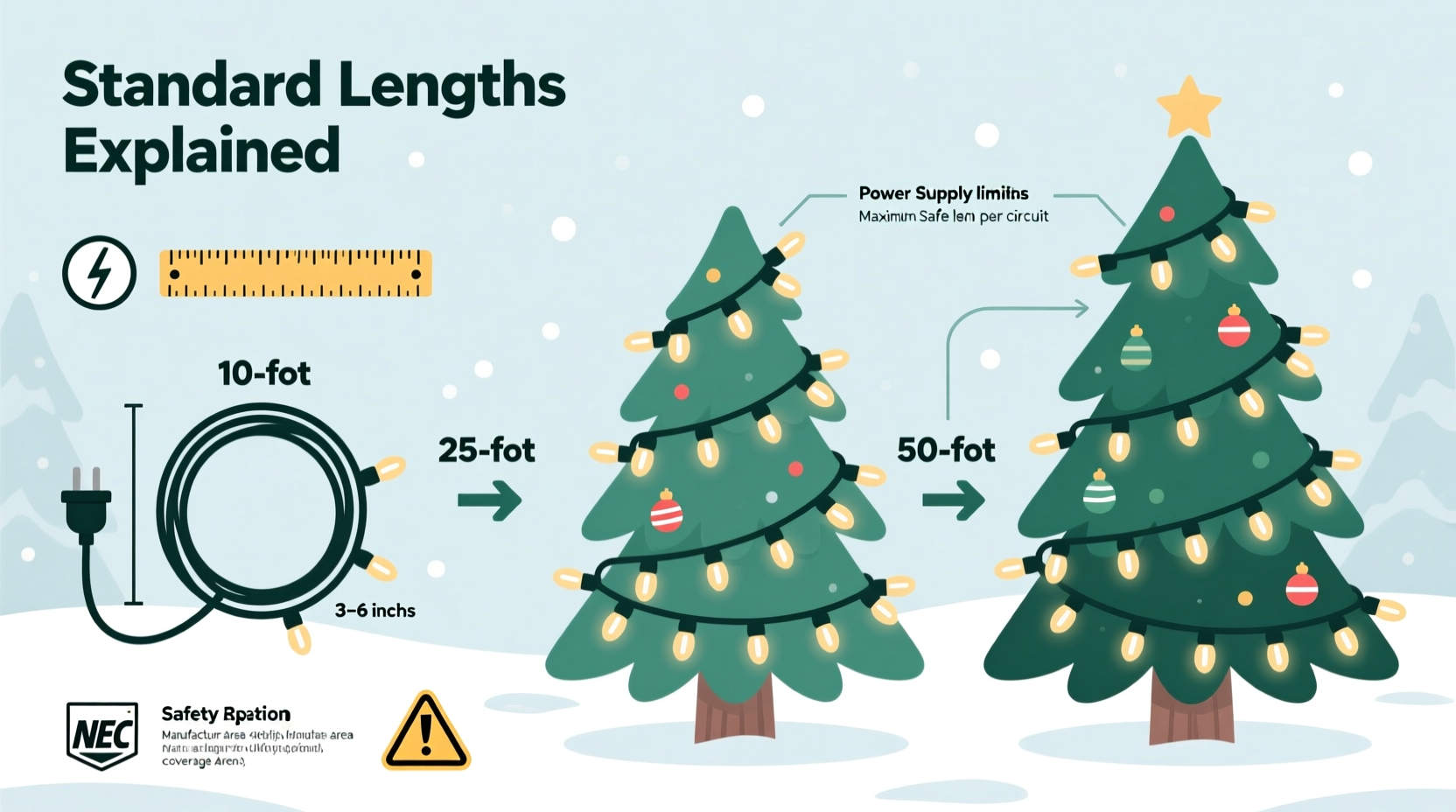
One of the most critical reasons for differing strand lengths lies in electrical physics—specifically, voltage drop. As electricity travels along a wire, resistance causes a gradual decrease in voltage. In low-voltage systems (like typical incandescent mini-lights operating at 120V), this becomes a limiting factor. The longer the strand, the greater the resistance, and the more likely bulbs at the end will appear dimmer or fail to light altogether.
To maintain consistent brightness and prevent overheating, manufacturers cap the number of bulbs per circuit. For example, traditional incandescent mini-lights often max out at 50 bulbs per strand when wired in series. Since each bulb consumes about 0.4 watts, exceeding that limit increases current draw, raising fire risk and tripping household circuits.
“Voltage drop is a real issue in long runs of incandescent lights. Beyond 25 feet, performance degrades noticeably without proper gauge wiring or parallel circuits.” — Carlos Mendez, Electrical Safety Engineer at UL Solutions
LED technology has changed this equation significantly. LEDs consume far less power—typically 0.04 to 0.1 watts per bulb—allowing longer runs without excessive load. That’s why modern LED strands often reach 100+ bulbs on a single string, sometimes up to 50 feet in length, while staying within safe amperage limits.
Standardization vs. Regional and Brand Variability
While some standard lengths have emerged over time, there is no universal regulation mandating exact strand measurements. Instead, common lengths evolved through industry consensus and consumer expectations.
In North America, typical strand lengths include:
- 9 feet – Often used for indoor trees or small window displays
- 18–25 feet – Most common for outdoor eaves, railings, and larger trees
- 35–50 feet – Typically LED-only, designed for large property outlines or commercial use
These standards are influenced by outlet spacing in residential construction. Many homes have exterior outlets spaced roughly 12 to 20 feet apart, making 18- to 25-foot strands ideal for covering one section without extension cords.
Outside North America, variations increase due to different voltage systems (e.g., 230V in Europe) and plug types. European strands may be shorter or use transformers for safety, especially in damp conditions. Additionally, EU regulations under CE marking require stricter insulation and current limits, which can restrict maximum run lengths compared to U.S.-market products.
Comparison of Common Strand Types and Length Limits
| Bulb Type | Avg. Length | Bulbs per Strand | Max Connectable Strands | Voltage |
|---|---|---|---|---|
| Incandescent Mini | 9–25 ft | 20–50 | 2–3 | 120V |
| LED Mini | 18–50 ft | 50–100+ | Up to 40* | 120V |
| Commercial C9 | 25 ft | 25 | 5–6 | 120V |
| European String Lights | 6–15 m (~20–50 ft) | 20–40 | 1–2 | 230V |
*Depends on total wattage; must stay under 400W or 3.3A per circuit.
Design Intent: Indoor vs. Outdoor vs. Commercial Use
The intended application plays a major role in determining length. Manufacturers tailor strand dimensions based on where they expect the lights to be used.
Indoor strands tend to be shorter—often 9 to 18 feet—because they’re meant for confined spaces like Christmas trees, mantels, or bookshelves. Aesthetics matter more here; uniform spacing and controlled brightness take priority over coverage.
Outdoor residential lights are built longer to span rooflines, fences, and walkways. Durability is key: these strands use thicker insulation, weather-resistant sockets, and sometimes shatterproof bulbs. Their increased length reduces the number of plugs needed, minimizing tripping hazards and water exposure points.
Commercial-grade lighting, such as C7 or C9 bulbs used on municipal buildings or shopping centers, often comes in 25-foot sections but allows daisy-chaining dozens of units. These are engineered with heavier-gauge wire and grounded plugs to handle prolonged use and high visibility.
Real Example: A Suburban Home Makeover
Consider Sarah Thompson, a homeowner in Denver who wanted to outline her two-story house with white mini-lights. Her roofline measured approximately 180 linear feet. She initially bought several 9-foot incandescent strands, only to discover they couldn’t be safely connected beyond three units. After tripping her breaker twice, she switched to commercial-spec LED strands rated for 40-connectable runs. With five 25-foot strands, she covered the entire perimeter using just one outlet and a single timer. The longer strands weren’t just more convenient—they were safer and more energy-efficient.
This scenario illustrates how mismatched strand length and project scale can lead to frustration or danger. Choosing the right product for the job isn’t just about aesthetics—it’s about matching electrical capacity with physical requirements.
Manufacturing Constraints and Cost Efficiency
Behind every spool of lights is a production line optimized for speed and yield. Manufacturers cut wire to standard lengths that minimize waste and streamline assembly. A 25-foot strand, for instance, might derive from a 100-foot master roll, allowing four identical units per cut with minimal scrap.
Additionally, longer strands require more robust components: thicker wires to reduce resistance, stronger sockets to support added weight, and sometimes inline fuses. These increase material costs. For budget-conscious consumers, shorter, simpler strands remain popular despite limitations.
There’s also a retail consideration: shelf space. Long strands are harder to package neatly. Retailers prefer compact boxes, so manufacturers balance usability with marketability. That’s why many “long” strands are folded into tight coils rather than marketed as continuous runs.
Step-by-Step Guide: Choosing the Right Strand Length for Your Project
Selecting the appropriate light strand isn’t guesswork. Follow this process to ensure safety, efficiency, and visual impact:
- Measure your space. Use a tape measure or laser distance tool to calculate linear footage for eaves, trees, railings, etc.
- Determine power source access. Identify nearby outdoor outlets and assess whether GFCI protection is required (mandatory for exterior circuits).
- Choose bulb type. Decide between incandescent (warmer glow, higher heat) and LED (cooler, energy-efficient, longer runs possible).
- Calculate total load. Multiply number of bulbs by wattage per bulb. Ensure total does not exceed 80% of a 15A/120V circuit (1440 watts max).
- Select strand length and connectability. Pick a length that minimizes gaps and respects manufacturer daisy-chain limits. Prefer pre-connected kits for complex layouts.
- Test before installation. Plug in the full chain indoors first to verify all bulbs work and connections hold.
Checklist: Before Buying Christmas Light Strands
- ✅ Measure total linear feet to be covered
- ✅ Confirm outlet locations and GFCI status
- ✅ Decide between LED and incandescent
- ✅ Check max connectable strands per set
- ✅ Verify if lights are rated for indoor, outdoor, or both
- ✅ Look for ETL or UL certification label
- ✅ Consider storage method for post-season
Frequently Asked Questions
Can I connect a 9-foot strand to a 25-foot strand?
Only if both are designed for daisy-chaining and the combined load stays within the maximum allowable limit. Mismatched lengths often have different fuse ratings or wire gauges, increasing failure risk. Always follow manufacturer instructions.
Why do LED strands allow more connections than incandescent?
LEDs use significantly less power—up to 90% less—so more strands can be linked without exceeding circuit capacity. A typical LED mini-string draws 4–6 watts, versus 20–40 watts for incandescent equivalents.
Are longer strands more dangerous?
Not inherently. Longer strands made with proper materials and safety certifications pose no greater risk. However, cheaply made extended sets with undersized wiring or missing fuses can overheat. Always buy from reputable brands with clear specifications.
Conclusion: Matching Length to Purpose Ensures Better Results
The variation in Christmas light strand lengths isn’t arbitrary—it reflects careful balancing of electrical safety, user needs, manufacturing efficiency, and technological progress. From the limitations of vintage incandescent circuits to the flexibility offered by modern LEDs, each dimension serves a purpose.
By understanding the “why” behind the lengths available, you can make smarter choices that enhance both the beauty and safety of your holiday display. No more tangled messes, tripped breakers, or dim ends. Just well-lit eaves, glowing trees, and peace of mind knowing your setup is as efficient as it is festive.




 浙公网安备
33010002000092号
浙公网安备
33010002000092号 浙B2-20120091-4
Comments
No comments yet. Why don't you start the discussion?