
Every holiday season, thousands of homeowners plug in their favorite string lights—only to discover that when they flip the dimmer switch, nothing happens, the lights flicker violently, buzz loudly, or worse, trip the circuit breaker. This isn’t a wiring flaw or a faulty switch; it’s a fundamental mismatch between lighting technology and control hardware. Understanding why most traditional Christmas lights resist dimming isn’t just about convenience—it’s about safety, longevity, and energy efficiency. Modern LED strings, vintage incandescent mini-lights, and even commercial-grade C9 displays each behave differently under variable voltage. Without knowing the underlying electrical principles, attempts to force dimming can damage fixtures, shorten bulb life, or create fire hazards. This article explains exactly what makes lights incompatible with dimmers, decodes the technical language on packaging and spec sheets, and delivers actionable, code-compliant solutions—whether you’re upgrading a single mantle display or retrofitting an entire outdoor light show.
The Core Issue: How Dimmers Actually Work (and Why Most Lights Don’t Play Along)
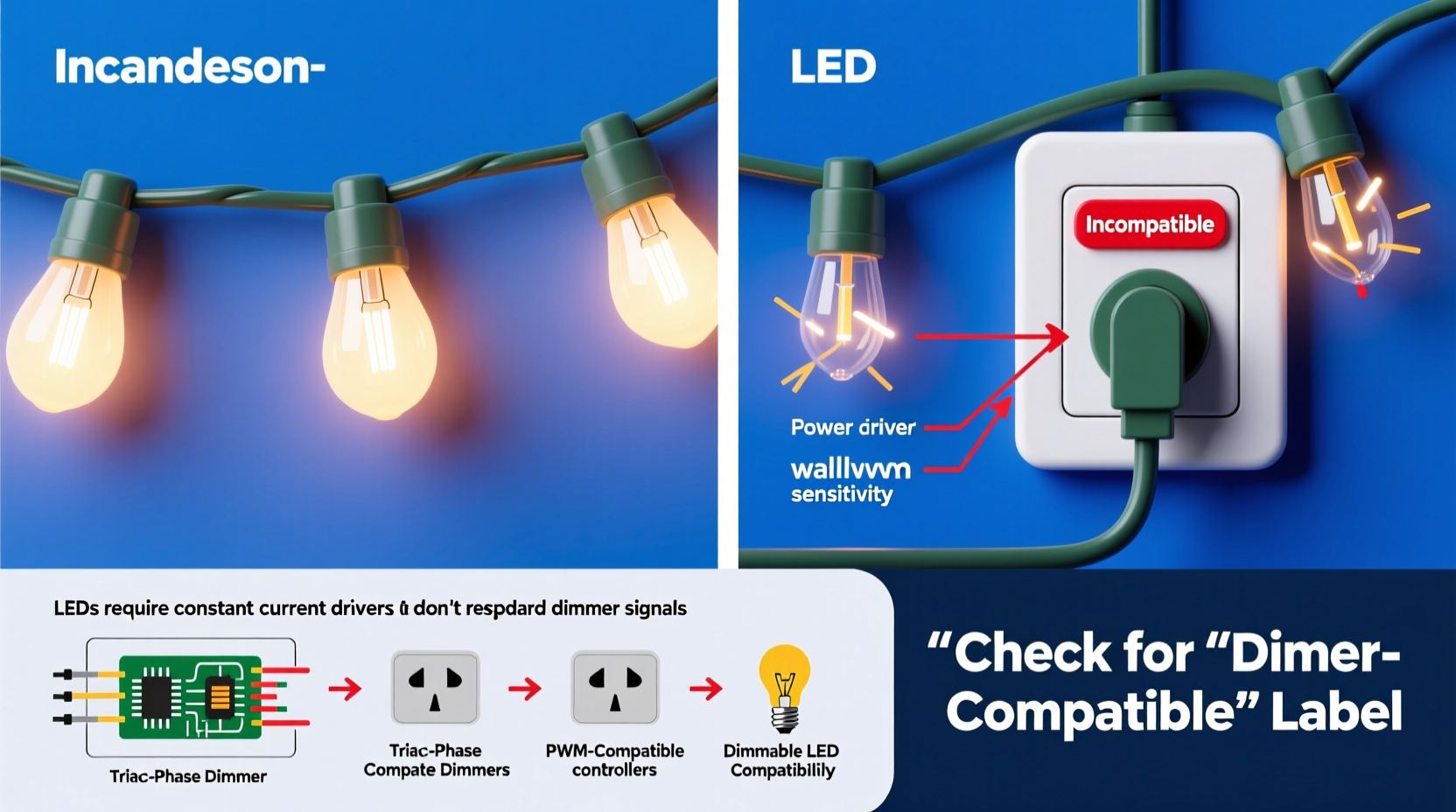
Traditional wall dimmers don’t reduce brightness by “turning down power” like a volume knob. Instead, they use phase-cutting—a method that chops portions of the AC sine wave before it reaches the load. Leading-edge dimmers (common in residential settings) cut the front portion of each half-cycle; trailing-edge dimmers cut the back. Both reduce the *average* voltage delivered—but only if the connected load responds predictably to those truncated waveforms.
Incandescent Christmas lights—especially older sets wired in series—rely on consistent 120V AC to heat filaments uniformly. When a dimmer interrupts the waveform, the filament cools and reheats rapidly, causing visible flicker and thermal stress. More critically, many series-wired strings lack individual shunt resistors. If one bulb burns out, the entire string goes dark—but under dimmed conditions, inconsistent current flow increases the chance of cold-filament arcing, which can degrade sockets or melt wire insulation.
LED Christmas lights face a different challenge. Most budget LED strings use simple rectifier-and-resistor driver circuits—not constant-current drivers. These rudimentary drivers expect full-wave, stable AC input. When fed chopped waveforms, they misinterpret voltage drops as faults, triggering erratic behavior: strobing, partial illumination, or complete shutdown. Even LEDs marketed as “dimmable” often require specific trailing-edge dimmers and minimum load thresholds—details rarely disclosed on retail packaging.
Compatibility Breakdown: What Works, What Doesn’t, and Why
Not all Christmas lights are created equal—and compatibility hinges on three interdependent factors: bulb technology, internal driver design, and wiring topology. The table below clarifies real-world performance across common categories.
| Light Type | Dimmer Compatibility | Key Limitation | Safer Alternative |
|---|---|---|---|
| Older Incandescent Mini-Lights (Series-Wired) | ❌ Not compatible | No shunt protection; voltage drop causes open-circuit failure and overheating | Replace with parallel-wired incandescent or certified dimmable LED |
| Budget LED Mini-Lights (Resistor-Driven) | ❌ Unreliable / Unsafe | Lack constant-current regulation; prone to thermal runaway at low voltage | Use only with manufacturer-specified dimmers or smart plugs |
| Premium LED Strings (IC-Driven, e.g., WS2811/2812) | ✅ Fully compatible with DMX or PWM controllers | Require digital signal input—not standard AC dimmers | Use dedicated LED controllers (e.g., Falcon Player, xLights) + USB-to-DMX interface |
| Commercial C7/C9 (Shunted Incandescent) | ⚠️ Limited (requires high-wattage leading-edge dimmer) | Minimum load often exceeds 100W; may hum or buzz below 50% brightness | Pair with heavy-duty Lutron Maestro or Leviton Vizia dimmers rated for 600W resistive load |
| Smart Wi-Fi/Bluetooth LED Strings (e.g., Philips Hue, Nanoleaf) | ✅ Yes—but bypass the wall dimmer entirely | Internal electronics interpret dimming commands digitally; AC dimmers interfere and void warranty | Install on always-on circuit; control brightness via app or voice assistant |
A Real-World Fix: How Sarah Solved Her Flickering Porch Lights
Sarah installed a new Lutron Caseta dimmer to soften her porch’s 200-bulb C9 display—only to find the lights pulsed erratically after 15 minutes, then emitted a sharp ozone smell. She called an electrician, who confirmed the set drew only 84W (well below the dimmer’s 150W minimum load) and used non-shunted incandescent bulbs. The root cause? Voltage instability caused micro-arcing inside cold sockets, degrading contacts over time.
Instead of replacing the $320 dimmer or the $180 light set, Sarah took a hybrid approach: she kept the Caseta dimmer but added a 100W incandescent “dummy load” (a simple A19 bulb in a junction box wired in parallel). This brought total load to 184W—within safe operating range. She then replaced her original C9s with shunted, heavy-duty replacements rated for dimmer use. Result: smooth dimming from 10% to 100%, zero buzzing, and no further socket corrosion. Her total cost? $27 for the dummy load kit and $42 for upgraded bulbs—less than 20% of replacing either component.
“Most dimmer failures with decorative lighting stem from load mismatch—not defective parts. A 25W difference can mean the difference between silent operation and destructive harmonic resonance.” — Carlos Mendez, Senior Applications Engineer, Lutron Electronics
Step-by-Step: Making Your Existing Lights Dimmable (Safely)
Follow this verified sequence before touching any wires or switches. Skipping steps risks equipment damage or violates NEC Article 411.4 (low-voltage lighting requirements).
- Verify dimmer specifications: Locate model number on dimmer faceplate. Check manufacturer datasheet for minimum/maximum load ratings, compatible load types (resistive vs. LED), and required dimmer curve (e.g., “incandescent-only” vs. “universal”).
- Measure actual load: Use a Kill-A-Watt meter to measure real-world wattage of your light string(s) at full brightness—not the “max wattage” printed on the box. Add all strings on the same circuit.
- Calculate compatibility gap: If measured load is below dimmer’s minimum, calculate deficit (e.g., dimmer min = 40W, lights draw 22W → deficit = 18W). You’ll need to add resistive load equal to or greater than this deficit.
- Select & install dummy load: Choose an incandescent or halogen bulb matching your circuit voltage (120V) and wattage ≥ deficit. Mount in an enclosed, ventilated junction box rated for continuous duty—not a lamp socket. Wire in parallel using UL-listed wire nuts and strain relief.
- Test incrementally: Turn on circuit. Gradually lower dimmer to 30%. Monitor for heat at outlets, buzzing, or flicker. If present, increase dummy load by 10W and retest. Never exceed 80% of dimmer’s maximum rating.
Smart Alternatives That Skip the Dimmer Altogether
For most homeowners, retrofitting legacy dimmers isn’t cost-effective or future-proof. Modern alternatives offer superior control without electrical compromises:
- Smart Plug Integration: Plug lights into a TP-Link Kasa or Wemo Mini Smart Plug, then schedule brightness ramps via app. Works with any light string—even non-dimmable LEDs—because it controls on/off timing, not voltage. Bonus: enables geofencing (“lights dim when I leave home”).
- DMX-Controlled Pixel Strings: For advanced users, addressable LED strings (like Ray Wu WS2811) connect to Raspberry Pi or ESP32-based controllers running xLights software. Enables per-bulb dimming, color transitions, and music synchronization—no AC dimmers involved.
- Integrated Dimmable Drivers: Replace entire light string with professional-grade options like Twinkly Pro or Lumina LED. These include built-in constant-current drivers calibrated for 120–277V input and accept 0–10V analog dimming signals—compatible with commercial building automation systems.
FAQ
Can I use a regular light dimmer for LED Christmas lights?
No—not unless the lights explicitly state compatibility with your dimmer model and type. Standard incandescent dimmers often lack the low-end torque needed for LED loads and can cause audible buzzing, reduced lifespan, or premature driver failure. Always match LED-rated dimmers (e.g., Lutron Diva DVCL-153P) with lights certified for that dimmer family.
Why do my lights work fine on a regular switch but buzz on the dimmer?
Buzzing indicates electromagnetic vibration in the dimmer’s internal triac or in transformer windings (if using low-voltage lights). It’s a sign of incompatibility—not just annoyance. Prolonged buzzing accelerates component wear and can induce harmonic distortion that affects other devices on the same circuit. Silence is the benchmark for proper dimmer-light pairing.
Is it safe to dim lights outdoors?
Only if all components are rated for wet-location use (UL Type ETLP or Wet Location listed) and the dimmer is installed in a NEMA 3R or higher enclosure. Never use indoor-rated dimmers or smart plugs in uncovered outdoor outlets—even under eaves. Moisture ingress combined with voltage chopping dramatically increases shock and short-circuit risk.
Conclusion
Christmas lights shouldn’t be a guessing game—or a safety gamble. The incompatibility between standard dimmers and decorative lighting isn’t a design flaw; it’s physics in action. Recognizing that mismatch as a solvable engineering problem—not a consumer inconvenience—empowers smarter choices: selecting purpose-built dimmable strings, applying load-matching techniques with confidence, or embracing intelligent, dimmer-free control. Whether you’re preserving heirloom incandescents or orchestrating a synchronized LED display, the right solution starts with understanding what’s happening inside the wire—not just what’s glowing outside it. This holiday season, skip the trial-and-error. Measure your load, read the datasheets, and choose the path that delivers ambiance without compromise.




 浙公网安备
33010002000092号
浙公网安备
33010002000092号 浙B2-20120091-4
Comments
No comments yet. Why don't you start the discussion?