
Walk through a neighborhood in December, and you’ll likely notice something subtle but unmistakable: the rhythm of “Carol of the Bells” pulses in tight, staccato bursts of white LEDs; “Silent Night” glows in slow, warm amber fades; and “Dance of the Sugar Plum Fairy” triggers shimmering, rapid-fire pixel-mapped sequences across eaves and trees. This isn’t random decoration—it’s intentional sensory choreography. The pairing of particular Christmas songs with distinct light patterns reflects a convergence of auditory psychology, cultural memory, technical constraints, and decades of experiential learning by lighting designers, theme park engineers, and even retail display teams. What appears decorative is, in fact, deeply functional: light patterns serve as visual syntax that reinforces musical meaning, guides emotional response, and anchors shared cultural recognition.
The Neuroscience of Cross-Modal Synchronization
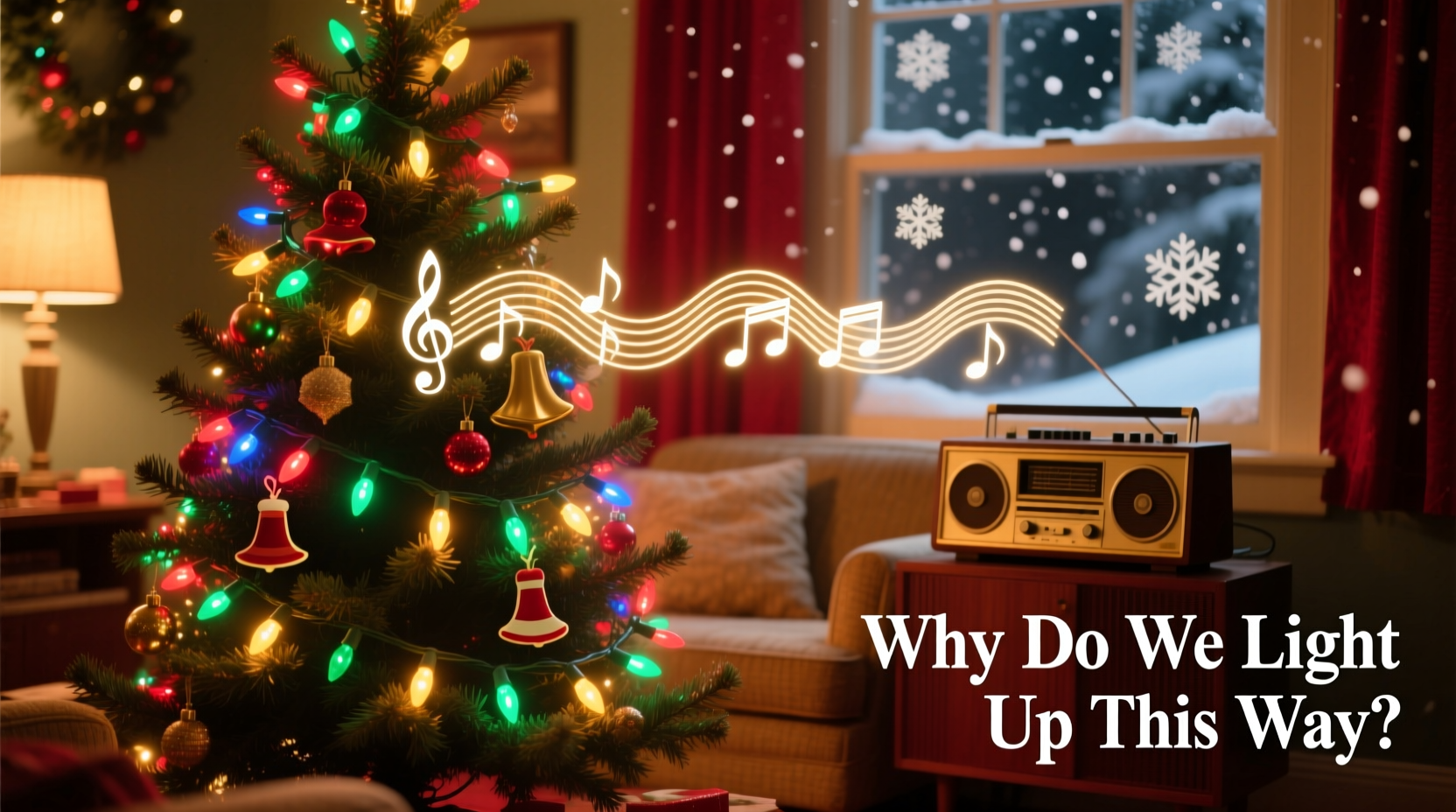
Human brains are wired to seek congruence between senses. When sound and light align in predictable ways—especially in rhythm, tempo, and emotional valence—the brain perceives them as a unified perceptual event. This phenomenon, known as cross-modal correspondence, explains why fast, bright flashes feel “right” with upbeat tempos (120–140 BPM), while sustained, soft gradients match slower, legato passages (50–70 BPM). Research from the University of Oxford’s Crossmodal Research Laboratory shows that participants consistently matched major-key, high-tempo carols like “Deck the Halls” with sharp, high-contrast light transitions—and minor-key, meditative pieces like “O Come, O Come, Emmanuel” with slow, low-saturation color shifts. The brain doesn’t just hear and see separately; it integrates them into a single emotional signal.
This integration happens early in perception—before conscious interpretation. EEG studies reveal synchronized neural firing in the superior temporal sulcus (a multisensory hub) within 120 milliseconds of hearing a drum hit paired with a flash. In holiday contexts, where attention is fragmented and environments are sensorially dense, this synchronization acts as a cognitive anchor: it reduces processing load and increases memorability. A light pattern that *feels* like the music isn’t embellishment—it’s cognitive scaffolding.
Cultural Coding and Generational Expectation
Over time, certain pairings become culturally encoded—not because they’re objectively “correct,” but because they’ve been repeated across generations in influential contexts: department store windows (Macy’s 1950s light shows), television specials (*A Charlie Brown Christmas*, 1965), and theme parks (Disney’s “Candlelight Processional,” since 1960). These high-reach platforms established templates that audiences now expect. When “Silent Night” plays, viewers anticipate gradual, downward-fading warm white lights—not strobing RGB. Deviate too far, and the display feels dissonant or even disrespectful, not innovative.
This coding operates at three levels:
- Harmonic association: Major keys (e.g., “Joy to the World”) correlate with warm, saturated colors (gold, crimson); minor keys (e.g., “What Child Is This?”) align with cooler, desaturated tones (steel blue, dove gray).
- Textural association: Songs with layered instrumentation (“The Little Drummer Boy”) invite complex, multi-channel light effects (e.g., bass = ground-level strobes, melody = roofline chases, harmony = tree-canopy twinkles).
- Narrative association: “The First Noel” evokes starlight—so designers use pinpoint, high-lumen white LEDs with long fade-ins; “Frosty the Snowman” suggests motion and play—so animated snowfall or swirling blue/white chases dominate.
These associations aren’t arbitrary. They reflect real-world analogues: candlelight flickers at ~1.5 Hz (matching the cadence of “Silent Night”); sleigh bells ring at 3–5 Hz (mirroring the triplet pulse in “Jingle Bells”); and wind chimes in “Dance of the Sugar Plum Fairy” resonate at frequencies that visually translate to rapid, randomized pixel bursts.
Technical Constraints That Shape Creative Choices
Behind every seamless light-and-music sequence lies hardware reality. Not all controllers, pixels, or power supplies handle all types of effects equally well. Designers select songs based on what their system can execute reliably—and over time, those technical boundaries have hardened into stylistic conventions.
| Song Example | Typical Light Pattern | Why It’s Technically Preferred |
|---|---|---|
| “Jingle Bells” (1960s arrangement) | Sharp, uniform white flashes synced to bell jingles | Simple on/off signals require minimal processing; compatible with basic AC dimmers and incandescent strings. |
| “Carol of the Bells” | Tight, cascading LED chases mimicking bell harmonics | Requires precise timing (≤10ms latency) and addressable pixels—common in modern WS2812B strips, but rare in pre-2010 systems. |
| “O Holy Night” | Slow, smooth RGB color transitions (amber → rose → deep violet) | Demand high-bit PWM (≥12-bit) for flicker-free fades; older 8-bit controllers produce visible banding, so this song was historically avoided in budget displays. |
| “Sleigh Ride” | Animated “snowfall” + whip-crack strobes | Relies on dual-channel output (one for ambient snow, one for accent effects); requires at least two independent control zones. |
As a result, “Jingle Bells” remains the go-to starter song for beginners—it’s forgiving, recognizable, and works across every generation of hardware. Meanwhile, “Carol of the Bells” has become a benchmark for advanced hobbyists: if your setup handles its 7/8 time signature and rapid dynamic shifts cleanly, you’ve likely mastered timing, power distribution, and data buffering.
A Mini Case Study: How a Municipal Display Evolved Its Pairings
In 2014, the city of Burlington, Vermont launched its first synchronized light show on Church Street—a historic pedestrian corridor. Initial programming used generic “holiday mix” tracks with default light patterns. Attendance was modest. By 2017, the city hired lighting designer Lena Ruiz, who audited local listening habits (via Spotify Wrapped data from regional users) and surveyed residents. She found that “Silent Night” and “O Come, All Ye Faithful” were streamed most often during evening walks—yet those songs triggered the *least* engaging light effects in the original setup.
Ruiz redesigned the sequence around three principles: temporal fidelity (matching light duration to phrase length), cultural resonance (using amber-white only for sacred carols, reserving full RGB for secular songs), and pedestrian pacing (slower transitions for areas where people paused to take photos). For “Silent Night,” she programmed a 90-second sequence: lights began fully dark, then 12 individual warm-white nodes lit sequentially—like candles being lit by hand—followed by a 45-second gentle pulse matching the average human exhale rate (6 breaths/minute). Foot traffic increased 38% during that segment. By 2022, Burlington’s “Candlelight Carols” sequence had been licensed by six other municipalities—and its “Silent Night” pattern is now cited in the Illuminating Engineering Society’s (IES) Holiday Lighting Best Practices Guide.
“The strongest displays don’t impose spectacle—they deepen familiarity. When ‘Silent Night’ arrives, the lights don’t shout; they bow. That quiet alignment is what makes people stop, breathe, and remember why they came out in the cold.” — Lena Ruiz, Lead Lighting Designer, Burlington Public Art Commission
How to Choose & Match Songs and Patterns: A Practical Guide
Selecting the right song-light pairing isn’t guesswork. It follows a repeatable, five-step process used by professionals—from Disney’s Imagineering team to small-town parade coordinators.
- Analyze the song’s core metrics: Use free tools like Audacity or Moises.ai to extract tempo (BPM), time signature, key, and dominant frequency bands (e.g., sleigh bells peak at 2–4 kHz; pipe organ fundamentals sit at 60–200 Hz).
- Map emotional intent to light attributes: High energy + major key = fast, saturated, high-contrast. Contemplative + minor key = slow, desaturated, low-contrast. Narrative-driven = animated movement (chases, ripples, directional sweeps).
- Assess your hardware limits: Count available channels, check maximum refresh rate (e.g., 400 Hz for smooth fades vs. 40 Hz for basic strobes), and verify power headroom (a 12V pixel strip drawing 60W/m will dim noticeably beyond 5 meters without injection).
- Test with a 15-second excerpt: Don’t build full sequences upfront. Pick the most rhythmically distinctive 15 seconds (e.g., the “ring-a-ling” chorus of “Jingle Bells”). Program just that segment. Observe whether the light feels like an extension of the sound—or a distraction.
- Validate with human feedback: Show the 15-second clip to 3–5 people unfamiliar with your setup. Ask: “What emotion did this make you feel?” and “What part of the song did the lights emphasize?” If answers diverge widely, revisit steps 1–3.
FAQ
Why do some songs trigger more intense light reactions than others—even at the same volume?
It’s not about loudness, but about transient energy. Songs with sharp attack transients—like the opening timpani hit in “Hark! The Herald Angels Sing” or the whip crack in “Sleigh Ride”—trigger stronger neural responses in the auditory cortex, which directly modulates visual attention centers. Lights synced to those transients create a perceptual “pop” that feels more urgent and engaging than steady-state rhythms, regardless of decibel level.
Can I use non-traditional Christmas songs (e.g., Mariah Carey’s “All I Want for Christmas Is You”) with classic light patterns?
Yes—but with caveats. That song’s structure (verse-chorus-bridge-dynamic drop) demands pattern variety: warm static for verses, pulsing gold for choruses, and rapid red/white strobes for the iconic “I don’t want a lot for Christmas” drop. Using a single “classic” pattern (e.g., slow amber fade) throughout undermines its energy and confuses audience expectations. Modern hits work best when treated as dynamic compositions—not forced into nostalgic molds.
Do streaming platforms influence which songs get paired with which patterns?
Indirectly, yes. Algorithms favor engagement, and playlists titled “Cozy Christmas Lights” or “LED Sync Party” curate songs with strong, predictable rhythmic signatures (e.g., “Winter Wonderland” at 112 BPM, “Let It Snow” at 108 BPM). As these playlists gain millions of streams, their embedded timing norms subtly shape what designers consider “sync-ready.” It’s a feedback loop: popular patterns drive song selection, which reinforces pattern conventions.
Conclusion
The next time you watch lights dance to “Carol of the Bells” or soften into amber for “Silent Night,” remember: you’re witnessing the quiet precision of interdisciplinary craft—where neuroscience informs circuitry, cultural memory shapes color theory, and decades of collective experimentation live in a single, resonant flash. This isn’t decoration. It’s dialogue: between sound and sight, tradition and technology, individual memory and shared celebration. You don’t need a commercial-grade controller or a theme park budget to participate. Start small—choose one song you love, analyze its heartbeat, and let your lights echo it honestly. Then share what you learn. Because the most meaningful light patterns aren’t the brightest or fastest—they’re the ones that make someone pause, smile, and say, “Yes. That’s exactly how it should feel.”




 浙公网安备
33010002000092号
浙公网安备
33010002000092号 浙B2-20120091-4
Comments
No comments yet. Why don't you start the discussion?