
The Chinese giant salamander (Andrias davidianus) is the largest amphibian in the world, capable of growing over 1.8 meters in length and living up to 70 years in captivity. Once widespread across China’s mountain streams and rivers, this ancient species—evolutionarily distinct for over 170 million years—is now on the brink of extinction. Classified as Critically Endangered by the International Union for Conservation of Nature (IUCN), fewer than 50 mature individuals are believed to remain in the wild. The decline of this ecological sentinel reflects broader environmental degradation and highlights urgent conservation challenges.
Habitat Loss and Fragmentation
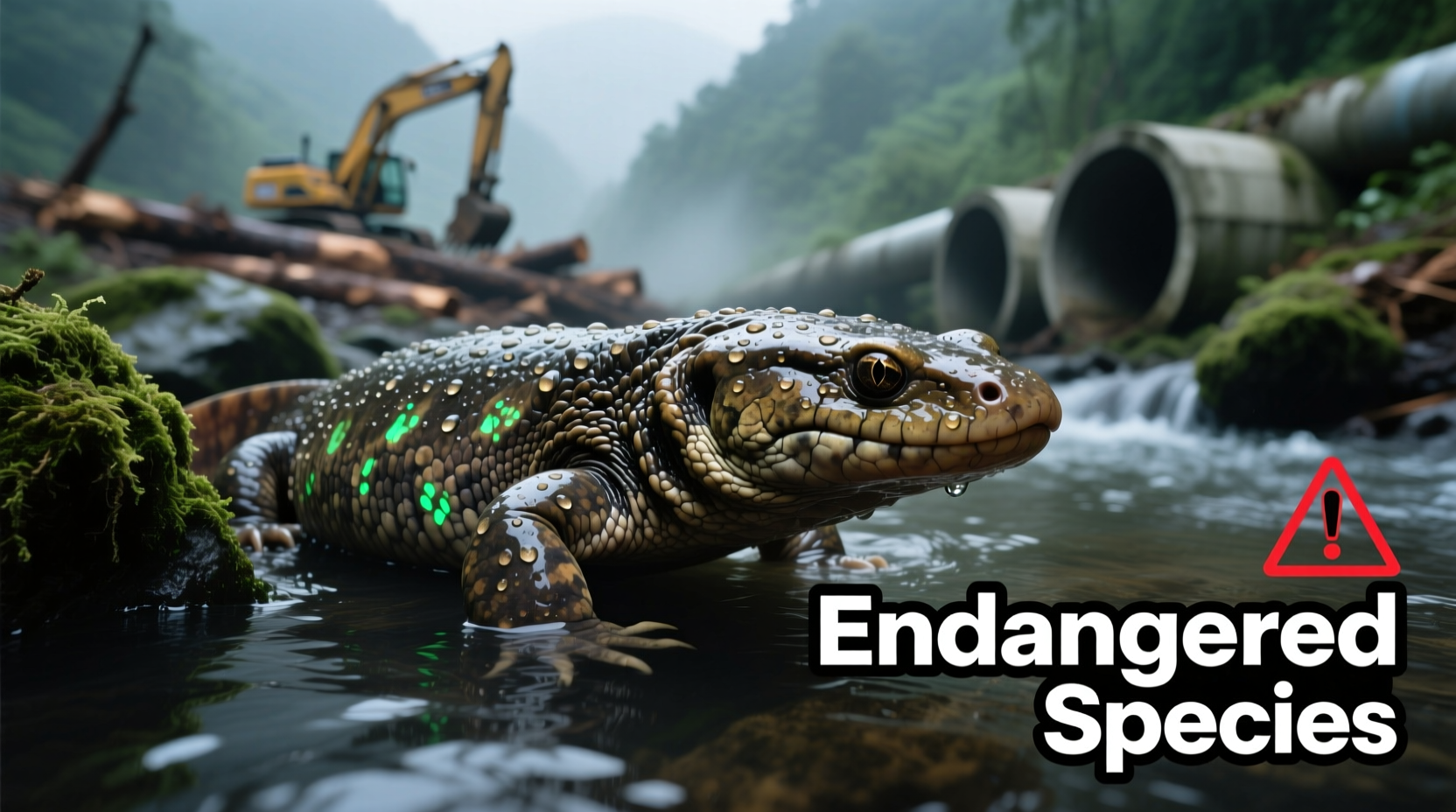
One of the primary drivers behind the salamander’s decline is the destruction and fragmentation of its natural habitat. These amphibians rely on cold, clear, fast-flowing streams in forested mountain regions—habitats increasingly compromised by human development. Dam construction for hydroelectric power disrupts water flow, alters temperature regimes, and blocks migration routes essential for breeding. Deforestation exacerbates soil erosion, leading to siltation that smothers rocky crevices where salamanders shelter and lay eggs.
Urban expansion, agricultural runoff, and mining operations further degrade water quality. Pesticides, heavy metals, and sediment pollution reduce oxygen levels and harm larval development. Unlike more adaptable species, Chinese giant salamanders cannot survive in polluted or stagnant waters, making them highly vulnerable to even minor environmental changes.
Overexploitation and Illegal Trade
Historically, Chinese giant salamanders were hunted for food due to their large size and cultural significance in traditional cuisine. Despite legal protections enacted since the 1980s, illegal poaching remains rampant. High market demand drives black-market trade, with live specimens fetching thousands of dollars. Farms legally breed salamanders for commercial sale, but these operations often source animals from the wild or inadvertently promote laundering of illegally caught individuals.
A critical issue arises when farmed salamanders—often genetically distinct or hybridized—are released into the wild under misguided “conservation” restocking programs. These introductions threaten the genetic integrity of remaining wild populations, potentially spreading diseases like ranavirus and chytridiomycosis, both of which have devastated amphibian populations globally.
“Releasing farm-bred salamanders into native rivers is like introducing invasive species—it can do more harm than good.” — Dr. Samuel Turvey, Senior Researcher at ZSL (Zoological Society of London)
Climate Change and Environmental Stressors
Rising temperatures pose a growing threat to cold-adapted species like the Chinese giant salamander. As ectotherms, their metabolism and survival depend on stable thermal conditions. Warmer waters reduce dissolved oxygen levels and increase susceptibility to pathogens. Seasonal shifts in precipitation patterns also affect stream hydrology, reducing the availability of suitable breeding sites.
Moreover, climate change amplifies existing stressors. Droughts lower water levels, concentrating pollutants and increasing competition for space. Conversely, extreme rainfall events trigger flash floods that destroy nests and displace juveniles. These compounded pressures leave little room for population recovery.
Conservation Strategies and Recovery Efforts
Effective conservation requires coordinated action across multiple fronts. In recent years, scientists and policymakers have implemented several key initiatives:
- Establishment of protected areas targeting core habitats in Shaanxi, Hunan, and Sichuan provinces.
- Genetic screening of wild and captive populations to identify pure lineages and prevent hybridization.
- Community-based monitoring programs engaging local residents in anti-poaching patrols and habitat restoration.
- Development of disease-free assurance colonies to safeguard genetic diversity.
In 2023, a landmark study led by researchers from ZSL and Chinese institutions used environmental DNA (eDNA) sampling to detect salamander presence in remote streams. This non-invasive method allows scientists to monitor distribution without disturbing fragile populations.
Step-by-Step Guide to Effective Conservation Intervention
- Assess Wild Populations: Use eDNA and camera traps to confirm presence and estimate abundance.
- Secure Critical Habitats: Designate no-take zones and restrict dam development in key watersheds.
- Combat Illegal Trade: Strengthen enforcement of wildlife laws and trace supply chains from farms to markets.
- Improve Captive Breeding Protocols: Ensure genetic purity and disease screening before any reintroduction planning.
- Engage Local Communities: Provide education and alternative livelihoods to reduce reliance on poaching.
- Monitor Long-Term Trends: Implement annual surveys to evaluate intervention success.
Checklist: How You Can Support Chinese Giant Salamander Conservation
- Support NGOs working on amphibian conservation in Asia (e.g., ZSL, Wildlife Conservation Society).
- Avoid purchasing products linked to unsustainable wildlife farming.
- Advocate for stronger international regulations on amphibian trade through CITES.
- Spread awareness about the ecological importance of amphibians.
- Reduce your carbon footprint to mitigate climate impacts on sensitive ecosystems.
Mini Case Study: The Qinling Mountains Initiative
In central China’s Qinling Mountains—a biodiversity hotspot once home to dense salamander populations—scientists discovered a small surviving group during a 2022 survey. Using eDNA analysis, they confirmed the presence of genetically distinct individuals not previously documented. In response, local authorities partnered with conservation biologists to launch a pilot project combining habitat protection, community outreach, and strict anti-poaching measures.
Rangers trained villagers to report suspicious activity, while school programs taught children about the salamander’s role in maintaining stream health. Within two years, signs of juvenile recruitment were observed, suggesting improved breeding success. Although still fragile, this localized effort demonstrates how science-led, community-involved strategies can yield measurable results.
Threat Comparison Table: Key Risks Facing Chinese Giant Salamanders
| Threat | Impact Level | Current Mitigation Status | Urgency |
|---|---|---|---|
| Habitat Destruction (Dams, Logging) | High | Limited; some protected areas exist | Critical |
| Illegal Poaching and Trade | Very High | Poor enforcement; widespread black market | Immediate |
| Genetic Pollution from Farm Releases | High | Only recently recognized; few controls | Urgent |
| Disease (Ranavirus, Chytrid) | Moderate to High | No active surveillance in most regions | High |
| Climate Change | Growing | No targeted adaptation plans | Increasing |
Frequently Asked Questions
Are there any pure wild populations left?
Recent studies suggest a handful of genetically pure populations may persist in isolated mountain streams, particularly in the Qinling and Wuyi ranges. However, most wild sightings involve hybrids or escaped farmed individuals, complicating conservation assessments.
Can Chinese giant salamanders be saved from extinction?
Yes—but only with immediate, science-based action. Success depends on halting poaching, protecting intact habitats, preventing harmful releases from farms, and building public support. Captive assurance colonies offer a safety net, but long-term survival hinges on restoring functional wild ecosystems.
Why should we care about saving this species?
Beyond its evolutionary uniqueness, the Chinese giant salamander acts as an indicator of freshwater ecosystem health. Its decline signals broader environmental problems affecting water quality, biodiversity, and human well-being. Preserving this species means protecting entire watersheds that millions rely on.
Conclusion: A Call to Action for Global Stewardship
The plight of the Chinese giant salamander is not just a national crisis for China—it is a global conservation emergency. As one of Earth’s oldest vertebrate lineages, its disappearance would represent an irreplaceable loss of biological heritage. While the challenges are immense, proven strategies exist to reverse the trend. What’s needed now is political will, sustained funding, and international cooperation.
Scientists, policymakers, and citizens alike must recognize that saving this creature is not merely about preserving a single species. It is about defending the integrity of freshwater systems, respecting ecological limits, and honoring our responsibility as stewards of the planet. The time to act is before silence replaces the last whispers of movement beneath the stones.




 浙公网安备
33010002000092号
浙公网安备
33010002000092号 浙B2-20120091-4
Comments
No comments yet. Why don't you start the discussion?