
Holiday yard displays have evolved far beyond inflatable snowmen and static light strings. In recent years, a new centerpiece has emerged: the customizable LED message board. These sleek, weather-resistant panels—often mounted on stakes or integrated into lawn signs—let homeowners broadcast scrolling greetings, animated snowflakes, family names, or even live temperature readings across their front lawns. Their rapid adoption isn’t driven by novelty alone. It reflects deeper shifts in how people celebrate, connect, and express identity during the holidays. Unlike traditional decorations that communicate passively (“We’re festive”), LED message boards invite interaction, adaptation, and intentionality—turning the front yard into a dynamic, responsive extension of the home.
1. Personalization Meets Emotional Resonance
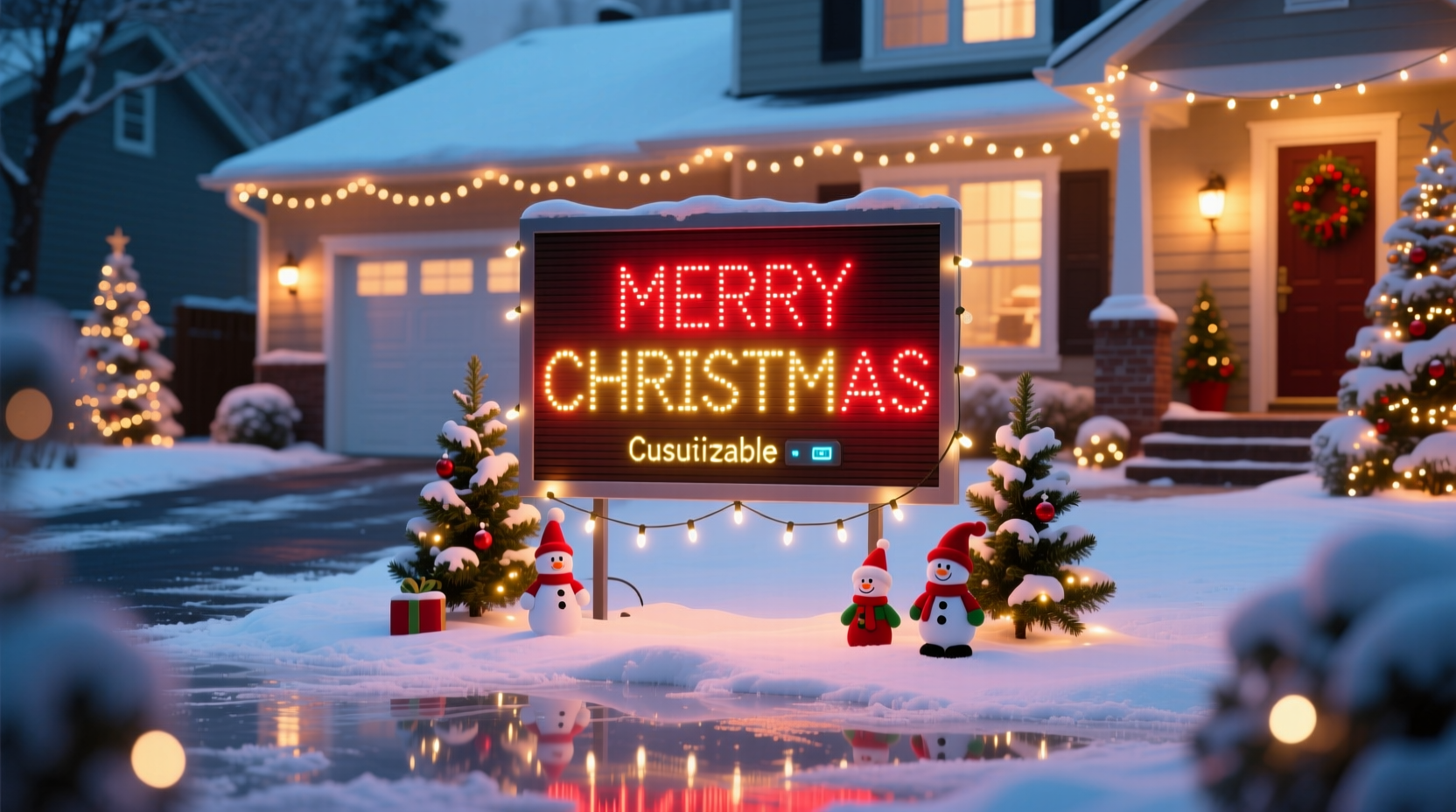
At its core, the appeal of customizable LED boards lies in their capacity for meaning-making. A “Merry Christmas” sign is warm—but a board that reads “Welcome Home, Maya & Ben — Class of ’24!” carries layered significance. Families use them to mark milestones: graduations, engagements, military homecomings, or remembrances. Others rotate messages weekly—“Warm Wishes from the Chen Family,” “Hot Cocoa & Good Vibes Only,” “Praying for Our Nurses This Season”—infusing public space with private sentiment.
This isn’t decoration as ornamentation; it’s decoration as narrative. Psychologists note that personalized environmental cues strengthen a sense of belonging and continuity—especially valuable during holidays when routines shift and emotions run high. When neighbors see a board celebrating a child’s first solo piano recital or honoring a late grandparent, it invites empathy rather than passive observation.
2. Community Connection in an Age of Digital Isolation
In neighborhoods where porch conversations have dwindled and doorbells go unanswered, LED message boards function as low-barrier social infrastructure. They don’t require face-to-face interaction, yet they signal presence, warmth, and shared cultural rhythm. A board flashing “Happy Hanukkah to All Our Neighbors!” or “Thank You, First Responders!” becomes a quiet act of civic care.
Real-world impact is measurable. In Maplewood, New Jersey, a neighborhood association distributed subsidized LED boards to 32 homes in 2022. Within six weeks, residents reported a 68% increase in spontaneous sidewalk greetings, and local polling showed a 22-point rise in perceived “neighbor trust.” As Dr. Lena Torres, urban sociologist at Rutgers University, observes:
“The LED board is the digital-age porch light: visible, non-intrusive, and intentionally hospitable. It doesn’t replace human contact—but it lowers the threshold for initiating it.” — Dr. Lena Torres, Urban Sociologist & Author of Shared Space, Shared Meaning
What makes this especially potent is its accessibility. Unlike complex smart-home integrations, most boards sync via Bluetooth or simple app interfaces—no coding, no Wi-Fi dependency. Grandparents program messages from tablets; kids design animations using drag-and-drop tools. The barrier to participation remains low, while the emotional return stays high.
3. Practical Advantages Over Traditional Yard Decor
Beyond sentiment, LED message boards solve persistent pain points of seasonal decorating:
- Space efficiency: Replaces multiple static signs (welcome, nativity, menorah marker) with one compact unit (typically 12\" × 24\" or smaller).
- Weather resilience: IP65-rated models withstand rain, snow, freezing temps, and UV exposure—no fading, warping, or electrical hazards.
- Energy economy: Modern boards draw just 3–8 watts—less than a string of 50 incandescent bulbs—and many include motion-sensing dimming or solar-charged battery options.
- Storage simplicity: Folds flat or detaches easily; no tangled cords, broken figurines, or bulb replacements needed post-holiday.
Crucially, they eliminate the “decorative clutter” fatigue many experience. Instead of accumulating dozens of seasonal items over decades, families invest once in a versatile platform that adapts year after year—reducing both physical storage demands and decision fatigue around “what to display.”
4. Smart Integration Without the Complexity
Today’s top-tier LED boards bridge analog charm with thoughtful digital utility—not flashy gimmicks. Consider these real-world integrations:
| Feature | Practical Holiday Use Case | Why It Matters |
|---|---|---|
| Bluetooth + App Control | Change messages remotely from your phone while sipping cocoa indoors | Eliminates trips outside in freezing weather; ideal for elderly or mobility-limited users |
| Preloaded Holiday Animations | Scrolling snowflakes, pulsing candy canes, flickering candlelight effects | Creates visual rhythm without manual programming; appeals to all ages |
| Temperature Display Mode | Shows current temp alongside “Stay Warm!” or “Bundle Up!” | Functional + festive—adds utility while reinforcing seasonal awareness |
| Multi-Zone Text Scrolling | Top line: “The Miller Family”; middle: “Wishing You Joy”; bottom: “Dec 1–Jan 6” | Maximizes information density without visual overload |
| Scheduled Auto-Off | Turns off at 10:30 PM daily; reactivates at dusk | Respects neighborhood lighting ordinances and reduces light pollution |
This isn’t about “smart for smart’s sake.” It’s about embedding intelligence where it removes friction—not adds it. The best boards operate like trusted assistants: reliable, unobtrusive, and quietly enhancing the experience.
5. A Mini Case Study: The Hendersons’ First-Year Transformation
The Henderson family in Portland, Oregon, installed their first 16×32-inch LED board in November 2023. Initially, they used it simply for “Happy Holidays!”—but within days, they noticed something unexpected. A neighbor with early-stage dementia began waving each morning when she saw the board light up. Her daughter later emailed thanking them: “She now associates your sign with safety and routine. It’s become her anchor.”
That prompted experimentation. They added rotating messages: “Ask us about our cookie recipe!” (which led to three impromptu baking exchanges), “Our dog Max says hi!” (sparking pet-friendly walks), and “Free hot chocolate, Sat 3–5 PM” (drawing 27 neighbors over two weekends). By New Year’s Eve, they’d programmed a countdown timer synced to midnight—and hosted a small, socially distanced toast on their driveway.
What began as a decorative purchase became a catalyst for localized belonging. “We didn’t set out to build community,” said Sarah Henderson. “We just wanted something cheerful. But the board gave us a voice we didn’t know we needed—and our neighbors responded in ways we couldn’t have predicted.”
6. Getting Started: A Realistic 5-Step Setup Timeline
Installing and optimizing a board takes under two hours—even for tech-wary users. Here’s how seasoned adopters approach it:
- Week -2 (Planning): Measure your mounting location (e.g., mailbox post height, fence clearance); confirm power access (outdoor GFCI outlet or solar panel placement).
- Week -1 (Setup): Assemble stake or wall mount; secure board; plug in and verify basic operation using factory default settings.
- Day 3 (First Message): Program a simple greeting (“Hello, Neighbors!”) via app or remote; test visibility from street and sidewalk.
- Day 5 (Refinement): Adjust brightness (60–70% for residential streets), scroll speed (2.5 sec/line feels natural), and add one animation (e.g., gentle snowfall).
- Ongoing (Engagement): Update messages weekly; track which prompts replies (e.g., “Guess the number of lights on our tree!” drew 12 submissions); retire tired phrases after 10 days.
Pro tip: Start conservative. Overly complex animations or rapid text changes distract more than delight. Clarity and warmth consistently outperform spectacle.
7. What to Avoid: A Holiday-Specific Do’s and Don’ts Checklist
- ✅ Do test visibility at dusk—not midday—to gauge true legibility.
- ✅ Do use high-contrast color combos (white-on-black, red-on-white) for maximum readability.
- ✅ Do include your street name or house number if you host open houses or deliveries.
- ❌ Don’t use blinking text faster than 1.5 seconds—it triggers photosensitivity in some viewers.
- ❌ Don’t display political slogans, religious proselytizing, or commercial promotions (e.g., “Buy from Us!”)—these erode goodwill and may violate HOA rules.
- ❌ Don’t leave messages unchanged for more than 10 days—stale content reads as neglect, not tradition.
8. FAQ: Addressing Common Concerns
How bright is too bright for a residential street?
Most municipalities regulate signage brightness at 200–300 nits for residential zones. Reputable LED boards include adjustable brightness sliders; aim for 180–220 nits. If the board casts sharp shadows on the sidewalk at night, it’s likely too intense. Dim until text remains crisp but doesn’t “glow” into adjacent yards.
Can I use the board year-round—or is it strictly seasonal?
Absolutely year-round. Many users switch to “Welcome Spring!” in March, “Happy Graduation!” in May, “We Support Our Teachers!” in September, or “Vote Here!” during elections. The hardware is built for continuous outdoor use, and firmware updates often add seasonal templates. Think of it less as a holiday product and more as a flexible community communication tool with strong seasonal utility.
What’s the average lifespan—and is maintenance difficult?
Quality boards last 50,000+ hours (≈6 years of nightly 6-hour use) with zero maintenance beyond occasional lens wiping. No bulbs to replace, no wiring to re-splice. Most manufacturers offer 3-year warranties covering weather damage and pixel failure. The biggest longevity risk? Physical impact (e.g., snow blower debris), so mount securely away from high-traffic snow-clearing paths.
Conclusion: Your Yard, Your Voice, Your Moment
Customizable LED message boards are popular not because they’re trendy, but because they meet a quiet, widespread need: the desire to be seen, to belong, and to share warmth without demanding attention. In a season often defined by hurried schedules and fragmented connections, they offer a rare convergence of simplicity and significance—a single device that welcomes, celebrates, informs, and unites. They turn passive observation into active participation, transforming the boundary between private home and public street into a space of shared humanity.
You don’t need a grand gesture to begin. Start with one thoughtful message. Watch how it lands—not just in eyes, but in smiles, waves, and unexpected conversations. Then adjust, refine, and expand. Your yard isn’t just land; it’s a canvas for kindness, a bulletin board for belonging, and a quiet invitation to pause, connect, and remember what the season truly asks of us: to light up—not just for ourselves, but for everyone who passes by.




 浙公网安备
33010002000092号
浙公网安备
33010002000092号 浙B2-20120091-4
Comments
No comments yet. Why don't you start the discussion?