
The word \"dinosaur\" evokes images of towering beasts, thunderous footsteps, and a lost world millions of years in the past. But few pause to consider what the name actually means or who first gave these ancient creatures their now-iconic title. The term “dinosaur” is not just a label for large prehistoric reptiles—it’s a scientific term rooted in classical language and shaped by 19th-century discovery. Understanding its origin reveals much about how science interprets the natural world and how names can carry both literal meaning and cultural weight.
The Birth of the Word \"Dinosaur\"
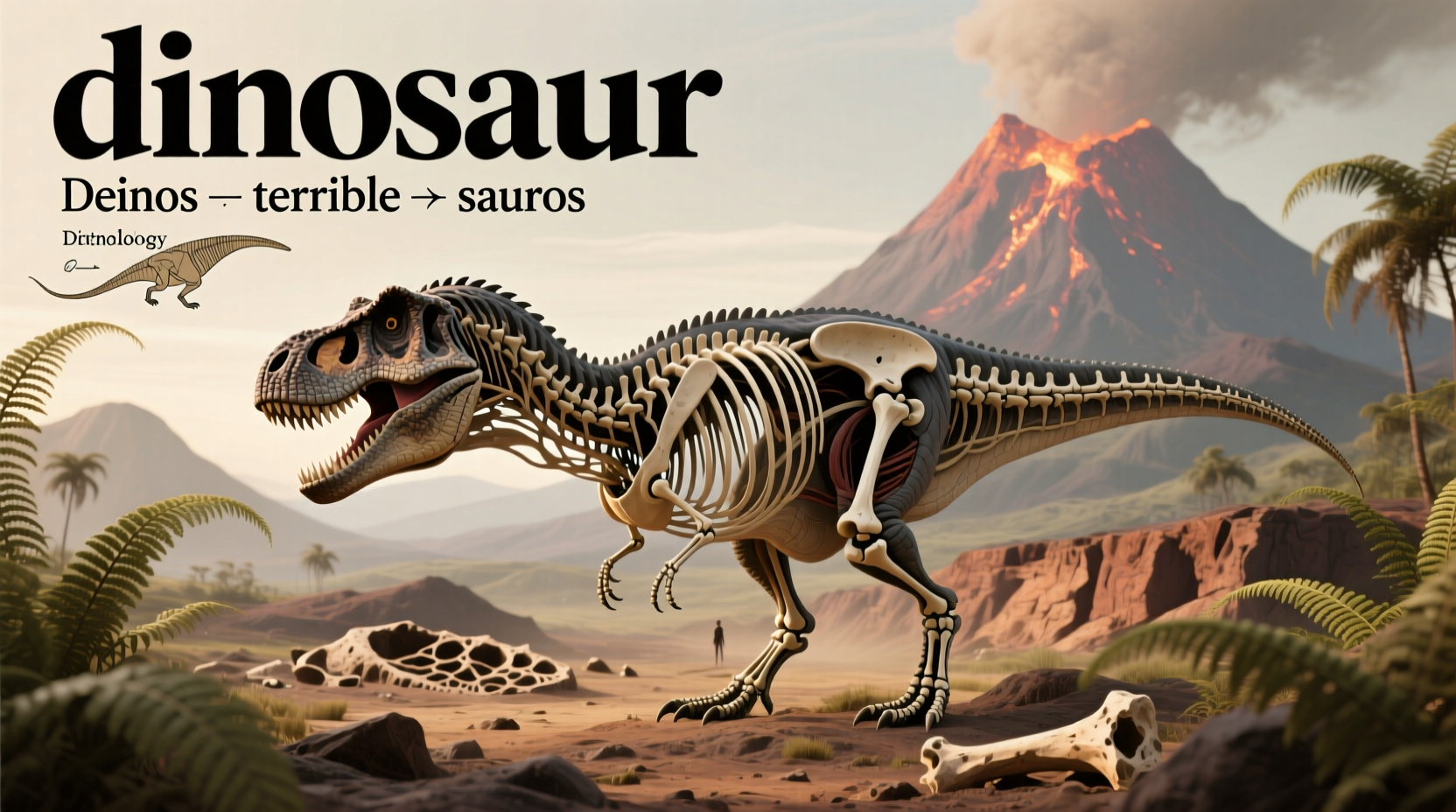
In 1842, British paleontologist Sir Richard Owen introduced the term \"Dinosauria\" to classify a growing number of fossilized reptiles that exhibited unique anatomical features. These fossils, unearthed across England and Europe, didn’t fit neatly into existing biological categories. They were distinct from modern reptiles in posture, skeletal structure, and inferred behavior. Owen recognized a pattern among species like Megalosaurus, Iguanodon, and Hylaeosaurus, and he needed a name to unite them under a single group.
He turned to Ancient Greek. “Deinos” (δεινός) means \"terrible,\" \"potent,\" or \"fearfully great,\" while “sauros” (σαῦρος) translates to \"lizard\" or \"reptile.\" Thus, Dinosauria literally means \"terrible lizards.\" It's important to note that Owen did not intend \"terrible\" in the modern sense of something evil or monstrous. Rather, he used it in the classical context—suggesting awe-inspiring magnitude, power, and grandeur.
“Fearing no adversary, these ancient reptiles ruled their domains with unmatched dominance.” — Sir Richard Owen, describing early dinosaur reconstructions
Why \"Terrible Lizards\"? Context Matters
To understand why Owen chose such a dramatic name, one must consider the scientific climate of the early 1800s. Fossils were still a relatively new field of study. The idea that entire species could go extinct challenged religious and philosophical views of a static, unchanging natural world. When massive bones were discovered—some larger than any living animal—scientists and the public alike were stunned.
Owen was not merely naming fossils; he was framing a narrative about Earth’s deep history. By calling them \"terrible lizards,\" he emphasized their imposing size and ecological supremacy during the Mesozoic Era. The name was meant to inspire wonder, not fear. In fact, Owen saw dinosaurs as advanced, active animals—closer in physiology to mammals and birds than to sluggish modern reptiles.
A Closer Look at the Etymology
The components of the word reveal deeper layers of meaning:
- Deinos (δεινός): Often translated as \"terrible,\" but also carries connotations of \"wondrous,\" \"formidable,\" or \"extraordinary.\" In Homer’s epics, heroes face \"deinos\" challenges—not just dangerous, but epic in scope.
- Sauros (σαῦρος): Means \"lizard\" or \"reptile.\" At the time, all cold-blooded, scaly creatures were grouped broadly under this term, even though we now know dinosaurs are more closely related to birds than to lizards.
So \"Dinosauria\" essentially means \"fearfully great reptiles\"—a tribute to their majesty rather than a judgment on their nature.
Common Misconceptions About the Name
Many assume \"dinosaur\" means \"terrible lizard\" because they were monstrous predators. While some dinosaurs certainly were fearsome, many were herbivores, small, or even feathered. The name applies to an entire clade of animals—over 900 identified species—that lived between 230 and 66 million years ago. It includes everything from the 100-ton Argentinosaurus to the chicken-sized Compsognathus.
The misperception persists partly because early reconstructions depicted dinosaurs as slow, tail-dragging beasts—a view long since overturned by modern paleontology. Today, scientists recognize that many dinosaurs were agile, warm-blooded, and socially complex.
Timeline of the Term’s Evolution
Here’s how the term \"dinosaur\" developed from scientific classification to global cultural phenomenon:
- 1824: Megalosaurus becomes the first scientifically described dinosaur genus (though not yet called a dinosaur).
- 1837: Fossil discoveries increase; researchers begin noticing similarities among large reptilian fossils.
- 1842: Richard Owen coins \"Dinosauria\" during a presentation to the British Association for the Advancement of Science.
- 1854: Life-sized dinosaur models debut at the Crystal Palace Park in London, popularizing the image of dinosaurs as colossal reptiles.
- Early 1900s: The term enters common usage, appearing in books, newspapers, and educational materials.
- 1993: The release of *Jurassic Park* cements \"dinosaur\" in global pop culture, often overshadowing its scientific roots.
How the Meaning Has Shifted Over Time
Originally a precise taxonomic category, \"dinosaur\" has evolved into a broader cultural symbol. In everyday language, people often use \"dinosaur\" to describe anything outdated or obsolete—“That printer is a real dinosaur.” This metaphorical use dilutes the scientific precision of the term, though it speaks to how deeply embedded dinosaurs are in public imagination.
Meanwhile, scientific understanding has refined the definition. Dinosaurs are now defined as all descendants of the most recent common ancestor of Triceratops and modern birds. Yes—birds are technically dinosaurs, making Dinosauria a living group. This redefinition highlights evolutionary continuity and challenges outdated notions of extinction as total erasure.
| Era | Usage of \"Dinosaur\" | Key Developments |
|---|---|---|
| 1840s–1900 | Scientific classification | Owen’s original definition based on anatomy |
| 1900–1970 | Popular science & museums | Dinosaurs portrayed as slow, cold-blooded giants |
| 1970–Present | Revolution in paleontology | Bird-dinosaur link confirmed; active, warm-blooded models |
| Modern Day | Cultural metaphor | Used to describe anything old-fashioned or massive |
Expert Insight: What Paleontologists Say
Modern scientists emphasize that the name \"dinosaur\" is both a blessing and a limitation. While it captures public interest, it can also mislead.
“The name ‘dinosaur’ stuck because it’s dramatic, but it carries baggage. We’re not studying monsters—we’re uncovering the evolutionary story of life on Earth.” — Dr. Julia Sankey, Vertebrate Paleontologist
Researchers today advocate for greater public awareness of what dinosaurs truly were: a diverse, dynamic group of animals that dominated terrestrial ecosystems for over 160 million years—longer than humans have existed.
Mini Case Study: The Naming of Velociraptor
A compelling example of how dinosaur names reflect both science and perception is Velociraptor. Named in 1924 by paleontologist Henry Fairfield Osborn, the name means \"swift seizer\"—from Latin *velox* (swift) and *raptor* (robber or plunderer). Though later popularized by *Jurassic Park* as a large, intelligent predator, real Velociraptor was about the size of a turkey, likely covered in feathers, and lived in present-day Mongolia.
This case shows how names influence public perception. \"Raptor\" sounds menacing, which helped fuel cinematic portrayals—even if they diverged from reality. Yet the name itself remains accurate: it was indeed fast and carnivorous. The lesson? Names shape stories, but science must correct the record.
Frequently Asked Questions
Did dinosaurs really look like lizards?
No. While early scientists classified them as reptiles due to skeletal similarities, modern research shows key differences. Dinosaurs had upright postures (legs beneath the body), higher metabolic rates, and many had feathers. They are more closely related to birds than to lizards or crocodiles.
Are birds really dinosaurs?
Yes. Birds evolved from small theropod dinosaurs during the Jurassic Period. They share numerous anatomical traits—hollow bones, wishbones, and nesting behaviors. Under modern cladistics, birds are considered living dinosaurs, just as humans are mammals.
Why didn’t Owen call them something less intimidating?
Owen aimed to convey their significance, not scare people. In Victorian science, grandeur and awe were valid descriptors. He wanted to highlight their importance in Earth’s history, not imply they were evil or grotesque.
Actionable Checklist: Understanding Dinosaur Names
Next time you encounter a dinosaur name, use this checklist to decode its meaning:
- Break the name into parts (usually Greek or Latin roots)
- Look up each component (e.g., “-saurus” = lizard, “tri-” = three)
- Consider the feature being highlighted (size, teeth, location, discoverer)
- Check if the name reflects myth, appearance, or behavior
- Remember: the name may not reflect current scientific understanding
Conclusion: Reclaiming the True Meaning
The name \"dinosaur\" carries more than etymological weight—it holds centuries of scientific inquiry, cultural fascination, and evolving understanding. Far from being mere \"terrible lizards,\" dinosaurs represent one of evolution’s most successful experiments in terrestrial life. Their name, born from classical language and Victorian curiosity, continues to inspire exploration and wonder.




 浙公网安备
33010002000092号
浙公网安备
33010002000092号 浙B2-20120091-4
Comments
No comments yet. Why don't you start the discussion?