
Flatworms—members of the phylum Platyhelminthes—are among the simplest bilaterally symmetrical animals on Earth. Found in marine, freshwater, and terrestrial habitats, these soft-bodied creatures share one unmistakable trait: they are extremely flat. This distinctive morphology is not accidental; it is a direct adaptation to their physiology, environment, and evolutionary history. The flatness of flatworms plays a crucial role in their ability to survive without complex organ systems found in higher animals. Understanding why flatworms are flat reveals fascinating insights into the interplay between form and function in nature.
The Anatomy Behind the Flatness
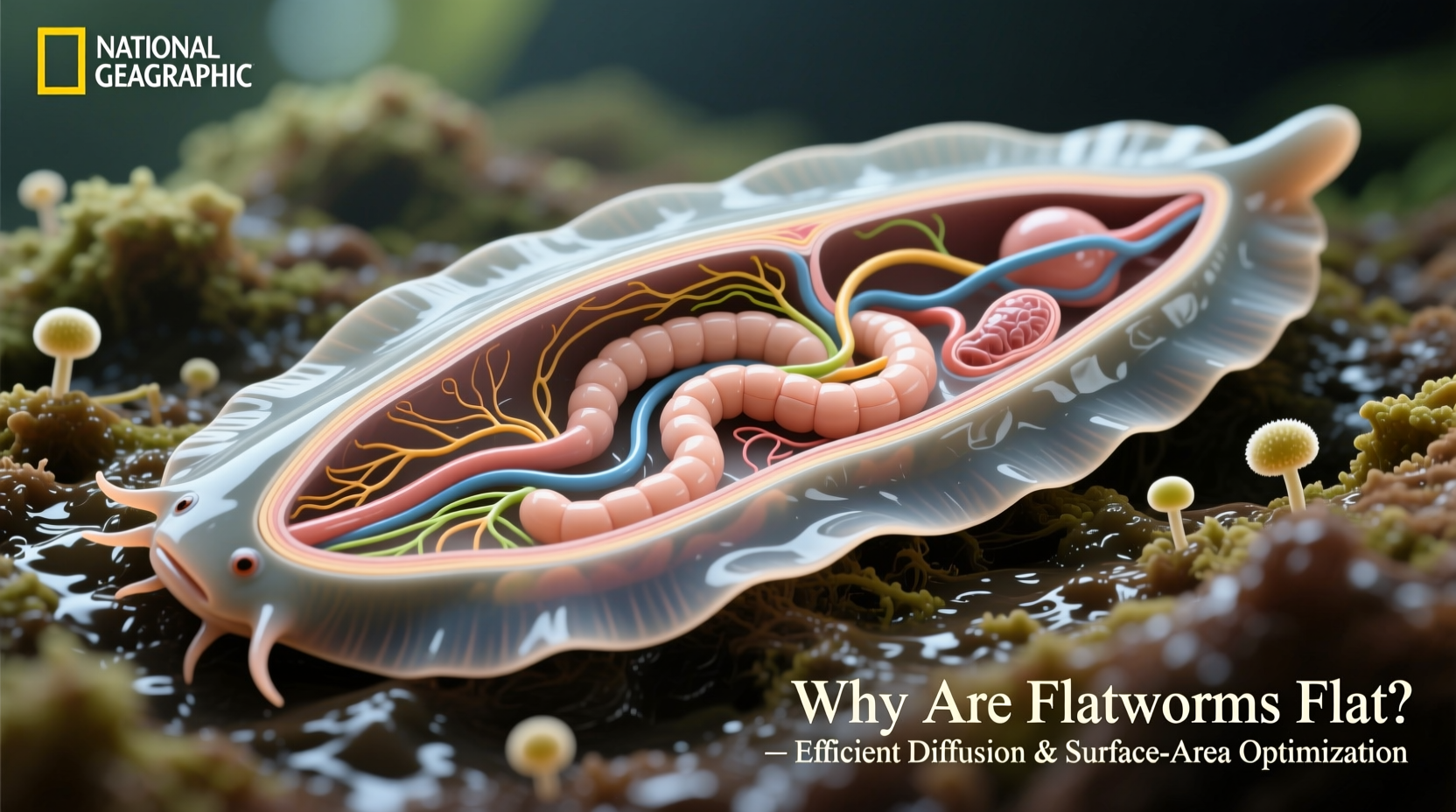
Flatworms lack a true body cavity (coelom), circulatory system, and respiratory organs like lungs or gills. Instead, their flattened bodies allow for efficient diffusion of gases, nutrients, and waste across their tissues. Oxygen enters the body directly through the skin via diffusion, and carbon dioxide exits the same way. Because diffusion only works effectively over short distances, having a thin, dorsoventrally compressed body ensures that no cell is too far from the external environment.
This structural design limits how thick flatworms can grow. If they were thicker, cells in the center would be too distant from the surface to receive adequate oxygen or expel metabolic waste. Thus, natural selection has favored individuals with flatter bodies, leading to the evolution of this defining characteristic.
Diversity Within Flatness
While all flatworms are flat, they vary significantly in size and shape depending on species and habitat. For example:
- Dugesia (planarians) have broad, leaf-shaped bodies ideal for gliding over moist surfaces.
- Tapeworms are long and ribbon-like, adapted to live inside the intestines of hosts.
- Flukes are more oval and often equipped with suckers for clinging to internal organs.
Despite these variations, the underlying principle remains: flatness enables survival without advanced physiological systems.
Respiration Without Lungs: How Flatness Supports Survival
In most animals, oxygen delivery relies on circulatory systems that transport gases from respiratory organs to tissues. Flatworms do not possess such systems. Instead, every cell must be close enough to the surrounding water or moist tissue to absorb oxygen directly.
Their high surface-area-to-volume ratio is key. A flat shape increases surface area while minimizing volume, allowing more of the body to be in contact with the environment at once. This geometric advantage makes passive diffusion sufficient for meeting metabolic demands.
“Flatworms exemplify how evolutionary constraints lead to elegant solutions. Their flat body isn’t primitive—it’s precisely tuned to their ecological niche.” — Dr. Lena Patel, Invertebrate Biologist, University of Oregon
Experiments show that even slight increases in thickness reduce survival rates under low-oxygen conditions. This underscores the importance of flatness as an adaptive trait rather than a developmental limitation.
Movement and Feeding: Functional Advantages of Being Flat
Beyond respiration, flatness enhances mobility and feeding strategies. Most free-living flatworms, such as planarians, move using cilia on their ventral surface combined with muscular contractions. Their flattened underside creates a large contact area with the substrate, improving grip and enabling smooth gliding over rocks, sediment, or plant matter.
Additionally, many parasitic flatworms use their flat bodies to wedge themselves into tight spaces within host organisms. Tapeworms, for instance, anchor themselves to intestinal walls using hooks and suckers located on their scolex (head). Their flattened segments (proglottids) stack efficiently behind the head, maximizing nutrient absorption across a wide surface exposed to digested food.
| Function | How Flatness Helps |
|---|---|
| Gas Exchange | Shortens diffusion distance for O₂ and CO₂ |
| Nutrient Absorption | Increases surface area for uptake in gutless species |
| Mobility | Improves adhesion and propulsion on surfaces |
| Parasitism | Allows insertion into narrow host tissues |
A Mini Case Study: Planarian Regeneration in Lab Settings
In a research lab at Stanford University, scientists studied the regeneration capabilities of planarians—free-living flatworms known for regrowing entire bodies from small fragments. One observation stood out: regenerated individuals consistently restored their original flat profile, even after being cut into irregular shapes.
Researchers concluded that maintaining flatness was not incidental but essential. Worms that failed to re-flatten during regeneration showed reduced motility and lower oxygen uptake, eventually dying unless environmental oxygen levels were artificially increased. This real-world example demonstrates that flatness is actively maintained by developmental mechanisms because it directly impacts survival.
Evolutionary Trade-offs of a Flat Body Plan
While flatness offers clear advantages, it also imposes limitations. The lack of a circulatory system restricts body size and complexity. Flatworms cannot evolve large, energy-intensive organs like centralized brains or hearts because those would require dedicated oxygen supply systems.
Similarly, their reliance on moisture constrains habitat range. Terrestrial flatworms, such as land planarians, must remain in damp environments like leaf litter or under logs. Dehydration quickly disrupts diffusion-based respiration, making them vulnerable to dry conditions.
Yet, within their ecological boundaries, flatworms thrive. Their simplicity allows rapid reproduction, effective parasitism, and remarkable regenerative abilities—all supported by the foundational trait of flatness.
Step-by-Step: How a Flatworm Maintains Homeostasis Without Organs
- Oxygen Intake: Dissolved oxygen in water diffuses across the epidermis into nearby cells.
- Nutrient Distribution: After digestion in a branched gastrovascular cavity, nutrients spread via diffusion.
- Waste Removal: Metabolic wastes like ammonia diffuse out through the body surface.
- Osmoregulation: Flame cells (protonephridia) filter excess water and excrete it through pores along the body.
- Maintenance of Shape: Muscle layers beneath the epidermis contract to preserve dorsoventral compression.
This sequence illustrates how each physiological process depends on proximity to the external environment—only possible due to flatness.
Frequently Asked Questions
Can flatworms survive out of water?
Some terrestrial species can survive brief exposure to air if kept moist, but prolonged dryness is fatal. Their flat bodies lose moisture quickly, and without water, gas exchange halts. They are restricted to humid microhabitats.
Do all flatworms have the same degree of flatness?
No. While all are dorsoventrally flattened, the extent varies. Free-living planarians tend to be uniformly thin, whereas some parasitic flukes may appear slightly thicker due to protective teguments, though still fundamentally flat at the cellular level.
Why don’t flatworms evolve lungs or gills?
They haven’t needed to. Diffusion suffices for their size and metabolic rate. Evolving complex respiratory structures would require concurrent development of circulatory systems, representing a major evolutionary shift unlikely without strong selective pressure.
Practical Checklist: Key Takeaways About Flatworm Flatness
- ✅ Flatness enables efficient gas exchange via diffusion.
- ✅ High surface-area-to-volume ratio supports nutrient absorption and waste removal.
- ✅ Flattened bodies improve locomotion on surfaces and attachment in parasites.
- ✅ Lack of circulatory and respiratory systems makes flatness necessary, not optional.
- ✅ Evolutionary trade-offs include limited size and dependence on moist environments.
Conclusion
The flatness of flatworms is far more than a curious anatomical quirk—it is a masterclass in biological efficiency. Every aspect of their physiology, from respiration to movement, hinges on this singular adaptation. By embracing simplicity, flatworms occupy niches that more complex organisms cannot easily access. Whether gliding through freshwater streams or surviving inside host intestines, their shape is perfectly aligned with their lifestyle.




 浙公网安备
33010002000092号
浙公网安备
33010002000092号 浙B2-20120091-4
Comments
No comments yet. Why don't you start the discussion?