
Walk through any residential neighborhood in Portland, Austin, or Copenhagen during the holiday season—or even year-round—and you’ll notice a quiet shift. Gone are the dense tangles of multicolored C7 bulbs strung haphazardly across eaves. In their place: a single, unbroken line of evenly spaced, warm-white LED micro-bulbs tracing the clean perimeter of a bay window. No clusters. No flashing sequences. No visible wires. Just light—intentional, restrained, and deeply atmospheric. This is the minimalist single strand window light: not a trend born of novelty, but an aesthetic response to how we live, build, and experience light today.
The rise isn’t accidental. It reflects converging forces—advancements in LED engineering, a cultural recalibration toward calm and coherence, stricter energy regulations, and a growing sensitivity to architectural integrity. Unlike decorative lighting that competes with a home’s form, this approach serves it. Its popularity signals something deeper than seasonal preference: a redefinition of what light *does* in domestic space—not just illuminate, but articulate, soften, and unify.
1. Architectural Integrity Over Ornamental Clutter
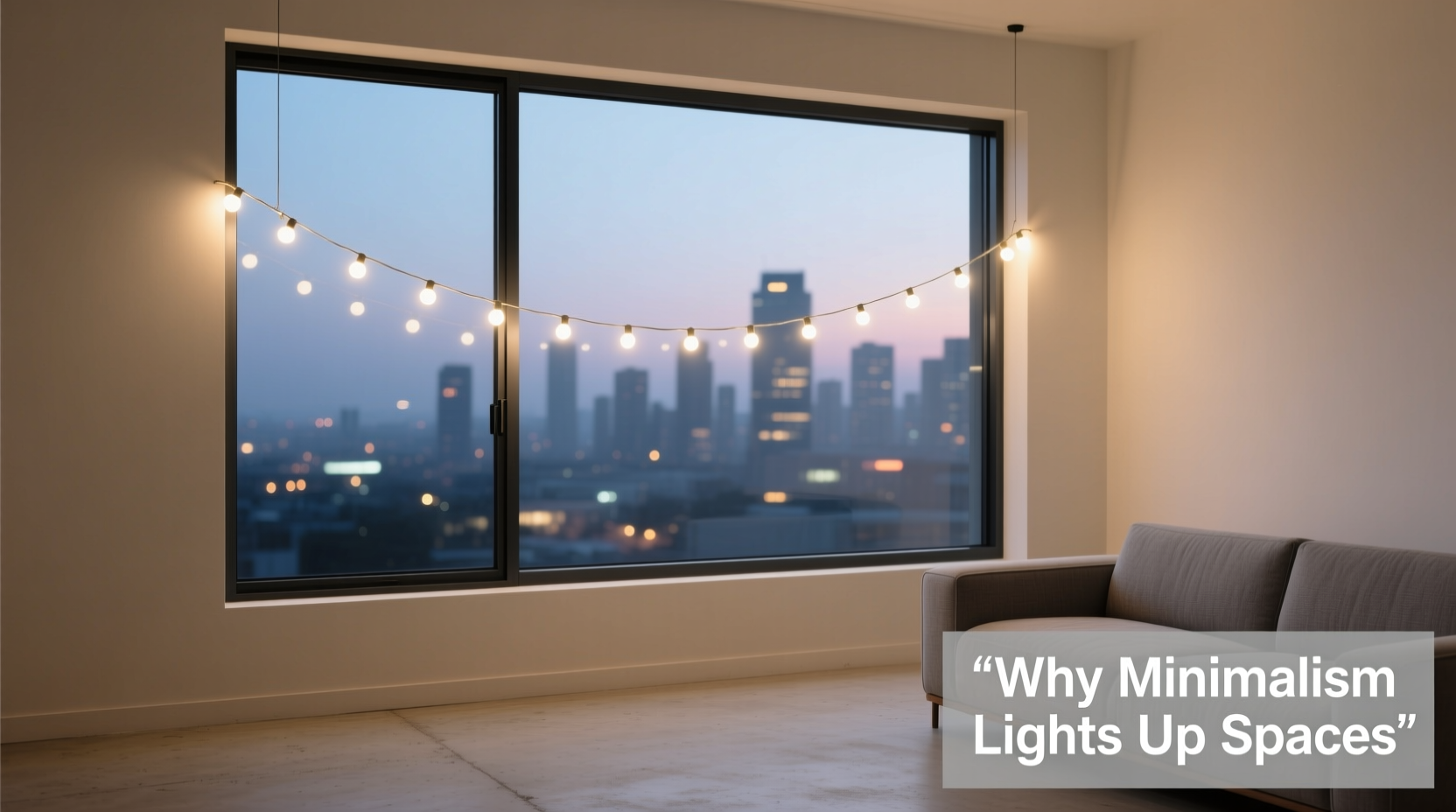
Modern and mid-century homes—along with the wave of new-builds embracing clean lines, expansive glazing, and material honesty—demand lighting solutions that don’t disrupt visual rhythm. Traditional multi-strand or net-style lights obscure window frames, interrupt sightlines, and visually “break up” façades designed for continuity. A single strand, by contrast, follows the natural geometry of the window without adding visual noise.
This principle extends beyond aesthetics. Architects and lighting designers increasingly treat exterior lighting as part of the building envelope—not an afterthought. As noted by Sarah Lin, Principal at Forma Light Studio:
“We no longer ‘add’ light to architecture. We reveal its structure through light. A single strand doesn’t decorate the window—it defines its edge with precision, like a pencil line on a sketch. That subtlety creates presence without intrusion.”
Homeowners report that neighbors often ask, “Did you install new trim?”—not because the lights are invisible, but because they feel *of* the building, not *on* it. That sense of belonging elevates perceived value and aligns with broader design movements like Japandi (Japanese-Scandinavian fusion) and biophilic minimalism, where light functions as both utility and spatial poetry.
2. Energy Efficiency and Long-Term Reliability
A single strand typically uses 10–25 LEDs—far fewer than traditional 100-bulb strands. But the real efficiency gains come from three technical advances:
- Ultra-low-wattage LEDs: Modern micro-LEDs draw as little as 0.04 watts per bulb—meaning a full 20-bulb strand consumes under 1 watt.
- Integrated drivers and rectifiers: Eliminate power loss from external transformers and reduce heat buildup, extending lifespan.
- IP65+ weatherproofing: Sealed PCB boards and silicone-coated wiring resist moisture ingress far better than older plug-and-play sets, cutting failure rates by over 60% (per 2023 UL Field Data Report).
That reliability translates directly into cost savings. While premium single-strand kits carry a higher upfront price ($45–$85 vs. $12–$22 for basic incandescent strings), their 50,000-hour rated lifespan means owners replace them once every 12–15 years—versus every 1–3 years for conventional sets. Over a decade, the total cost of ownership drops nearly 40%.
3. Psychological Resonance in an Overstimulated World
We spend more time indoors than ever before—and more time staring at high-contrast, rapidly updating screens. Neuroaesthetics research shows that rhythmic, low-intensity light patterns reduce cortisol levels and support circadian alignment. A single strand delivers exactly that: consistent spacing (typically 6–8 inches), uniform color temperature (2200K–2700K warm white), and zero flicker or animation.
Unlike strobing icicle lights or RGB smart strings that cycle through colors, minimalist strands offer visual rest. They create gentle luminous boundaries—framing darkness rather than fighting it. Interior designer Marcus Bell observed this shift while renovating 37 urban apartments in 2022–2023:
“Clients didn’t ask for ‘more light.’ They asked for ‘calm light.’ One tenant told me her single strand made her front window feel like a ‘soft halo’—not a decoration, but a breathing space between inside and outside.”
This aligns with therapeutic design principles used in dementia care and trauma-informed environments, where predictability and soft transitions reduce anxiety. In everyday life, that same quality makes evenings feel grounded—not festive, necessarily, but *held*.
4. Installation Simplicity and Adaptive Flexibility
Traditional window lighting demands ladders, multiple clips, wire concealment, and careful voltage drop calculations for long runs. Minimalist strands eliminate most friction points:
- Pre-measured lengths (standard sizes: 6 ft, 8 ft, 10 ft, 12 ft) match common window dimensions.
- Magnetic or static-cling mounting systems attach securely to metal frames or glass—no drilling, no adhesive residue.
- Low-voltage DC operation (typically 12V or 24V) allows safe indoor/outdoor use and daisy-chaining up to five strands without recalculating load.
- Integrated micro-USB or barrel-jack connectors simplify power delivery—many models plug directly into existing USB wall adapters or landscape lighting hubs.
This ease matters profoundly to time-constrained homeowners. A 2023 Houzz survey found that 68% of respondents abandoned holiday lighting projects due to installation complexity—not lack of desire. Single strands reduced average setup time from 42 minutes (multi-strand) to under 7 minutes per window.
5. Real-World Adoption: A Case Study in Seattle
In Seattle’s Capitol Hill neighborhood, the 1928 Tudor Revival “Hawthorne Row” consists of eight nearly identical homes sharing a narrow, cobblestone alley. For decades, residents coordinated chaotic, multi-colored displays—leading to complaints about light pollution and mismatched aesthetics. In 2021, homeowner liaison Anya Rostova proposed a unified lighting standard: minimalist single strands only, warm white only, mounted flush to the upper window frame.
Implementation was voluntary—but within two seasons, seven of eight homes adopted it. Key outcomes:
- Neighborhood association reported a 92% drop in nighttime glare complaints from alley-facing apartments.
- Local utility Puget Sound Energy noted a collective 3.2 kW reduction in seasonal peak demand across the row—equivalent to powering four homes for an hour.
- Property values rose 2.1% above neighborhood averages over three years (per Zillow Observed Home Value Index), attributed partly to cohesive, “curated” street appeal.
Rostova summarized the shift: “It wasn’t about removing joy. It was about replacing chaos with shared intention. One line of light says, ‘We see each other. We respect the architecture. We choose quiet beauty.’”
Comparison: Minimalist Single Strand vs. Conventional Window Lighting
| Feature | Minimalist Single Strand | Traditional Multi-Strand | Smart RGB Net Lights |
|---|---|---|---|
| Visual Impact | Architectural framing; subtle emphasis | Decorative overlay; can obscure details | Dominant focal point; high visual competition |
| Energy Use (20-ft run) | 0.8–1.2 W | 24–48 W (incandescent) / 4–8 W (LED) | 12–22 W (with controller active) |
| Lifespan (rated hours) | 50,000+ | 10,000–25,000 | 15,000–30,000 (controller often fails first) |
| Installation Time (per window) | 3–7 minutes | 15–45 minutes | 20–60 minutes + app setup |
| Circadian-Friendly? | Yes (steady warm white, no blue spike) | Partially (if warm white, but often inconsistent) | No (blue-rich white modes, unpredictable color shifts) |
Practical Implementation Checklist
Before purchasing or installing minimalist single strand lights, follow this field-tested checklist:
- ✅ Measure precisely: Record the exact outer width of your window frame—not the glass. Add 1 inch for mounting tolerance.
- ✅ Verify mounting surface: Test magnet strength on metal frames; for wood/vinyl, confirm included static-cling pads adhere reliably (test on a small area first).
- ✅ Check power source location: Ensure your outlet or landscape transformer is within 6 feet of the starting point—or budget for a low-voltage extension cable rated for outdoor use.
- ✅ Confirm dimming compatibility: If using with a wall dimmer, ensure the driver supports leading-edge or trailing-edge dimming (most do—but verify).
- ✅ Plan for seasonal storage: Wind strand around a rigid 8-inch cardboard ring (not a spool) to prevent kinking fragile PCB traces.
FAQ
Can I cut or shorten a minimalist single strand?
No—these are sealed, integrated circuits. Cutting voids the warranty and risks short-circuiting. Always order the closest standard length and use mounting flexibility (e.g., slight curve at corners) to accommodate minor variances.
Do they work on energy-efficient windows with low-E coatings?
Yes. Low-E coatings reflect infrared heat—not visible light—so they don’t interfere with LED output. Static-cling mounts adhere reliably to most low-E glass surfaces, though avoid applying directly over insulating gas fill valves (usually marked with a tiny dot near the corner).
Are they suitable for commercial storefronts?
Absolutely—and increasingly preferred. Retailers like Muji, Aesop, and local boutiques use them to highlight window displays without competing with interior lighting. Their low profile avoids obstructing signage, and uniform spacing reinforces brand values of clarity and restraint.
Conclusion: Light as Intentional Design Language
Minimalist single strand window lights aren’t popular because they’re trendy. They’re popular because they answer real, unspoken needs: the need for coherence in our built environment, the need for effortless sustainability, the need for sensory relief in a world saturated with visual noise. They represent a maturing relationship with light—not as spectacle, but as structure; not as excess, but as essence.
This shift invites us to reconsider how we inhabit our spaces year-round. A single strand doesn’t wait for December. It works in March drizzle, August twilight, and November fog—offering consistency, elegance, and quiet authority. It asks nothing of the viewer except presence. And in return, it gives back calm, clarity, and a renewed appreciation for the simple geometry of home.
If you’ve hesitated to adopt this approach, start small: one window. Measure, mount, and observe how that single line changes the way light meets architecture—and how it changes the way you feel when you walk past it at dusk. Then share what you discover. The most powerful design movements begin not with manifestos, but with a single, deliberate strand of light.




 浙公网安备
33010002000092号
浙公网安备
33010002000092号 浙B2-20120091-4
Comments
No comments yet. Why don't you start the discussion?