
As the holiday season approaches, nothing sets the mood quite like a string of twinkling Christmas lights. But if you’ve noticed that your light strands grow progressively dimmer toward the end—especially after connecting multiple strings—you’re not imagining things. This is a real electrical phenomenon known as voltage drop, and it’s more common than you might think. While it may seem like a minor aesthetic issue, persistent dimming can indicate underlying problems that affect both performance and safety. Understanding why this happens—and how to fix it—can save you time, frustration, and even prevent potential fire hazards.
Understanding Voltage Drop in Christmas Light Circuits
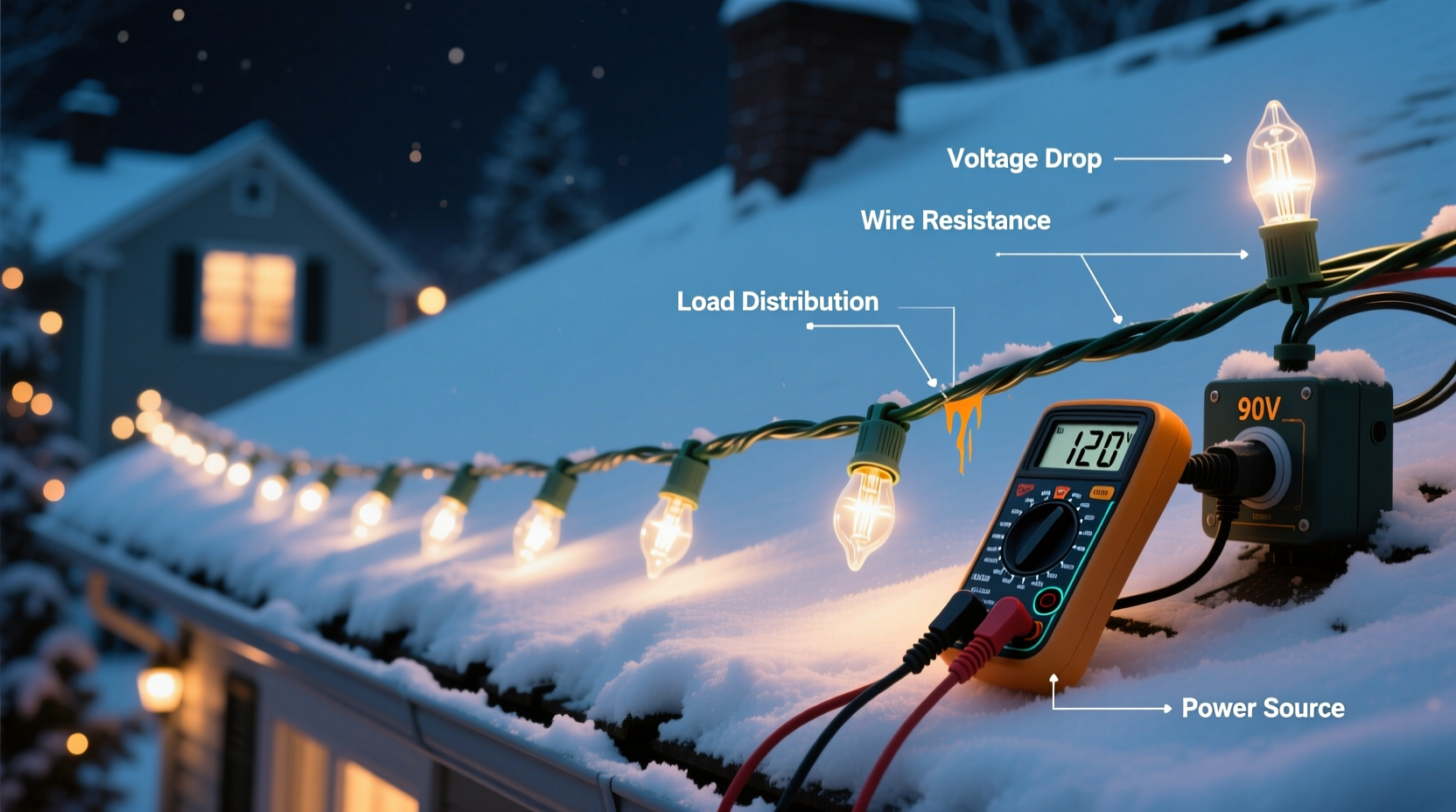
Voltage drop occurs when electrical current travels through a conductor—like the copper wire inside a light strand—and loses some energy due to resistance. The longer the wire or the more devices (lights) drawing power along it, the greater the loss. In practical terms, this means the first few bulbs receive close to the full voltage (typically 120V AC in U.S. homes), but by the time electricity reaches the last few bulbs, the voltage has dropped significantly, causing them to glow faintly or not at all.
This is especially prevalent with incandescent mini-lights, which are more sensitive to voltage fluctuations than LEDs. However, even LED strings can exhibit dimming if overloaded or poorly designed. Most standard Christmas light sets are rated for a maximum number of connectable strands—often between three and six, depending on wattage and manufacturer specifications. Exceeding this limit increases the load on the circuit and accelerates voltage drop.
“Voltage drop isn’t just about brightness—it’s a sign of inefficiency that can lead to overheating and premature bulb failure.” — Mark Reynolds, Electrical Systems Technician
Common Causes of Dimming in Light Strings
Several factors contribute to dimming beyond simple chain length. Identifying the root cause is essential before attempting repairs or replacements.
- Excessive daisy-chaining: Connecting too many strands end-to-end exceeds the manufacturer’s safe limit and overloads the initial segment.
- Low-quality wiring: Thin gauge wires have higher resistance, increasing voltage loss over distance.
- Faulty sockets or corroded contacts: Poor connections increase resistance at individual points, mimicking or worsening voltage drop.
- Using extension cords improperly: Long or undersized extension cords between the outlet and the first light set add additional resistance.
- Mixed bulb types: Combining different wattages or technologies (e.g., LED and incandescent) creates uneven current draw and inconsistent brightness.
- Damaged or aged strands: Over time, insulation degrades, wires break internally, and solder joints weaken—especially in lights stored improperly.
Step-by-Step Guide to Diagnosing Voltage Drop
If your lights are dimming toward the end, follow this systematic approach to identify and resolve the issue.
- Unplug all light strings immediately. Safety comes first. Never troubleshoot live circuits without proper training.
- Inspect each strand visually. Look for cracked sockets, frayed wires, darkened bulbs, or signs of melting near plug bases.
- Test individual strands separately. Plug one string into a known-working outlet. If it glows evenly, the problem likely stems from daisy-chaining. If it still dims, the strand itself may be defective.
- Measure voltage at key points (optional). Using a multimeter, test voltage at the input plug, midpoint, and far end of the chain. A drop of more than 5% (about 6 volts on a 120V circuit) indicates significant loss.
- Count connected strands. Compare the total number to the manufacturer’s maximum rating. If exceeded, reduce the chain length.
- Replace suspect components. Swap out older strands, damaged connectors, or mismatched bulbs.
- Rewire long runs using parallel connections. Instead of chaining everything in series, use a central power hub with multiple short runs branching out independently.
Do’s and Don’ts: Managing Voltage Drop Effectively
| Action | Recommendation | Reason |
|---|---|---|
| Use heavy-duty extension cords | ✅ Do | Reduces resistance over long distances; prevents added voltage loss |
| Connect 10+ strands in series | ❌ Don’t | Exceeds safe load limits; causes severe dimming and overheating risk |
| Use LED lights instead of incandescent | ✅ Do | Lower wattage reduces overall current draw and minimizes voltage drop |
| Plug light strings into power strips with overload protection | ✅ Do | Helps manage load and provides surge protection |
| Mix old and new light strands | ❌ Don’t | Variations in resistance and efficiency create uneven lighting and stress |
| Run wires under rugs or through high-traffic areas | ❌ Don’t | Increase wear, risk damage, and compromise insulation integrity |
Real-World Example: A Homeowner’s Holiday Lighting Challenge
Consider Sarah, who decorates her two-story home every December with hundreds of mini-lights. One year, she noticed the top half of her roofline display was noticeably dimmer than the lower section. She had connected eight 50-light incandescent strands end-to-end, thinking the plug-and-play design meant it was safe.
After troubleshooting, she discovered that the manufacturer rated the lights for only four connectable strands. The excessive chain caused nearly 20 volts of drop by the final string. Additionally, her 50-foot extension cord was thin-gauge (18 AWG), contributing further loss. By switching to six shorter LED strands powered from two separate outlets and using a 14 AWG extension cord, she restored full brightness and reduced energy consumption by 70%.
Sarah’s experience illustrates how easily voltage drop can occur—even among experienced decorators—and how small changes make a dramatic difference.
Expert Tips for Preventing Future Dimming Issues
Prevention is always better than repair, especially when dealing with seasonal decorations used only once a year. Implement these best practices to avoid recurring problems.
- Limit chain length strictly. Stick to the manufacturer’s recommended number of connectable sets—even if they physically plug together.
- Choose LEDs whenever possible. They operate at lower currents, generate less heat, and are inherently more resistant to voltage drop effects.
- Use multiple circuits. Distribute your lighting across several wall outlets or GFCI-protected circuits to balance the load.
- Avoid coiling excess wire tightly. Heat buildup in bundled wires can degrade insulation and increase resistance over time.
- Store lights properly off-season. Wrap them around cardboard reels or use specialized light keepers to prevent kinks and wire fatigue.
“The most reliable Christmas displays aren’t the longest chains—they’re the ones built with electrical discipline and attention to detail.” — Laura Mendez, Residential Lighting Designer
FAQ: Common Questions About Dimming Christmas Lights
Can voltage drop be dangerous?
Yes. While mild dimming is mostly an inconvenience, severe voltage drop often accompanies overheating at connection points. This can melt plastic sockets, damage plugs, or—in extreme cases—increase fire risk, particularly with older incandescent sets. Consistently low voltage also stresses filaments, leading to early burnout.
Why do my LED lights dim even though they use less power?
Even LEDs are subject to voltage drop if chained excessively or paired with incompatible controllers or transformers. Some cheaper LED strings use internal resistors that drop voltage intentionally, compounding the effect over long runs. Also, poor-quality rectifiers in non-shunted sockets can cause flickering or partial illumination.
Is there a way to boost voltage in existing light strings?
There is no safe consumer-level method to “boost” voltage within a light string. Adding external amplifiers or transformers introduces shock and fire risks. The correct solution is to reconfigure the layout—use shorter runs, higher-quality cords, or multiple power sources rather than trying to force electricity further down a single path.
Checklist: Fixing and Preventing Dimming in Your Light Display
Follow this actionable checklist before and during installation to ensure bright, even lighting:
- ☐ Verify the maximum connectable number on each light package
- ☐ Replace any worn, cracked, or discolored light strands
- ☐ Use only UL-listed extension cords rated for outdoor use (if applicable)
- ☐ Limit daisy-chained strings to manufacturer specifications
- ☐ Test each strand individually before final installation
- ☐ Power long runs from multiple outlets instead of one source
- ☐ Choose LED lights for longer runs and complex displays
- ☐ Inspect all plugs and connectors for tight fit and corrosion
- ☐ Avoid running cords under snow, water, or heavy foot traffic
- ☐ Store lights properly after the season to maintain wire integrity
Conclusion: Brighter Displays Start with Smarter Wiring
Dimming Christmas light strands aren’t just a nuisance—they’re a symptom of electrical strain that can compromise both aesthetics and safety. Voltage drop is predictable and manageable once you understand its causes. By respecting manufacturer limits, choosing efficient LED technology, and distributing loads wisely across multiple circuits, you can achieve a uniform, vibrant display that lasts throughout the season—and for years to come.
The holidays should be about joy, not troubleshooting flickering lights. Take the time now to audit your current setup, replace outdated or overloaded strands, and plan smarter for next year. A little electrical awareness goes a long way in making your home the brightest—and safest—one on the block.




 浙公网安备
33010002000092号
浙公网安备
33010002000092号 浙B2-20120091-4
Comments
No comments yet. Why don't you start the discussion?