
If you’ve ever tried to share a photo during a FaceTime call only to find the option grayed out or missing entirely, you’re not alone. The ability to send photos directly within a FaceTime conversation is one of its most convenient features—especially for families, friends, and remote collaborators. When it stops working, it disrupts communication and raises frustration. The good news: in most cases, this issue is fixable with the right steps. Whether it’s a settings misconfiguration, software glitch, or compatibility problem, understanding the root cause is the first step toward resolution.
Understanding FaceTime Photo Sharing
Introduced with iOS 15, FaceTime’s SharePlay feature allows users to share photos, music, and even screen time during a video or audio call. Photo sharing works seamlessly when both parties are using compatible devices and have enabled the necessary permissions. However, if the photo icon doesn’t appear during a call or appears dimmed, the functionality is effectively disabled—even if everything seems normal otherwise.
This feature relies on several underlying systems: iCloud syncing, network connectivity, app permissions, and up-to-date operating systems. A failure in any of these areas can interrupt photo sharing. It's important to recognize that FaceTime photo sharing isn't just about the app itself—it’s an ecosystem-dependent function that requires harmony across multiple services.
“FaceTime’s integration with iCloud and SharePlay means photo sharing depends on more than just the FaceTime toggle. Users often overlook background services that must be active.” — Jordan Lee, Apple Support Specialist
Common Causes of Disabled FaceTime Photos
Before jumping into solutions, identify what might be causing the issue. Here are the most frequent culprits:
- Incompatible Devices or OS Versions: Older iPhones or iPads running iOS versions below 15 cannot support SharePlay-based photo sharing.
- SharePlay Disabled: This feature must be enabled in Settings; some users disable it unknowingly.
- iCloud Sync Issues: If Photos aren’t syncing properly via iCloud, the system may block sharing during calls.
- Network Instability: Poor Wi-Fi or cellular signal prevents real-time media transfer.
- Do Not Disturb or Focus Modes: These can restrict background activities including SharePlay.
- Incorrect Permissions: The FaceTime app may lack access to your photo library.
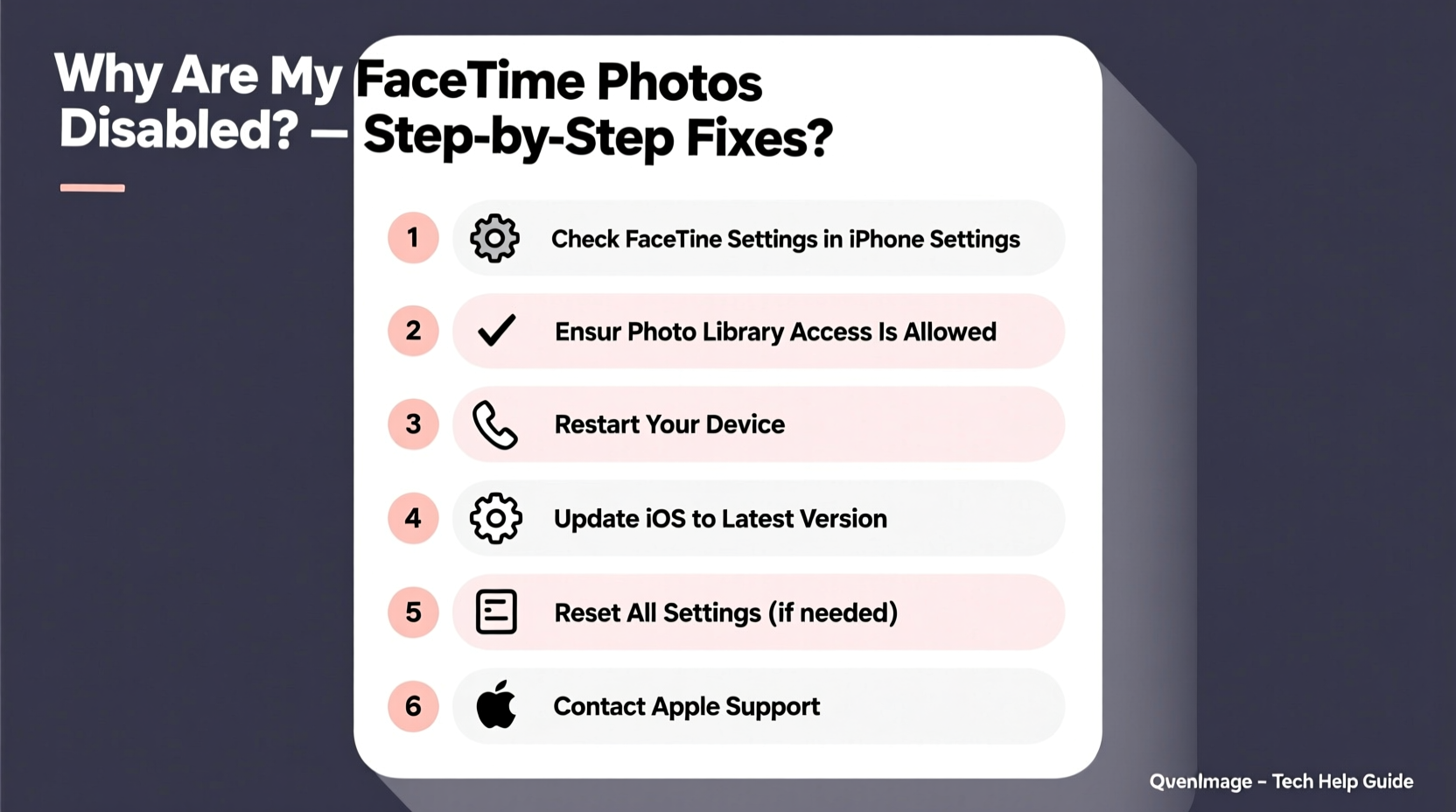
Step-by-Step Troubleshooting Guide
Follow this structured approach to systematically eliminate potential issues. Start from the basics and work toward deeper diagnostics.
- Verify Device Compatibility: Ensure both devices run iOS 15 or later (iPhone 6s and newer) or iPadOS 15+. Go to Settings > General > Software Update.
- Enable SharePlay: Navigate to Settings > FaceTime and confirm “SharePlay during FaceTime” is toggled on.
- Check iCloud Photos: Open Settings > [Your Name] > iCloud > Photos and make sure “iCloud Photos” is enabled. Without this, local-only photos may not be accessible during shared experiences.
- Grant Photo Access to FaceTime: Go to Settings > Privacy & Security > Photos, find FaceTime, and set access to “Selected Photos” or “All Photos.”
- Restart the Device: A simple reboot clears temporary glitches affecting SharePlay functionality.
- Toggle Airplane Mode: Turn on Airplane Mode for 10 seconds, then disable it. This resets network interfaces and can resolve connection hiccups.
- Sign Out and Back Into iCloud: In rare cases, corrupted iCloud tokens prevent synchronization. Sign out at Settings > [Your Name], then sign back in.
- Test with Another Contact: Initiate a FaceTime call with someone else to rule out recipient-side limitations.
Advanced Fixes for Persistent Problems
If standard steps fail, consider these deeper interventions:
- Reset Network Settings: Found under Settings > General > Transfer or Reset iPhone > Reset > Reset Network Settings. Note: This erases saved Wi-Fi passwords.
- Disable Low Data Mode: During a FaceTime call, swipe down to reveal controls and ensure Low Data Mode is off. This setting throttles bandwidth-heavy features like photo sharing.
- Reinstall FaceTime (Indirectly): While you can’t delete FaceTime, resetting all settings (Settings > General > Reset > Reset All Settings) restores default configurations without data loss.
Troubleshooting Checklist
- ✅ Both devices on iOS/iPadOS 15 or later
- ✅ FaceTime and iCloud Photos enabled
- ✅ SharePlay allowed in FaceTime settings
- ✅ FaceTime has permission to access Photos
- ✅ Stable internet connection (Wi-Fi recommended)
- ✅ No active Focus modes blocking interruptions
- ✅ Restarted device after making changes
Do’s and Don’ts of FaceTime Photo Sharing
| Do | Don’t |
|---|---|
| Use Wi-Fi instead of cellular data for smoother sharing | Assume the other person sees the same options—you may have different OS versions |
| Keep iCloud Photos turned on for full library access | Ignore error messages like “Waiting for connection” without checking network status |
| Update devices regularly to maintain compatibility | Disable Background App Refresh for FaceTime or Photos |
| Test sharing with multiple contacts to isolate the issue | Force close FaceTime repeatedly—this doesn’t help SharePlay performance |
Real Example: Resolving a Family Call Issue
Sarah noticed she couldn’t share vacation photos during a group FaceTime call with her parents. Her mother saw the photo icon but couldn’t open them; her father didn’t see the option at all. After testing, Sarah realized her dad was still on iOS 14. She helped him update his iPhone SE to iOS 16. Then, she checked her own settings and found that “SharePlay during FaceTime” had been disabled after a recent iOS update. Once re-enabled and after restarting both devices, photo sharing worked flawlessly. The key was isolating variables: outdated software on one end, and a hidden setting on the other.
Frequently Asked Questions
Can I share photos on FaceTime if the other person is on Android?
No. SharePlay and in-call photo sharing are exclusive to Apple devices running iOS 15 or later, iPadOS, or macOS Monterey and above. Android users joining via link (introduced in later updates) cannot participate in shared experiences like photo viewing.
Why does the photo button disappear mid-call?
This typically happens due to network instability or if one participant enables Low Data Mode. It can also occur if the receiving device runs low on memory or background processing limits kick in. Try reconnecting or reducing multitasking on the affected device.
Are there limits to how many photos I can share?
Apple doesn’t specify a hard limit, but performance degrades with large batches. For best results, share 5–10 photos at a time. Extremely high-resolution images (like ProRAW) may take longer to load or fail to transfer over slower connections.
Conclusion
FaceTime photo sharing enhances personal connection by letting you show memories in real time. When disabled, it’s usually due to correctable settings or minor software hiccups—not permanent flaws. By methodically verifying compatibility, permissions, and connectivity, most users can restore full functionality within minutes. The process underscores a broader truth about Apple’s ecosystem: seamless experiences depend on synchronized settings across devices and accounts.




 浙公网安备
33010002000092号
浙公网安备
33010002000092号 浙B2-20120091-4
Comments
No comments yet. Why don't you start the discussion?