
Many people notice their wrists appear disproportionately narrow compared to the rest of their body—especially when building muscle in the arms or shoulders. While small wrists aren’t a health concern, they can affect how clothing fits, influence perceived strength, or impact performance in certain sports. Understanding the underlying causes and knowing what actions are effective (and which aren’t) can help you make informed decisions about your fitness and self-image.
Anatomical and Genetic Factors
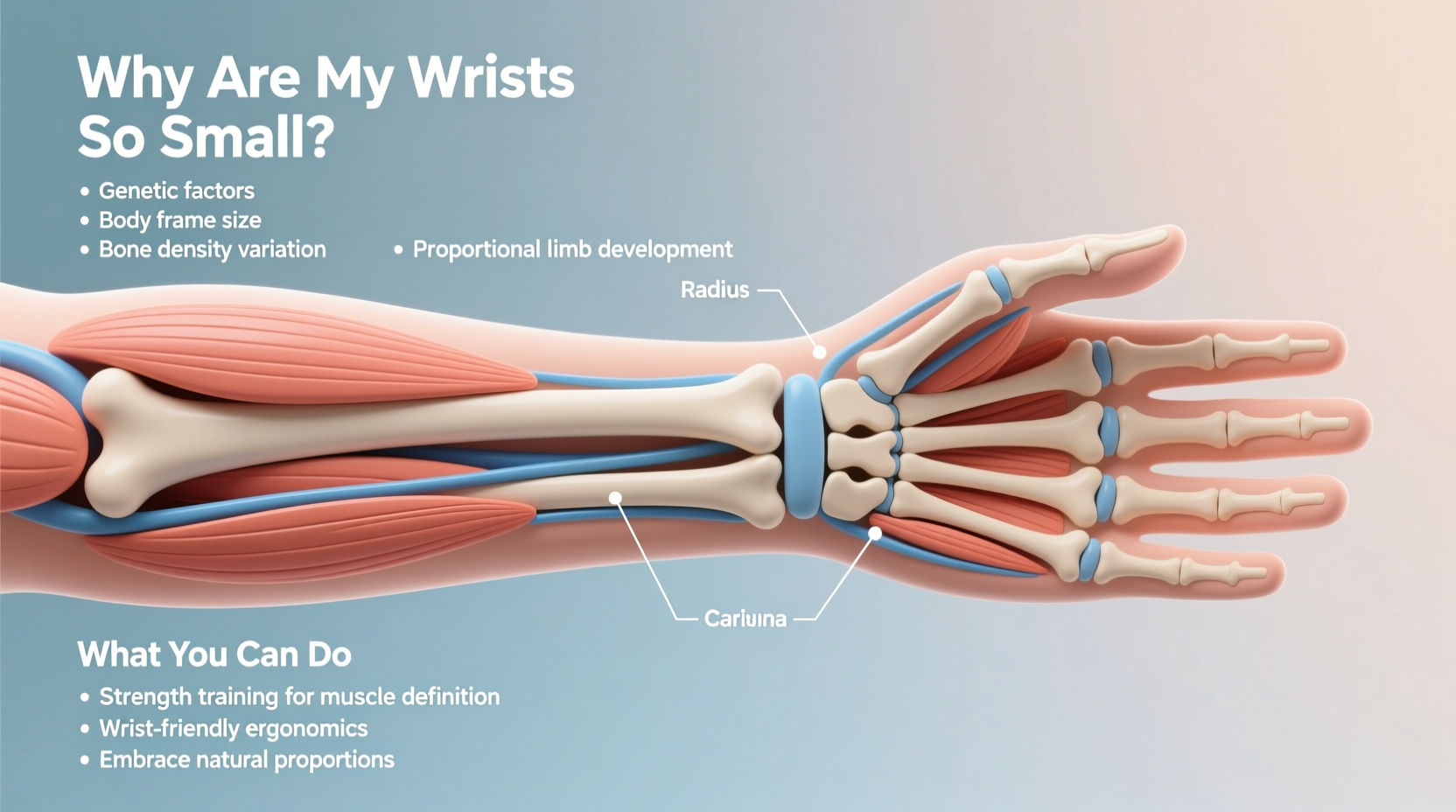
The size of your wrists is largely determined by bone structure, specifically the width of the radius and ulna—the two long bones in the forearm—and the joint at the wrist itself. These skeletal dimensions are primarily influenced by genetics. If your parents or close relatives have slender frames or narrow joints, it’s highly likely you’ve inherited similar proportions.
Wrist size also correlates with overall body frame type. Individuals with ectomorph body types—characterized by lean builds, narrow shoulders, and thinner limbs—often have smaller wrists. This isn't a flaw; it's simply a natural variation in human anatomy. Bone density and growth plate development during adolescence further solidify wrist dimensions early in life, making significant changes later on biologically limited.
“Bone structure is one of the most fixed aspects of physique. While you can build muscle around joints, you can't alter the actual bone width.” — Dr. Lena Peterson, Sports Medicine Physician
Nutrition and Growth Considerations
Nutrition plays a critical role during developmental years. Poor diet during childhood and adolescence can impair bone growth and density, potentially leading to smaller joint structures. Key nutrients like calcium, vitamin D, protein, and magnesium are essential for proper skeletal development. Chronic deficiencies in these areas may contribute to underdeveloped bone mass, including in the wrists.
However, once growth plates close—typically by age 18–25—bone length and width stabilize. After this point, increasing wrist size through nutrition alone is not possible. That said, maintaining strong bones through adequate nutrition remains important for joint health and injury prevention, especially if engaging in resistance training.
Can You Actually Make Your Wrists Bigger?
You cannot increase the diameter of your wrist bones after maturity. However, you *can* enhance the appearance and functional strength of your wrists by developing the surrounding muscles—primarily the forearm flexors and extensors. Though these muscles don’t wrap directly around the wrist joint, increased forearm girth creates a visual taper that makes the wrist seem less narrow in comparison.
Some individuals mistakenly believe wrist curls or grippers will dramatically widen the wrist area. In reality, forearm muscles insert near the hand and lower forearm, so gains appear more in the forearm than at the wrist itself. Still, consistent training can lead to noticeable improvements in grip strength and forearm definition, contributing to a more balanced arm profile.
Effective Exercises for Forearm and Wrist Strength
- Reverse Barbell Curls – Targets the brachioradialis and forearm extensors.
- Finger Extensions with Resistance Bands – Builds extensor strength and balance.
- Farmer’s Carries – Enhances grip endurance and engages all major forearm muscles.
- Towel Pull-Ups – Increases grip demand and activates wrist stabilizers.
- Deadlifts (without straps) – Forces the forearms and wrists to work hard under load.
| Exercise | Muscles Targeted | Frequency Recommendation |
|---|---|---|
| Reverse Curls | Forearm extensors, brachioradialis | 2–3 times/week |
| Farmers Walk | Grip, wrist stabilizers, forearms | 2 times/week |
| Wrist Roller | Flexors and extensors (dynamic) | 1–2 times/week |
| Hanging from Bar | Passive grip and wrist endurance | Daily (30–60 sec) |
Realistic Expectations and Common Misconceptions
A common misconception is that wrist size reflects weakness. In fact, many elite athletes—from rock climbers to Olympic weightlifters—have relatively small wrists but possess extraordinary grip and forearm strength. The key is function over form. A smaller wrist doesn’t limit potential; it simply defines proportion.
Another myth is that wrist wraps or compression sleeves can \"reshape\" the wrist over time. These tools offer support during heavy lifting but do not alter bone or muscle structure. Similarly, topical creams or supplements marketed for \"joint enlargement\" lack scientific backing.
Mini Case Study: Alex’s Journey to Stronger Wrists
Alex, a 26-year-old software developer, felt self-conscious about his narrow wrists despite gaining 15 pounds of muscle in his upper body. His t-shirts hung loosely at the cuff, and he struggled with barbell stability during lifts. He began incorporating farmer’s carries, deadlifts without straps, and reverse curls into his routine three times per week. Within five months, his grip strength improved by 40%, and his forearms measured nearly half an inch larger. While his wrist bones didn’t change, the enhanced forearm-to-wrist ratio created a more proportional look. More importantly, he reported greater confidence and control during workouts.
Checklist: What You Can Do About Small Wrists
- ✅ Assess your body frame type—accept that some traits are genetically set.
- ✅ Train forearm muscles 2–3 times weekly using compound and isolation moves.
- ✅ Avoid overtraining wrists; tendons heal slower than muscles.
- ✅ Use grip-intensive exercises like deadlifts and pull-ups to stimulate growth.
- ✅ Wear well-fitted shirts or cuffs to create visual balance if aesthetics matter.
- ✅ Consult a trainer or physiotherapist if experiencing pain or instability.
Frequently Asked Questions
Can wrist size be increased naturally after puberty?
No, the actual bone width of the wrist cannot increase after growth plates close. However, building forearm muscle can improve the visual proportion between the forearm and wrist, creating the appearance of a thicker wrist.
Do small wrists affect lifting capacity?
Not necessarily. Many powerlifters and strongmen have relatively small wrists but generate tremendous force through strong tendons, ligaments, and technique. Wrist size does not determine strength potential.
Are there risks in training small wrists too hard?
Yes. Overloading the wrists without proper progression can lead to tendonitis, especially in exercises like wrist curls or heavy grip work. Always prioritize form, gradual loading, and adequate recovery.
Final Thoughts and Action Steps
Small wrists are a normal variation in human anatomy, not a deficiency. They result from genetics, body type, and early developmental factors—all of which are beyond your control. But while you can’t change your bone structure, you can strengthen the surrounding musculature, improve joint resilience, and shift focus from appearance to performance.
If wrist size affects your confidence, consider reframing the narrative: narrow wrists often correlate with longer levers, which can be advantageous in sports like swimming or gymnastics. In strength training, they may even allow greater range of motion and muscle stretch.
“Strength isn’t measured by joint size—it’s measured by what you can do with what you have.” — Marcus Reed, Certified Strength Coach




 浙公网安备
33010002000092号
浙公网安备
33010002000092号 浙B2-20120091-4
Comments
No comments yet. Why don't you start the discussion?