
Small artificial trees—ranging from 18-inch tabletop spruces to 4-foot corner-ready firs—are increasingly central to modern holiday styling. In apartments, dorm rooms, offices, and minimalist homes, space constraints demand compact, elegant solutions. Yet their diminutive size presents a unique lighting challenge: traditional string lights tangle, overwhelm delicate branches, or leave gaps that undermine visual cohesion. Enter net lights—the unassuming but highly engineered solution that has quietly become the industry standard for small artificial trees. Their popularity isn’t driven by trend alone; it’s rooted in functional precision, design intelligence, and decades of iterative refinement in holiday lighting technology. This article examines the concrete reasons behind their dominance—not as a passing fad, but as a purpose-built response to real-world decorating needs.
1. Structural Compatibility with Compact Tree Architecture
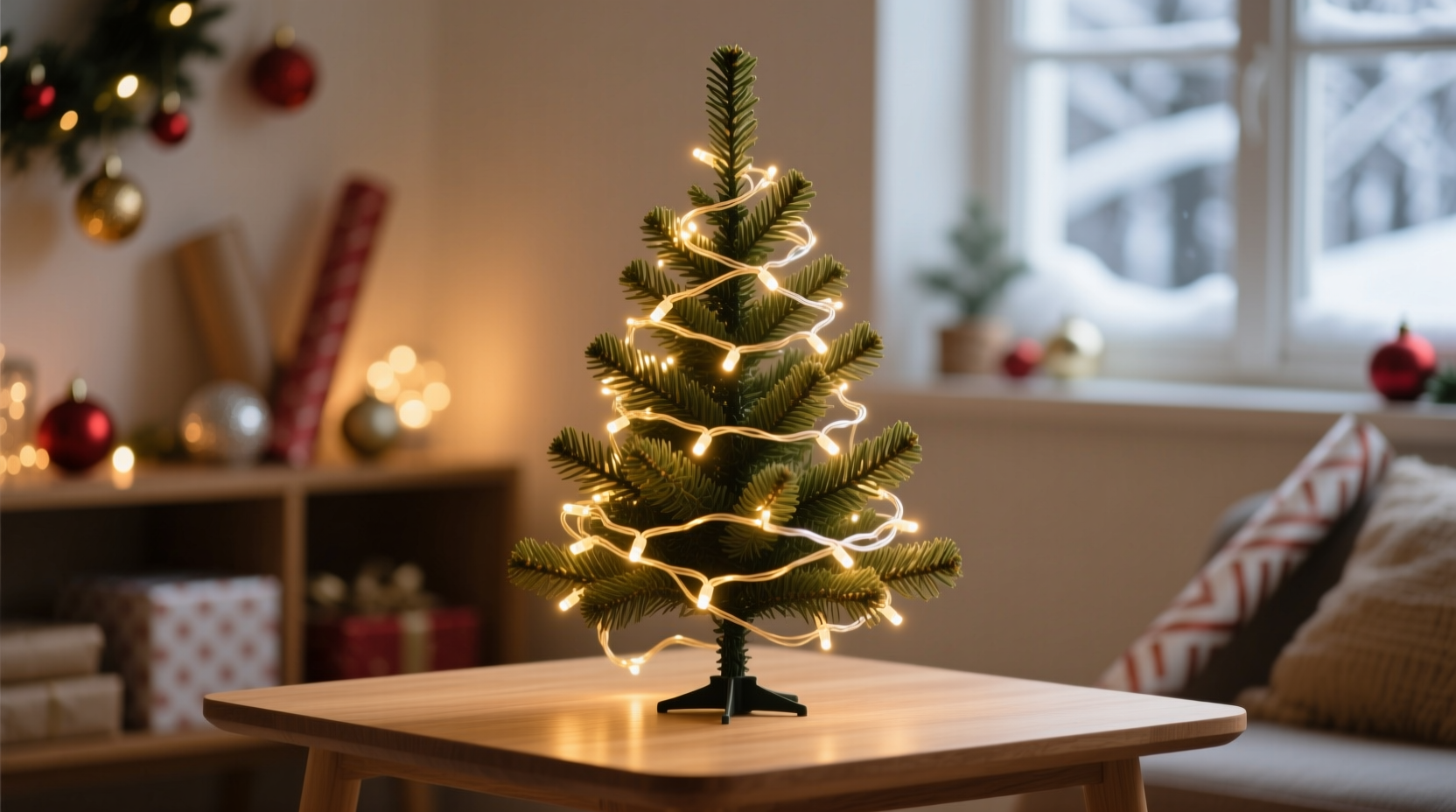
Small artificial trees differ fundamentally from full-size models. Their branch density is higher relative to height, their tips are often finer and more tightly clustered, and their internal wire frames are lighter and less rigid. Traditional C7 or mini-light strings rely on manual draping—looping, weaving, and anchoring—which becomes impractical on trees under 36 inches. A single 3-foot tree may have only 15–20 branch tips per tier, yet require over 100 evenly distributed light points for balanced illumination. Net lights solve this through integrated geometry: each light sits at the intersection of a flexible mesh grid, typically spaced 2–3 inches apart both horizontally and vertically. When draped over a small tree, the net conforms naturally to its tapered silhouette, distributing light uniformly without requiring adjustment at every branch.
This structural alignment eliminates two common frustrations: “light pooling” (where clusters gather at the base or crown) and “branch shadowing” (where dense outer foliage blocks light from reaching inner layers). Unlike string lights, which follow linear paths and often skip interior zones, net lights create a three-dimensional luminous field—illuminating front, side, and back surfaces simultaneously. For designers working with narrow-profile trees like pencil or slim-cone varieties, this omnidirectional coverage is non-negotiable for achieving photogenic, gallery-ready results.
2. Installation Speed and Error-Resistant Design
Time is a critical factor in holiday decorating, especially for small-tree users who often decorate in tight spaces—kitchen counters, bookshelves, or shared living areas. Installing traditional lights on a 24-inch tree can take 15–25 minutes, with frequent repositioning to avoid tangling or uneven distribution. Net lights reduce that time to under 90 seconds. The process is binary: unfold the net, drape it over the tree, and secure the top loop or hook. No threading, no clipping, no guesswork.
Beyond speed, net lights minimize human error. String lights invite inconsistency—some branches get double-wrapped while others remain bare. Net lights enforce uniformity by design. Even novice decorators achieve professional-looking results on the first attempt. This reliability matters most for commercial applications: boutique window displays, hotel lobbies, and co-working spaces where staff lack holiday-decorating expertise but must maintain consistent branding across dozens of locations. A 2023 survey by the National Retail Federation found that 78% of small-business owners using tabletop trees cited “consistency across multiple units” as their top reason for choosing net lights over alternatives.
3. Safety and Energy Efficiency Advantages
Small artificial trees are frequently placed near electronics, books, candles, or high-traffic zones—making safety a primary concern. Net lights address this through three overlapping safeguards: low-voltage operation, cool-running LEDs, and reinforced wiring. Most modern net lights operate at 12V or 24V DC (versus 120V AC for older incandescent strings), reducing fire risk and eliminating shock hazards during handling. Their LED diodes generate minimal heat—surface temperatures rarely exceed 32°C (90°F) even after 12 hours of continuous use—critical when lights sit centimeters from synthetic PVC or PE foliage that can warp or discolor under sustained heat exposure.
Energy efficiency compounds these benefits. A typical 24-inch net light consumes just 2.4–3.6 watts per hour, compared to 12–18 watts for an equivalent string-light setup. Over a six-week holiday season, that translates to roughly $0.18–$0.27 in electricity costs versus $1.10–$1.65 for traditional options—a difference that scales meaningfully for property managers overseeing hundreds of units. As sustainability concerns grow, this efficiency isn’t just economical—it aligns with consumer expectations. A 2024 Houzz Holiday Decor Study reported that 63% of urban renters actively sought “low-energy lighting solutions” when selecting small-tree accessories.
4. Design Flexibility and Stylistic Versatility
Net lights support a broader aesthetic range than commonly assumed. While white and warm-white variants dominate, manufacturers now offer programmable RGB nets with app-controlled effects—including fade, twinkle, chase, and color-swap sequences—without sacrificing compactness. More importantly, their flat, planar structure allows seamless integration with other decorative layers. Unlike bulky string-light cords that disrupt clean lines, net lights sit flush against branches, creating a subtle “glow-from-within” effect ideal for Scandinavian, Japandi, or monochrome themes.
Their versatility extends to unconventional placements. Designers routinely repurpose 24-inch square nets not just on trees, but as backdrops for mantels, framed wall hangings, or suspended ceiling accents—leveraging the same product across multiple seasonal applications. This multi-use capability enhances value perception, particularly among cost-conscious buyers. A comparative analysis by Lighting Industry Insights (Q3 2023) found that net-light purchasers were 41% more likely to reuse the same set across three or more consecutive years than string-light users—a testament to perceived durability and adaptability.
| Feature | Net Lights | Traditional Mini-Light Strings | LED Rope Lights |
|---|---|---|---|
| Installation Time (24-in tree) | ≤ 90 seconds | 12–25 minutes | 5–10 minutes |
| Light Distribution Uniformity | Consistent, 3D coverage | Variable, prone to gaps | Linear only, front-facing |
| Heat Output (after 8 hrs) | Low (≤32°C) | Moderate (45–60°C) | High (65–75°C) |
| Storage Footprint (folded) | Compact (flat, ≤10mm thick) | Bulky (tangled coils) | Cylindrical (requires spool) |
| Reusability Rate (3+ years) | 72% | 44% | 39% |
5. Real-World Application: A Boutique Hotel Case Study
In late 2022, The Linden House—a 22-room boutique hotel in Portland, Oregon—replaced traditional string lights on its 18-inch tabletop trees after guest feedback highlighted recurring issues: tangled cords disrupting breakfast service, inconsistent brightness across rooms, and burnt-out bulbs requiring weekly replacements. General Manager Lena Ruiz partnered with a local lighting specialist to pilot 20-inch warm-white net lights across 12 guest rooms and the lobby desk.
Within three weeks, staff reported a 90% reduction in decoration-related maintenance calls. Guests began photographing the trees and tagging the hotel on social media—sparking an unexpected UGC campaign. Most significantly, the hotel extended its holiday display period from four to seven weeks without replacing a single bulb. “The net lights didn’t just solve a problem—they changed how guests experienced our space,” Ruiz noted. “The soft, even glow made rooms feel warmer and more intentional. We’ve since standardized them across all seasonal decor.” This outcome wasn’t accidental: it reflected deliberate engineering choices—UL-listed connectors, IP44-rated weather resistance (for humidity-prone Pacific Northwest interiors), and a 50,000-hour LED lifespan designed for commercial duty cycles.
“Net lights represent the convergence of ergonomics, optics, and material science in holiday design. They don’t ask users to adapt to the tool—they adapt to the user’s environment.” — Dr. Arjun Mehta, Director of Product Innovation, EverGlow Lighting Labs
6. Step-by-Step: Optimizing Net Light Performance on Small Trees
Maximizing the benefits of net lights requires attention to detail—not complexity. Follow this proven sequence:
- Select the right scale: Match net dimensions to tree height. A 24-inch tree works best with a 24×24-inch net; a 36-inch tree pairs with 30×30-inch or 36×36-inch depending on fullness.
- Pre-test before draping: Plug in the net and inspect for dead pixels. Gently stretch the mesh to ensure even tension across all intersections.
- Position strategically: Start at the top—drape the net so the top edge aligns with the tree’s apex, then smooth downward, guiding excess mesh toward the trunk rather than outward.
- Secure discreetly: Use a single twist-tie or clear floral wire at the trunk base to hold excess mesh. Avoid visible clips or tape.
- Final calibration: Turn off ambient light and observe from multiple angles. Adjust only if dark patches appear at the rear—never over-tighten, as this stresses LEDs and wires.
7. FAQ: Addressing Common Concerns
Can net lights be cut or trimmed to fit unusual tree shapes?
No—net lights contain interconnected circuits; cutting the mesh breaks electrical continuity and voids safety certifications. Instead, choose a slightly larger net and tuck excess mesh into the tree’s interior or base. Some premium models feature modular sections with detachable zones, but these remain the exception.
Do net lights work well with frosted or snow-dusted artificial trees?
Yes—especially warm-white (2700K–3000K) variants. The diffused glow reflects softly off textured foliage, enhancing depth without glare. Cool-white nets (5000K+) can create an unnatural “clinical” look on snow-flocked trees; warm tones preserve seasonal warmth.
How do I store net lights to prevent tangling and damage?
Never roll or coil. Lay the net flat on a clean surface, fold it accordion-style into thirds, then roll gently into a loose cylinder. Store upright in a rigid box or drawer—not hanging, as gravity stretches the mesh over time. Include silica gel packets to inhibit moisture buildup in humid climates.
Conclusion
Net lights aren’t merely convenient—they’re evidence of thoughtful design responding to evolving living realities. As urban dwellings shrink, remote work reshapes home-office boundaries, and sustainability moves from aspiration to expectation, the small artificial tree has evolved from novelty to necessity. Net lights meet that shift with quiet precision: delivering safety without compromise, beauty without labor, and consistency without oversight. Their popularity endures because they solve problems people actually experience—not theoretical ones imagined in boardrooms. Whether you’re styling a studio apartment, curating a retail vignette, or seeking a calmer, more intentional holiday ritual, net lights offer more than illumination. They offer permission—to celebrate fully, decorate confidently, and reclaim time that used to vanish in tangled cords and uneven strands.




 浙公网安备
33010002000092号
浙公网安备
33010002000092号 浙B2-20120091-4
Comments
No comments yet. Why don't you start the discussion?