
Among the vast diversity of marine life, few creatures captivate the imagination like the octopus. With eight writhing arms, eyes that seem to study you with quiet intent, and an uncanny ability to vanish into their surroundings, octopuses are more than just mysterious—they’re remarkably intelligent. Scientists have long puzzled over how a creature so evolutionarily distant from humans can exhibit behaviors that rival those of primates. From escaping enclosures to using tools and solving complex puzzles, octopuses challenge our understanding of what intelligence really means.
Their cognitive abilities aren’t just quirks of nature; they’re the product of millions of years of adaptation in complex environments. Unlike most invertebrates, octopuses possess large brains relative to their body size, sophisticated nervous systems, and a capacity for learning that defies conventional expectations. This article explores the biological, behavioral, and evolutionary foundations of octopus intelligence, revealing why these cephalopods stand out as some of the most intelligent animals on Earth—despite having no bones, no centralized parental care, and lifespans often shorter than two years.
The Evolutionary Roots of Octopus Intelligence
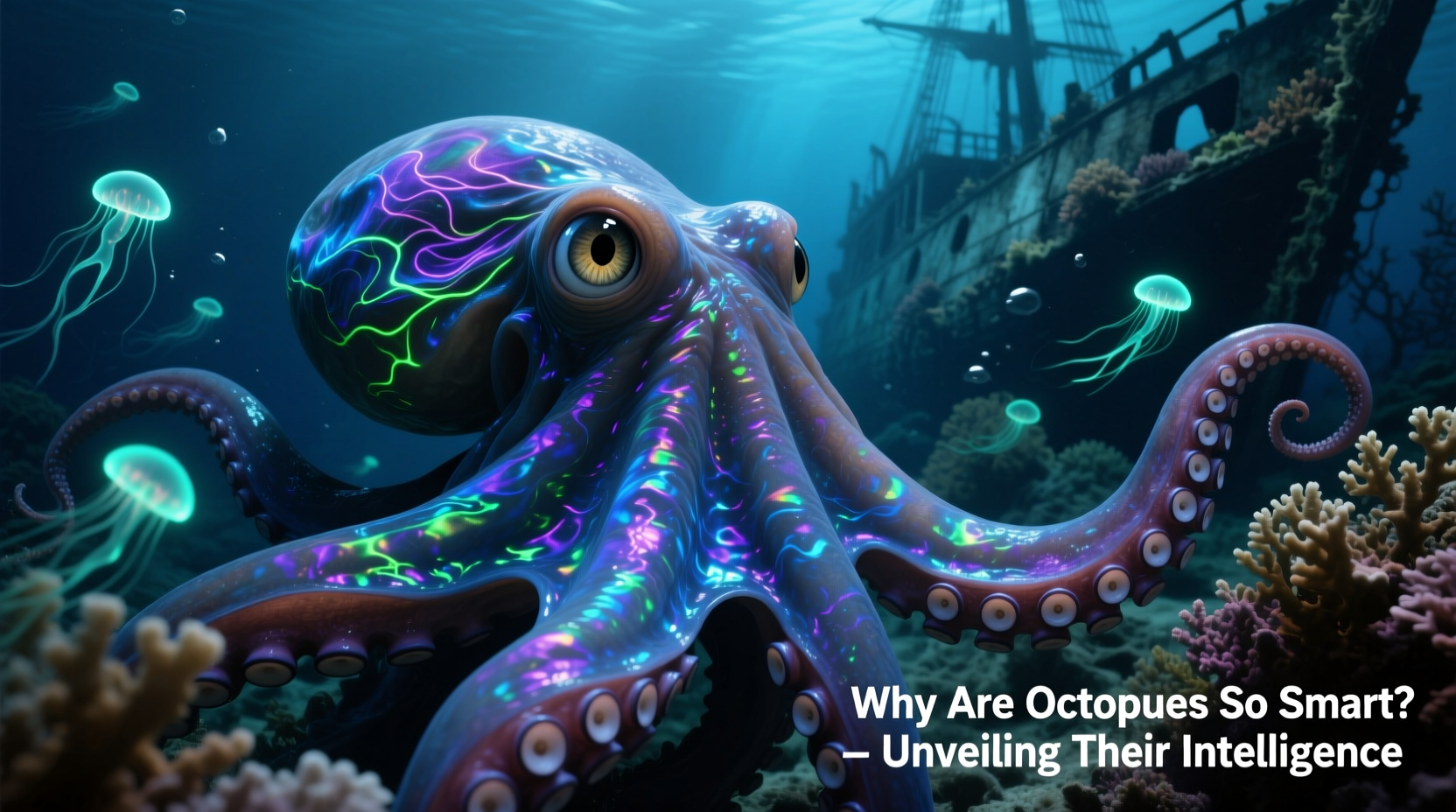
Octopuses belong to the class Cephalopoda, which includes squid and cuttlefish. Their lineage diverged from vertebrates over 500 million years ago, meaning any similarities in intelligence evolved independently—a phenomenon known as convergent evolution. While mammals developed intelligence through social structures and extended learning periods, octopuses evolved smarts under entirely different pressures: survival in dynamic ocean environments with abundant predators and limited physical defenses.
Without shells or armor, early cephalopods had to rely on agility, camouflage, and wits to survive. Natural selection favored individuals who could quickly assess threats, adapt behavior, and remember successful escape routes. Over time, this led to the development of a highly distributed nervous system—two-thirds of an octopus’s neurons are located not in its brain, but in its arms. This allows each arm to act semi-autonomously, processing sensory information and making decisions without waiting for signals from the central brain.
“Octopus intelligence evolved not for social cooperation, but for solitary survival in a dangerous world. It’s a completely different path to cognition—one that challenges our vertebrate-centric view.” — Dr. Jennifer Mather, Behavioral Psychologist and Cephalopod Researcher
Problem-Solving and Tool Use in Octopuses
In laboratory settings, octopuses consistently demonstrate advanced problem-solving skills. One well-documented experiment involved placing an octopus in a tank with a sealed jar containing a crab. After initial hesitation, many octopuses learned to unscrew the lid—some even remembered the technique days later. This shows not only dexterity but also insight learning, where an animal grasps a solution without trial and error.
Perhaps more astonishing is their use of tools in the wild. In Indonesia, researchers observed veined octopuses collecting discarded coconut shells, carrying them across the seafloor, and assembling them into protective shelters. This behavior requires foresight, planning, and recognition of future utility—traits once thought exclusive to humans and great apes.
Key Cognitive Abilities Observed in Octopuses
- Spatial memory: Navigating complex reef systems and returning to den sites.
- Observational learning: Some studies suggest octopuses can learn by watching others.
- Play behavior: Interacting with objects for non-survival purposes, indicating curiosity.
- Individual personalities: Some are bold explorers; others are cautious and reclusive.
Neurobiology Behind the Smarts
The octopus brain contains around 500 million neurons—comparable to dogs and significantly more than rats. But unlike vertebrates, their neural architecture is radically different. The central brain coordinates high-level functions, while each arm contains ganglia capable of independent action. This decentralized control enables multitasking: one arm can explore a crevice while another manipulates food, all while the body changes color to blend in.
Moreover, octopuses possess a form of short- and long-term memory. Experiments show they can be trained to distinguish shapes, colors, and even brightness levels, retaining this knowledge for weeks. Their learning is both associative (linking stimuli with outcomes) and operant (modifying behavior based on consequences).
| Cognitive Trait | Octopus Ability | Comparable To |
|---|---|---|
| Neuron Count | ~500 million | Dog |
| Tool Use | Coconut shell shelter construction | Chimpanzee |
| Learning Speed | Rapid acquisition of tasks | Parrot |
| Sensory Integration | Vision, touch, taste via skin | No direct vertebrate equivalent |
Mini Case Study: Inky the Escape Artist
In 2016, an octopus named Inky made international headlines after escaping from the National Aquarium of New Zealand. Living in a tank with a small drain opening near the top, Inky waited for a moment when staff left the lid slightly ajar. He climbed out, navigated across the floor, and slid down a three-foot-long drainpipe that emptied into the Pacific Ocean—successfully returning to the wild.
This wasn’t random chance. Inky’s escape required multiple cognitive steps: assessing the environment, identifying a route, timing his move during low supervision, and physically maneuvering his body through tight spaces. His story illustrates how octopuses combine spatial reasoning, memory, and motivation to achieve complex goals—often in ways humans underestimate.
How Scientists Study Octopus Intelligence
Studying octopus cognition presents unique challenges. They are sensitive to stress, short-lived, and difficult to keep in captivity without enrichment. Researchers use controlled experiments involving mazes, puzzle boxes, and choice tests to measure learning and memory. Ethical considerations are paramount, as growing evidence suggests cephalopods may experience pain and distress similarly to vertebrates.
- Design a task requiring manipulation or navigation.
- Train the octopus using rewards (typically food).
- Test retention after intervals of hours or days.
- Observe whether new strategies emerge over time.
- Compare performance across individuals to assess personality effects.
Checklist: Signs of Advanced Cognition in Octopuses
- ✅ Solves novel puzzles without prior exposure
- ✅ Uses objects as tools for future benefit
- ✅ Recognizes individual humans
- ✅ Displays play behavior with inanimate objects
- ✅ Escapes enclosures using multi-step planning
- ✅ Changes color and texture in response to specific threats
Frequently Asked Questions
Can octopuses recognize people?
Yes. Multiple studies and anecdotal reports from aquarium staff confirm that octopuses can distinguish between different humans, often responding differently to caregivers versus strangers—sometimes even squirting water at people they dislike.
Do octopuses have emotions?
While we can't confirm subjective feelings, octopuses display behaviors associated with emotional states—curiosity, frustration, fear, and preference. Their complex nervous system supports nuanced responses to stimuli, suggesting a level of sentience that demands ethical consideration.
Why don’t octopuses live longer if they’re so smart?
Most octopuses live only 1–2 years due to a built-in biological timer linked to reproduction. After mating, hormonal changes trigger rapid senescence. This limits long-term learning across generations, making their individual intelligence even more remarkable—each octopus must reinvent solutions within a single, brief lifetime.
Conclusion: Rethinking Intelligence Through the Octopus Lens
The intelligence of octopuses forces us to expand our definition of smarts beyond social hierarchies and long developmental periods. Here is an animal with no ancestral memory passed through culture, no parental guidance, and yet it can plan, innovate, and adapt with astonishing sophistication. Their minds evolved in isolation from ours, offering a glimpse into an alternative path to consciousness—one rooted in decentralization, sensory richness, and environmental mastery.
Understanding octopus intelligence doesn’t just satisfy scientific curiosity; it reshapes how we think about cognition itself. As research continues, these enigmatic creatures remind us that brilliance comes in many forms—even without a backbone.




 浙公网安备
33010002000092号
浙公网安备
33010002000092号 浙B2-20120091-4
Comments
No comments yet. Why don't you start the discussion?