
In recent years, a quiet but significant shift has taken place across parts of Asia: growing numbers of individuals and families are relocating from rural towns and less-developed regions—often symbolized by the generic term \"AskA,\" representing small or under-resourced communities—toward urban centers and more economically vibrant countries. This movement is not random; it reflects deep-rooted structural changes in labor markets, education access, climate pressures, and political climates. Understanding why people are leaving AskA requires examining the interplay of push and pull factors driving internal and cross-border migration throughout the continent.
Economic Disparities and Employment Opportunities
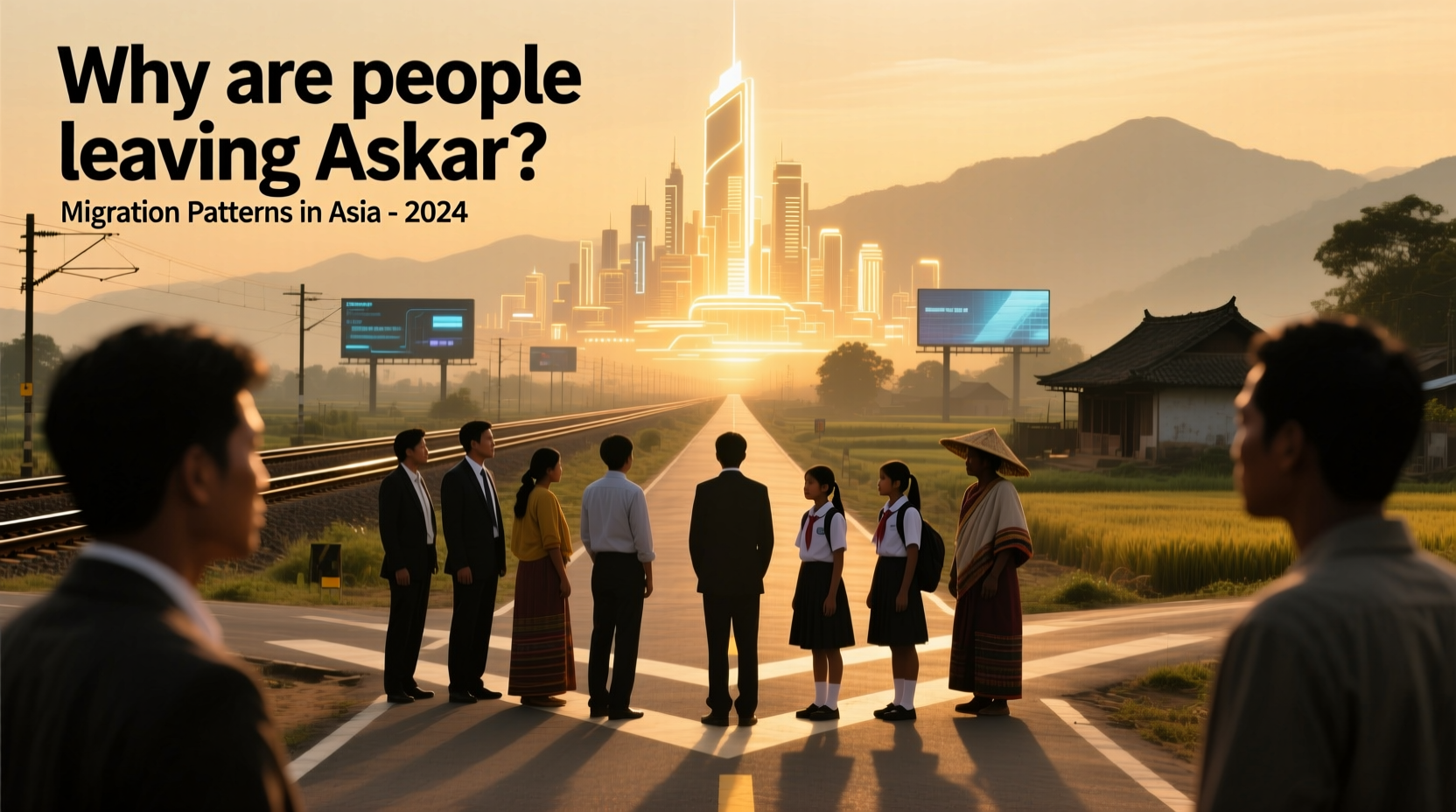
One of the most powerful drivers of migration in Asia is the stark contrast between rural poverty and urban prosperity. In many developing nations, rural areas like AskA suffer from limited infrastructure, irregular electricity, poor internet connectivity, and few formal job opportunities. Agriculture remains the primary livelihood, yet it is increasingly vulnerable to climate change, land degradation, and market volatility.
Meanwhile, cities such as Bangkok, Ho Chi Minh City, Kuala Lumpur, and Manila offer manufacturing jobs, service-sector employment, and growing digital economies. The promise of stable wages—even for low-skilled work—is enough to draw millions away from subsistence farming and informal labor.
A 2023 World Bank report found that internal migrants in Indonesia and the Philippines earn up to 60% more in urban areas than they did in their hometowns. While urban life presents its own challenges—overcrowding, high living costs, and insecure housing—the financial incentive remains compelling.
Education and Social Mobility
Access to quality education is another major factor pushing people out of places like AskA. Rural schools frequently lack qualified teachers, updated curricula, and basic facilities. Families with school-age children often relocate to cities or provincial capitals simply to ensure their children can attend better schools.
Higher education compounds this trend. Universities are concentrated in capital cities or special economic zones, forcing students—and sometimes entire families—to migrate temporarily or permanently. Once exposed to urban lifestyles, broader networks, and career pathways, young adults are less likely to return.
“Migration isn’t just about jobs—it’s about aspirations. When a child dreams of becoming an engineer or doctor, the nearest institution offering that future may be 500 kilometers away.” — Dr. Lin Mei Chen, Sociologist at National Taiwan University
Environmental Pressures and Climate Migration
Asia is the world’s most disaster-prone region, with frequent typhoons, floods, droughts, and rising sea levels. Communities in low-lying coastal areas, floodplains, and deforested hillsides—many of which resemble the hypothetical AskA—are on the front lines of climate-induced displacement.
In Bangladesh, for example, saltwater intrusion has rendered farmland unusable in southern districts, prompting mass migration toward Dhaka and Chittagong. In Vietnam’s Mekong Delta, farmers are abandoning rice paddies due to prolonged dry seasons and saline contamination. These environmental stressors don’t always trigger sudden evacuations but rather a slow, steady exodus over years.
| Country | Climate Stressor | Migration Pattern |
|---|---|---|
| Bangladesh | Rising sea levels, cyclones | Rural to urban (Dhaka, Khulna) |
| Philippines | Typhoons, landslides | Provincial towns to Metro Manila, Cebu |
| Mongolia | Dzud (severe winter), desertification | Herders moving to Ulaanbaatar |
| Indonesia | Coastal erosion, flooding | Outer islands to Java and Sumatra |
This form of migration is increasingly classified as “climate mobility”—not forced displacement, but a rational adaptation strategy to deteriorating environmental conditions.
Political Instability and Governance Gaps
In some regions, people leave AskA not because of what is happening to the land, but because of what is missing from governance. Weak rule of law, corruption, lack of public services, and ethnic marginalization drive both internal and international migration.
In Myanmar, for instance, conflict in Rakhine and Shan States has displaced hundreds of thousands. Many flee not only violence but also the collapse of healthcare and education systems. Some seek refuge in neighboring Thailand or India; others move internally to Yangon, hoping for stability.
Similarly, in parts of Papua (Indonesia) and Mindanao (Philippines), indigenous communities face land encroachment and militarization, prompting relocation to urban peripheries where, despite poverty, they gain greater anonymity and access to civil society organizations.
Mini Case Study: The Journey from AskA to Hanoi
Take the case of Mai Thi Lan, a 28-year-old woman from a mountainous village in northern Vietnam—what one might call a real-world AskA. With no paved roads and only a single teacher for grades 1–5, her family prioritized her education by sending her to live with relatives in Hanoi at age 14. She completed high school, trained as a nurse, and now works in a district hospital. Though she sends money home monthly, returning permanently is not an option—there’s no clinic, no secondary school, and no future for her children there.
Lan’s story mirrors that of millions. Her migration wasn’t caused by a single crisis but by a cumulative realization: opportunity exists elsewhere. Her decision reflects not rejection of her roots, but investment in a different kind of security.
Regional Labor Markets and Cross-Border Movement
Migration within Asia is not only rural-to-urban but increasingly international. Countries like Singapore, South Korea, and Japan face aging populations and labor shortages, particularly in construction, caregiving, and agriculture. They have opened regulated pathways for foreign workers—many of whom come from AskA-like towns in Indonesia, the Philippines, Nepal, and Cambodia.
For example, over 2 million Filipino overseas workers are employed abroad, with nearly half in Asia. Remittances account for more than 9% of the Philippines’ GDP. These flows sustain households back home but also create dependency, brain drain, and emotional tolls from long-term separation.
- Singapore employs over 250,000 domestic workers, primarily women from Indonesia and the Philippines.
- Malaysia hosts more than 2 million documented migrant workers in plantations and factories.
- South Korea’s Employment Permit System includes over 200,000 workers from Vietnam, Thailand, and Cambodia.
While these programs provide income, they often come with restrictions on rights, mobility, and family reunification—raising ethical questions about temporary labor versus permanent integration.
Checklist: Key Factors Influencing Migration from AskA
- Economic Opportunity: Is there stable, paid work available locally?
- Education Access: Can children complete secondary and tertiary education nearby?
- Environmental Safety: Is the area prone to flooding, drought, or land degradation?
- Healthcare Availability: Are clinics or hospitals accessible within a reasonable distance?
- Political Stability: Is there rule of law, freedom of expression, and protection from conflict?
- Infrastructure: Is there reliable electricity, clean water, and internet connectivity?
- Social Networks: Do friends or family members already live in potential destination areas?
FAQ
Is migration from rural areas inevitable?
While not inevitable, it is highly probable when development is uneven. Without targeted investment in rural infrastructure, education, and green jobs, migration will continue as a survival and advancement strategy.
Can technology reduce the need to leave AskA?
Potentially. Expanding broadband access enables remote work, e-learning, and telemedicine. However, without devices, digital literacy, and reliable power, technological solutions remain out of reach for many.
Are governments responding to these migration trends?
Some are. Vietnam has launched rural revitalization programs. India’s Smart Villages initiative aims to upgrade infrastructure. But progress is slow and often underfunded compared to urban development projects.
Conclusion: Rethinking AskA and the Future of Mobility
The exodus from places like AskA is not merely a demographic shift—it’s a signal. It reveals where systems are failing and where human potential is being constrained by geography. Migration is a natural response to inequality, but it should not be the only option for dignity and opportunity.
The challenge ahead is twofold: to improve conditions in neglected communities so people can thrive where they are, and to manage urban and cross-border flows humanely, ensuring migrants are protected, integrated, and empowered. Sustainable development must focus not just on megacities, but on the countless small towns and villages that form the fabric of Asian society.




 浙公网安备
33010002000092号
浙公网安备
33010002000092号 浙B2-20120091-4
Comments
No comments yet. Why don't you start the discussion?