
In an age of instant communication and widespread access to opinions, people remain one of the most frequently used—but often least reliable—sources of information. Whether it’s a colleague offering career advice, a friend recounting a news story, or a family member explaining a health remedy, we routinely accept claims based on trust rather than verification. While interpersonal exchange is essential for learning, it's critical to recognize that humans are inherently flawed conduits of truth. Cognitive biases, memory distortions, social pressures, and misinformation all contribute to why individuals often fail as accurate information sources.
The Psychology Behind Misinformation
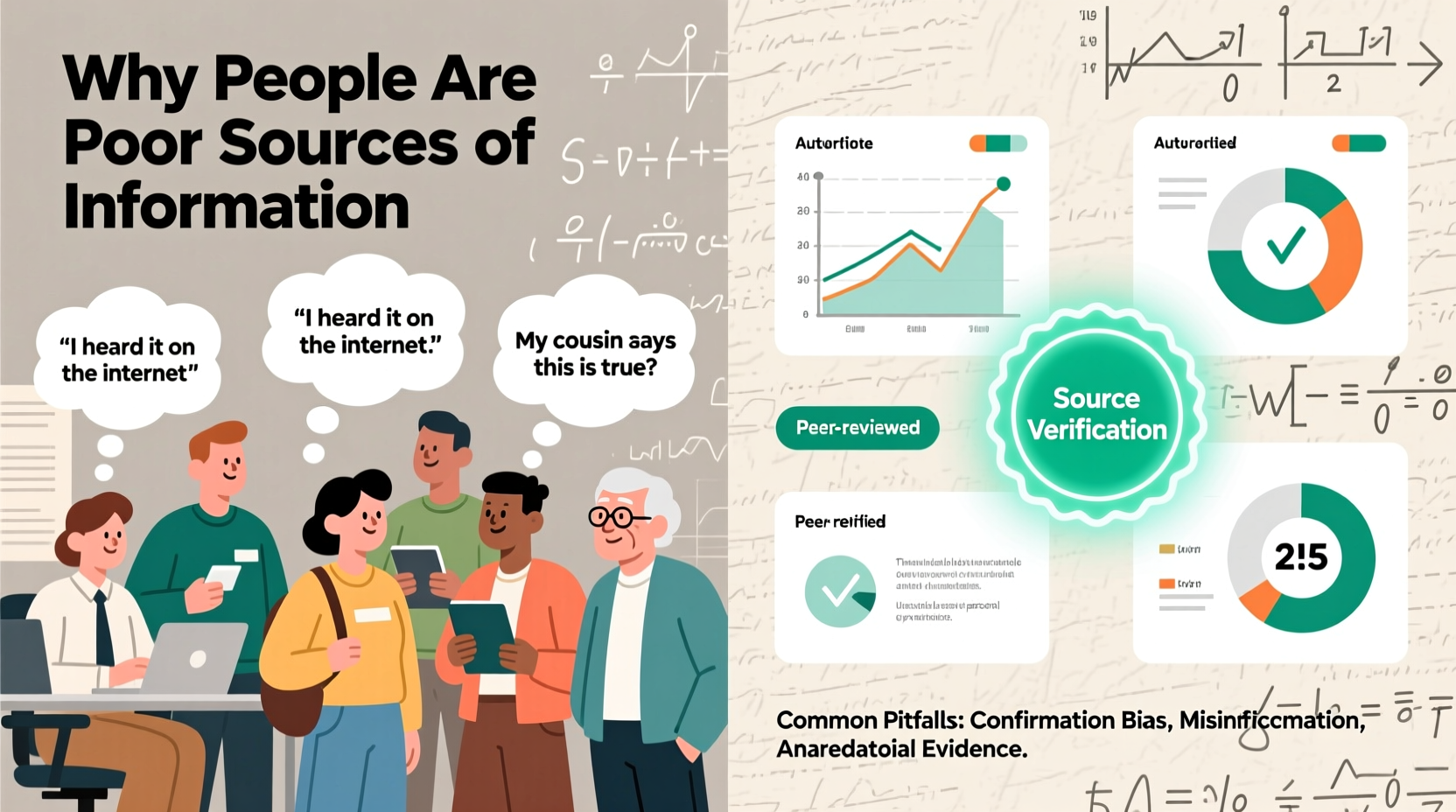
People don’t intentionally mislead others in most cases. Instead, inaccuracies stem from deep-seated psychological mechanisms. One of the most influential is confirmation bias—the tendency to favor information that aligns with existing beliefs while dismissing contradictory evidence. When someone shares information, they often filter it through their worldview, unintentionally distorting facts to fit a narrative they find comfortable or familiar.
Memory itself is another major culprit. Human recall is reconstructive, not reproductive. This means we don’t retrieve memories like files; we rebuild them each time we remember, often inserting details that never occurred. A study by Elizabeth Loftus demonstrated that simple changes in questioning could lead individuals to “remember” entire events that never happened. When such reconstructed memories become the basis for shared information, the risk of spreading falsehoods increases dramatically.
“Memory is not a video recorder. It’s more like a Wikipedia page—editable, collaborative, and prone to errors.” — Dr. Daniel Schacter, Harvard Psychologist and Memory Researcher
Common Pitfalls That Undermine Information Accuracy
Several recurring issues compromise the reliability of human-sourced information. Recognizing these patterns helps in evaluating claims before accepting or passing them along.
1. Overconfidence Without Expertise
People often express high confidence in topics they know little about. The Dunning-Kruger effect explains this phenomenon: individuals with low ability in a domain overestimate their competence because they lack the knowledge to recognize their own mistakes. A person might confidently explain how vaccines work despite having no medical training, simply because they watched a viral social media post.
2. Anecdotal Thinking
Humans naturally rely on personal stories and isolated examples to form general conclusions. While anecdotes can illustrate points, they are not substitutes for data. For instance, someone might claim that a certain diet cured their illness and insist it will work for everyone, ignoring broader scientific evidence and individual variability.
3. Social Contagion of Belief
Beliefs spread through social networks like viruses. Once an idea gains traction in a group, it becomes harder to question—even if it lacks evidence. Groupthink suppresses dissent, and individuals may adopt views not because they’re convinced but because they want social approval.
4. Misinterpretation of Correlation
Many people mistake correlation for causation. If two events occur together, they assume one caused the other. For example, someone might argue that crime rose after a new mayor took office, therefore blaming the mayor—without considering economic trends, policing policies, or reporting changes.
Case Study: The Spread of Health Myths
In 2015, a local community newsletter published a testimonial from a woman who claimed her child’s autism improved after switching to a gluten-free diet. Though she emphasized it was her personal experience, the story was picked up by parent groups, local forums, and eventually a regional talk show. Within months, pediatricians reported a surge in parents requesting dietary changes without medical consultation.
No clinical trials were cited, and the original author never claimed a cure. Yet, due to emotional appeal and social reinforcement, the anecdote evolved into a widely accepted belief. This case illustrates how well-meaning individuals can become vectors of misinformation when personal experiences are generalized without scrutiny.
How to Evaluate People as Information Sources
Not all human sources are unreliable. Experts, eyewitnesses, and experienced professionals provide valuable insights. The key is discernment. Use the following checklist to assess credibility before accepting or sharing information.
Information Source Evaluation Checklist
- Does the person have verifiable expertise in the subject?
- Can they cite specific evidence or studies?
- Are they open to counterarguments or alternative interpretations?
- Is their claim consistent with established knowledge?
- Do they distinguish between opinion and fact?
- Are they emotionally invested in the outcome?
| Red Flag | What It Means | Better Approach |
|---|---|---|
| \"Everyone knows this.\" | Appeal to popularity, not evidence. | Ask: Who specifically knows this? Where is the proof? |
| \"It worked for me.\" | Anecdotal reasoning; not generalizable. | Seek controlled studies or broader data. |
| \"Experts are hiding the truth.\" | Conspiracy thinking; distrust of institutions. | Check peer-reviewed research and consensus. |
| Overly confident tone without detail. | Likely influenced by cognitive bias. | Request specifics: dates, sources, methods. |
Strategies for Reducing Reliance on Poor Information Sources
Improving your information hygiene requires both skepticism and proactive habits. Follow this step-by-step guide to minimize exposure to unreliable claims.
- Pause Before Sharing: When someone tells you something surprising, resist the urge to repeat it immediately. Take time to verify.
- Trace the Origin: Ask: Where did this information come from? Is there a primary source?
- Consult Reputable Channels: Cross-check claims with academic journals, government agencies, or established news outlets.
- Use Fact-Checking Tools: Websites like Snopes, FactCheck.org, or Reuters News Tracer help validate viral claims.
- Encourage Source Transparency: In conversations, gently ask, “Where did you hear that?” This promotes accountability without confrontation.
“We’re wired to believe people we trust. The challenge is aligning that trust with evidence.” — Dr. Kate Starbird, University of Washington, Crisis Informatics Researcher
Frequently Asked Questions
Can’t I trust friends and family with information?
You can trust them emotionally, but not necessarily factually. Loved ones may share misinformation with good intentions. Treat their input as a starting point for inquiry, not a final answer.
What if someone gets offended when I question their information?
Frame your questions respectfully. Say, “That’s interesting—where did you learn about that?” instead of “That’s wrong.” Most people respond better to curiosity than correction.
Are experts always reliable?
Experts are more reliable than non-experts, but they aren’t infallible. Scientific consensus—not a single expert’s opinion—is the gold standard. Even experts revise conclusions as new data emerges.
Conclusion: Building a Smarter Information Diet
People will always be part of our information ecosystem. We learn from conversations, stories, and shared experiences. But treating every statement as truth risks perpetuating myths, making poor decisions, and spreading harm. By understanding the cognitive and social pitfalls behind misinformation, you gain the tools to navigate conversations with greater clarity and responsibility.
The goal isn’t to distrust everyone—it’s to think critically, seek evidence, and promote a culture where accuracy matters as much as opinion. Start today: question gently, verify consistently, and share wisely.




 浙公网安备
33010002000092号
浙公网安备
33010002000092号 浙B2-20120091-4
Comments
No comments yet. Why don't you start the discussion?