
Pop-up headlights were once a hallmark of automotive style and innovation—gliding open with mechanical precision on sports cars from the 1960s through the early 2000s. Models like the Toyota Supra, Mazda RX-7, and Chevrolet Corvette made them iconic. But today, you won’t find any new car with pop-up headlights. They’ve disappeared from production lines, not due to nostalgia fading, but because of concrete regulatory, safety, and technological shifts. The real question isn’t just why they’re rare—it’s why they became effectively illegal under modern vehicle standards.
The Rise and Fall of Pop-Up Headlights
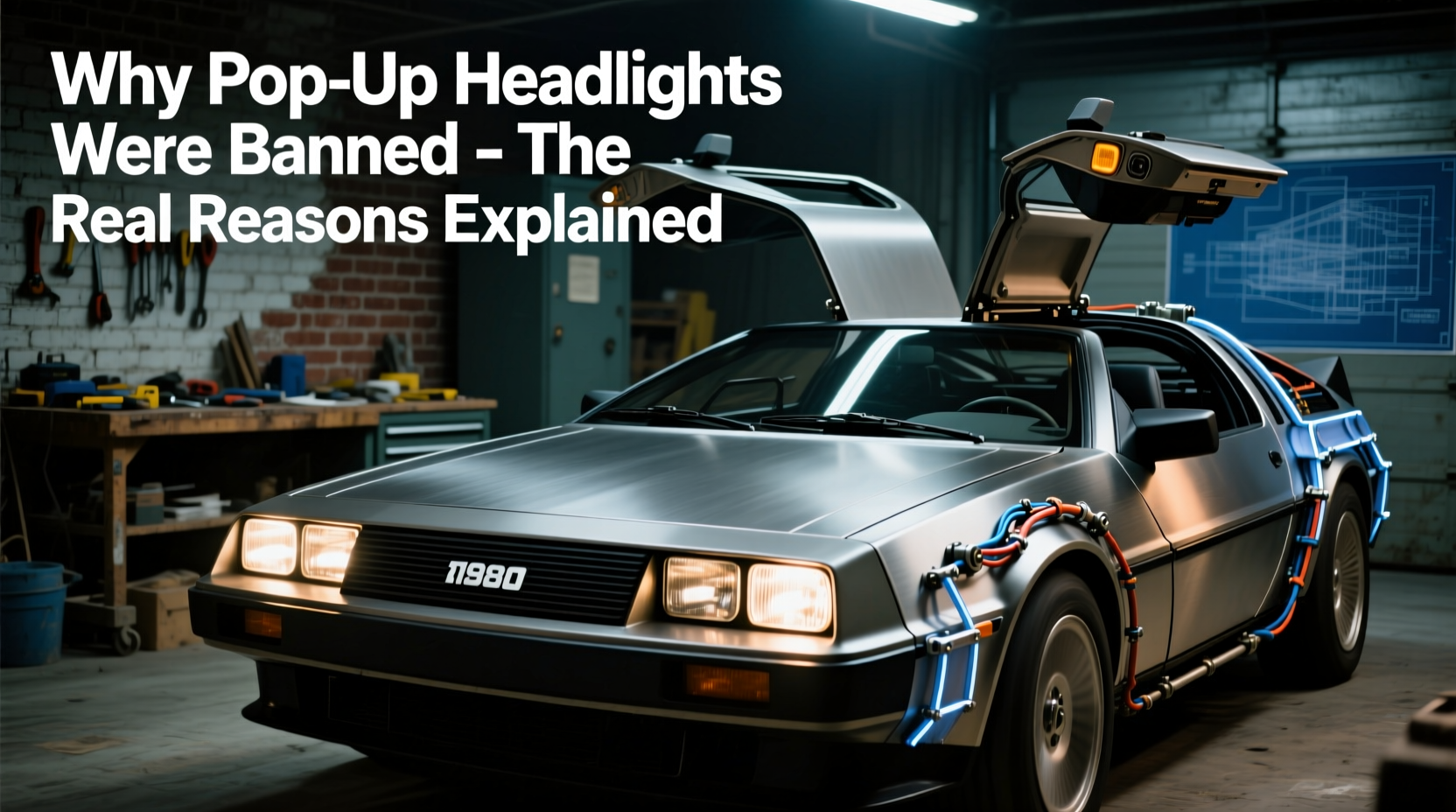
First introduced in the 1930s and popularized in the 1960s, pop-up headlights allowed automakers to maintain sleek, aerodynamic front ends while concealing lighting units when not in use. This was especially valuable during an era when designers prioritized form and speed-inspired aesthetics. By the 1980s and ’90s, they reached peak popularity on performance-oriented models where clean lines meant both visual appeal and improved airflow.
However, by the early 2000s, their use began to decline. The last mass-produced car with pop-up headlights was the 2004 Lotus Elise. Since then, no major manufacturer has reintroduced them on street-legal models. While some might assume it's purely a design trend shift, the truth lies deeper—in evolving safety laws, pedestrian protection standards, and engineering priorities.
Safety Regulations: The Primary Reason for the Ban
The most significant factor behind the disappearance of pop-up headlights is global vehicle safety legislation. Over the past three decades, regulatory bodies such as the U.S. National Highway Traffic Safety Administration (NHTSA) and the European Union’s General Safety Regulation have implemented increasingly strict rules regarding vehicle frontal impact performance and pedestrian safety.
Pop-up headlights present inherent structural weaknesses. When retracted, the front end lacks rigidity in the area where headlight mechanisms are housed. In a collision, this creates a \"crush zone\" that can collapse unpredictably, reducing the effectiveness of crumple zones designed to absorb energy gradually. More critically, protruding mechanical components increase injury risk during pedestrian impacts.
“Modern crash standards prioritize predictable deformation and energy absorption. Hidden headlight mechanisms compromise both.” — Dr. Alan Reeves, Automotive Safety Engineer at the Transportation Research Institute
In particular, Europe’s Pedestrian Protection Directive (Directive 2003/102/EC) mandates that vehicle fronts must minimize injury to legs and pelvises during impacts. Recessed or moving parts like pop-up housings create sharp edges and uneven surfaces that fail these tests. As automakers aim for global compliance, designing region-specific lighting systems is economically unfeasible.
Advancements in Lighting Technology
While regulations played a key role, technology sealed the fate of pop-up headlights. Modern LED and adaptive lighting systems require compact, fixed installations with precise alignment. Unlike halogen bulbs used in older pop-up units, LEDs generate less heat but demand stable mounting platforms for optimal beam control.
Adaptive Driving Beam (ADB) systems, now legal in the U.S. as of 2022, automatically adjust light distribution based on traffic conditions, road curvature, and oncoming vehicles. These systems rely on sensors and micro-motors within a rigid housing—something incompatible with flip-up mechanisms prone to misalignment from vibration or debris.
Moreover, aerodynamics have become more critical with the rise of electric vehicles (EVs). Every millimeter of drag affects range. Fixed headlights allow smoother airflow compared to the small gaps and seams required for pop-up mechanisms, which disrupt laminar flow and increase wind resistance.
Reliability and Maintenance Challenges
From a practical standpoint, pop-up headlights were maintenance-intensive. Their operation relied on motors, gears, vacuum actuators (in earlier models), and linkages—all susceptible to wear, corrosion, and failure. Exposure to road salt, moisture, and impact damage often led to seized mechanisms or misaligned beams.
A study by Consumer Reports in 2001 found that over 35% of vehicles with pop-up headlights aged between 5–10 years experienced at least one headlight actuation failure. Repair costs averaged $300–$600 per side, discouraging long-term ownership appeal.
Compare this to modern sealed-beam LED clusters: solid-state, vibration-resistant, and typically rated for 15,000+ hours of operation. Automakers naturally favor reliability over nostalgia, especially as warranty expectations extend beyond 100,000 miles.
Do’s and Don’ts of Maintaining Classic Cars with Pop-Up Headlights
| Do’s | Don’ts |
|---|---|
| Regularly lubricate pivot points and check motor function | Leave headlights up overnight in wet conditions |
| Clean lens covers frequently to prevent UV degradation | Use high-pressure washers near headlight wells |
| Inspect rubber seals annually for cracks or leaks | Ignore warning signs like slow deployment or grinding noises |
Mini Case Study: The Last Stand of the Mazda RX-7
The third-generation Mazda RX-7 (FD), produced from 1992 to 2002, featured elegant pop-up headlights integrated into a low-drag body. Despite its engineering excellence, Mazda faced growing challenges exporting the model to Europe due to tightening pedestrian safety rules. Although the RX-7 passed U.S. FMVSS 208 and 214 standards at the time, proposed EU regulations in the late 1990s signaled future non-compliance.
When Mazda evaluated a successor model in the early 2000s, engineers concluded that redesigning the front end around fixed projectors would be more cost-effective than reinforcing the hood and fender structure to meet upcoming impact standards. Combined with declining rotary engine viability and rising emissions requirements, the decision to discontinue the RX-7—and its signature lights—was inevitable.
This mirrors broader industry trends: even concept cars like the 2015 Acura NSX prototype initially explored hidden elements but ultimately adopted aggressive fixed LED arrays to satisfy global certification.
FAQ: Common Questions About Pop-Up Headlights and Legality
Are pop-up headlights completely banned worldwide?
No country has a law explicitly titled “ban on pop-up headlights,” but current safety standards make them virtually impossible to certify. Vehicles must pass rigorous crash and pedestrian impact tests, which pop-up designs consistently fail due to structural compromises and unpredictable deformation.
Can I install pop-up headlights on my modern car legally?
In most jurisdictions, modifying a vehicle’s original lighting configuration violates federal motor vehicle safety standards (FMVSS in the U.S.) or equivalent regional codes. Aftermarket installations that alter beam height, alignment, or structural integrity are generally not road-legal and may void insurance coverage in the event of an accident.
Why did manufacturers stop using them if people loved the look?
While aesthetically appealing, consumer preference cannot override mandatory safety regulations. Automakers must balance design with compliance, reliability, and manufacturing efficiency. Nostalgic features give way when they conflict with life-saving standards or add unacceptable production complexity.
Step-by-Step: How Safety Standards Killed Pop-Up Headlights
- 1970s–1980s: Pop-up headlights flourish as designers seek aerodynamic efficiency and visual drama.
- 1990s: Crash test programs (like NCAP) emerge, highlighting risks of weak front-end structures.
- Early 2000s: EU introduces pedestrian protection mandates requiring soft, deformable hoods and uniform front profiles.
- Mid-2000s: LED technology advances, offering brighter, smaller, and more efficient alternatives incompatible with moving parts.
- 2010s–Present: Global harmonization of safety rules makes pop-up systems economically and legally impractical.
Conclusion: Design Evolves, But Safety Leads
Pop-up headlights weren't outlawed by decree—they were phased out by progress. What once symbolized cutting-edge design now represents an engineering dead end in the face of superior safety, durability, and efficiency. While enthusiasts still admire their elegance, the automotive world has moved forward, driven by data, regulation, and responsibility.
If you own a classic car with pop-up lights, appreciate them as relics of a different era—one where style sometimes took precedence over systemic safety. For future vehicles, expect innovation in lighting to focus on intelligence, visibility, and integration, not mechanical theatrics.




 浙公网安备
33010002000092号
浙公网安备
33010002000092号 浙B2-20120091-4
Comments
No comments yet. Why don't you start the discussion?