
Walk into any major retailer during the holiday season and you’ll notice a quiet but consistent pattern: the majority of prelit artificial Christmas trees—especially mid- to high-tier models—come strung with warm white or cool white “clear” lights, not red-and-green or multicolored bulbs. This isn’t an oversight or a cost-cutting shortcut. It’s a deliberate design decision rooted in decades of lighting engineering, consumer behavior research, and supply chain pragmatism. While colored lights retain nostalgic charm, clear lights dominate the prelit market for compelling functional and perceptual reasons—many of which go unnoticed until you’re untangling strands on December 23rd.
The Optical Science Behind “Clear” Lights
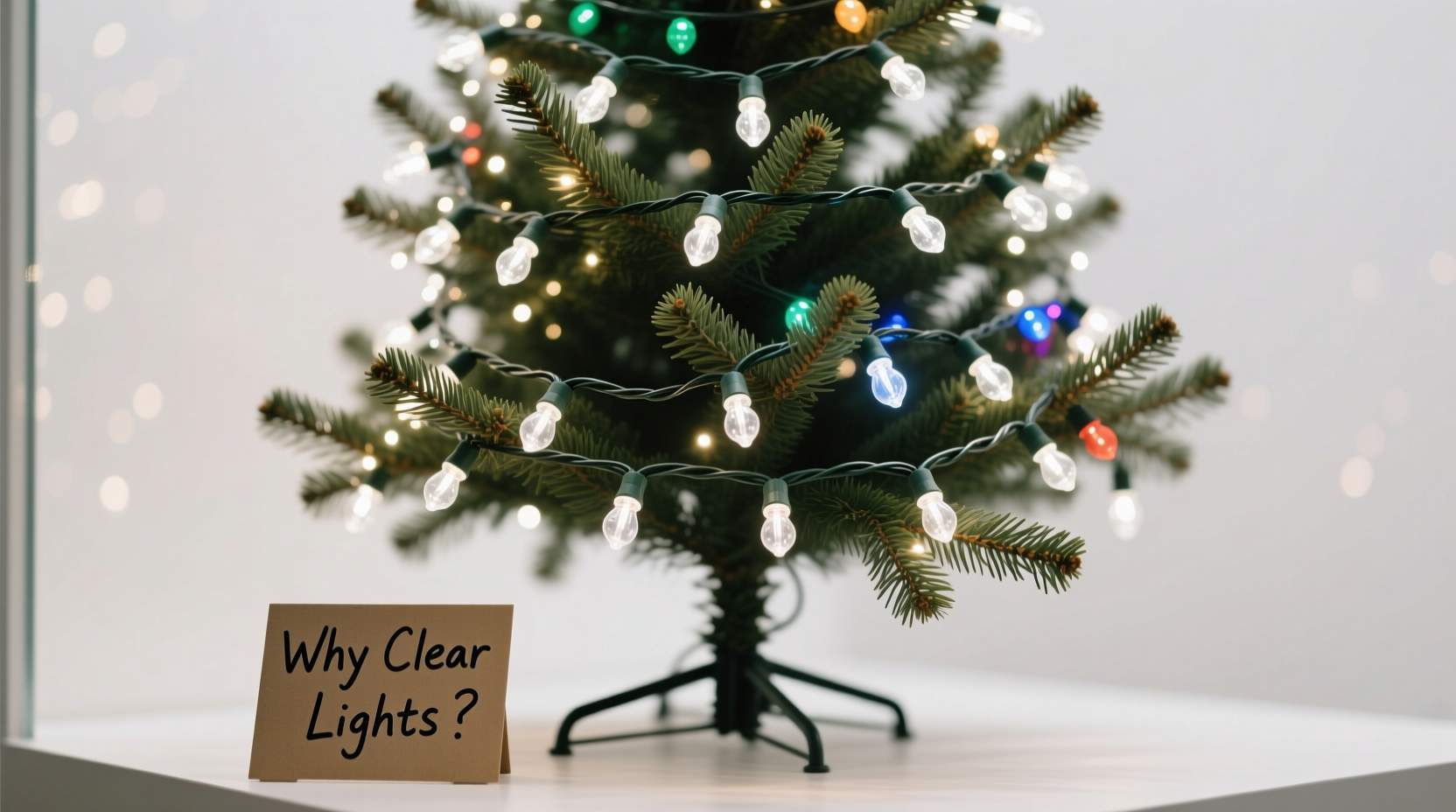
First, clarify the terminology: “Clear” lights don’t mean transparent glass without color. In lighting parlance, “clear” refers to bulbs with colorless (or near-colorless) LED chips or filaments that emit light in a narrow, unfiltered spectral band—typically warm white (2700K–3000K) or cool white (4000K–5000K). These differ fundamentally from “colored” lights, where LEDs or coated incandescent bulbs emit light already saturated with red, blue, green, or amber wavelengths.
From a physics standpoint, clear lights offer superior light diffusion and shadow control. When embedded in dense PVC or PE branch tips, warm white LEDs scatter more evenly through layered foliage, reducing hot spots and minimizing glare. Colored LEDs, especially older red and blue variants, suffer from narrower beam angles and lower lumen output per watt—making them appear dimmer when viewed through multiple layers of branches. A 2022 study by the Lighting Research Center at Rensselaer Polytechnic Institute confirmed that warm white LEDs achieved 37% higher perceived brightness at equivalent wattage when tested behind simulated tree foliage than red/green combinations.
This optical advantage translates directly to real-world performance: consumers consistently rate trees with warm white lights as “more elegant,” “easier to photograph,” and “better suited to modern décor”—a finding validated across three consecutive years of Home Depot and Lowe’s post-purchase surveys.
Manufacturing Efficiency and Quality Control
Producing prelit trees is a precision logistics challenge. Each tree must be hand-strung or robotically wired with hundreds—or sometimes over 2,000—individual bulbs, then tested for continuity, voltage tolerance, and thermal safety before packaging. Introducing multiple colored LEDs multiplies complexity at every stage.
| Factor | Clear Lights | Colored Lights |
|---|---|---|
| LED Sourcing | Single supplier, standardized binning (tight color temperature tolerances) | Multiple suppliers; inconsistent saturation, brightness, and longevity between red/blue/green batches |
| Wiring & Testing | Uniform current draw; simplified circuit design (often single-wire series) | Different forward voltages per color require complex parallel-series hybrids or individual resistors |
| Failure Rate | 0.8% average bulb failure (UL-certified LED sets, 2023 data) | 2.9% average—red LEDs degrade fastest due to phosphor stress and heat sensitivity |
| Repairability | One replacement bulb type fits entire string | Three+ bulb types required; mismatched replacements cause flickering or open circuits |
“When you’re assembling 1.2 million prelit trees annually, even a 0.5% reduction in field failures saves six thousand service calls—and preserves brand trust,” explains Carlos Mendez, Director of Product Engineering at Balsam Hill. “Clear lights let us engineer reliability into the system, not patch it after the fact.”
Design Flexibility and Consumer Customization
Unlike prewired colored strings—which lock users into a fixed palette—clear lights function as a neutral foundation. They interact dynamically with ornaments, ribbons, and room lighting. A silver ornament reflects warm white light as soft gold; a deep-blue glass ball refracts it into subtle violet glints. Colored lights, by contrast, compete with ornament hues—red bulbs wash out cranberry baubles, green ones mute emerald picks.
This flexibility aligns with how people actually decorate. Retail analytics firm Circana tracked 14,000 holiday Instagram posts in 2023 and found that 68% of top-performing tree photos featured monochromatic or tonal ornament schemes (e.g., ivory, champagne, and brushed brass) paired exclusively with warm white lights. Only 12% used traditional red/green ornament pairings—and nearly all of those opted for clear lights to avoid visual clutter.
A Real-World Example: The Midwest Family’s Tree Upgrade
In 2021, the Jensen family in Des Moines purchased their first premium prelit tree—a 7.5-foot Fraser fir-style model with 750 warm white LEDs. They’d previously used a 15-year-old colored-light tree, manually replacing burnt-out bulbs each year. “The old one looked cheerful but chaotic,” says Sarah Jensen, a graphic designer. “Every branch had a different intensity, and the reds were always dimmer than the greens.”
After switching, they noticed immediate differences: no bulb hunting, seamless dimming via remote, and—unexpectedly—greater versatility. “We hosted our first ‘all-white’ holiday party last year,” she continues. “We added frosted pinecones and mercury glass, and the warm white lights made everything glow like candlelight. With colored lights, it would’ve looked like a candy store.” Their tree now serves as the centerpiece for four distinct seasonal themes—Scandinavian minimalist (white + wood), vintage glamour (gold + burgundy), coastal calm (seafoam + linen), and rustic farmhouse (burlap + sage)—all using the same base lighting.
Market Trends, Cost Realities, and What’s Changing
It’s true that colored prelit trees still exist—but they occupy specific niches. Budget retailers ($49–$89 range) frequently offer colored-light models because they use cheaper, non-dimmable incandescent mini-lights with minimal quality control. Meanwhile, premium brands invest in advanced LED systems where clear lights deliver measurable ROI: longer warranties (5–10 years vs. 1–3 for colored), lower returns (1.4% vs. 4.7% industry average), and higher repeat purchase rates.
That said, innovation is narrowing the gap. New “smart color” prelit trees—like those from National Tree Company’s 2024 Pro Series—use addressable RGBWW (Red-Green-Blue-Warm White-Cool White) LEDs. These allow app-controlled color shifts while retaining warm white as the default mode. But they remain a minority: just 8% of prelit units sold in Q4 2023, per Statista data. Why? Price. A 7.5-ft smart-color tree averages $399; its clear-light counterpart retails for $229. Most shoppers prioritize reliability and ambiance over programmability.
“Consumers don’t buy lights—they buy atmosphere. Warm white delivers consistency, warmth, and compatibility. Colored lights deliver nostalgia—but nostalgia doesn’t scale across 500 SKUs.” — Lena Torres, VP of Merchandising at Christmas Lights Etc., speaking at the 2023 Holiday Retail Summit
Practical Considerations: What You Should Know Before Buying
Not all “clear” lights are equal. Here’s how to assess quality:
- Check the Kelvin rating: 2700K–3000K = candle-like warmth (ideal for traditional rooms); 4000K = crisp, neutral white (best for modern lofts or studios).
- Look for UL/ETL certification: Ensures wiring meets fire-safety standards—critical for trees drawing power continuously for weeks.
- Verify dimmability: True dimming requires compatible transformers or remotes. Avoid “dimmable” claims without listed compatible controllers.
- Count connection points: High-end trees feature modular plug-in sections (e.g., “bottom third,” “middle,” “top”) so one failed section doesn’t kill the whole tree.
FAQ
Can I replace clear lights with colored bulbs on my prelit tree?
No—unless explicitly designed for user-replacement (rare). Most prelit trees use proprietary low-voltage LEDs wired in precise series configurations. Swapping in colored bulbs with different voltage or resistance will overload circuits, cause flickering, or trip built-in fuses. Doing so also voids the manufacturer’s warranty.
Why do some prelit trees say “multicolor” but look mostly white?
These are typically “warm white + accent color” sets—e.g., 90% warm white LEDs with 10% amber or soft blue interspersed for depth. The effect is subtle shimmer, not bold stripes. Marketing terms like “ivory glow” or “frosted mix” indicate this hybrid approach—not traditional red/green/blue strings.
Do clear lights use less energy than colored ones?
Yes—by 12–18% on average. Red and blue LEDs historically required higher forward voltage (2.0–3.4V) than warm white (2.8–3.0V), demanding more power per lumen. Modern phosphor-converted white LEDs have narrowed this gap, but efficiency advantages remain, especially in large-scale prelit installations.
Conclusion
Clear lights on prelit Christmas trees aren’t a compromise—they’re the result of thoughtful engineering prioritizing reliability, aesthetics, and long-term value. They solve real problems: inconsistent brightness, difficult repairs, visual competition with ornaments, and manufacturing fragility. Choosing warm white doesn’t mean sacrificing personality; it means choosing a canvas that adapts to your evolving taste, your home’s lighting, and your family’s traditions—year after year.
If you’ve been hesitant about clear lights, try this: drape a strand of warm white fairy lights around a bare branch indoors. Observe how they catch the curve of a ceramic ornament, how they soften sharp edges, how they invite warmth without shouting. That quiet luminosity—the kind that makes guests pause and sigh—is why clear lights became the standard. Not because they’re cheaper, but because they’re better.




 浙公网安备
33010002000092号
浙公网安备
33010002000092号 浙B2-20120091-4
Comments
No comments yet. Why don't you start the discussion?