
In basements, thrift stores, and online marketplaces, old video game cartridges and discs once gathered dust—until they didn’t. Over the past decade, prices for retro games have skyrocketed. A sealed copy of *The Legend of Zelda* for the NES sold for over $800,000 in 2021. Even common titles now routinely sell for hundreds of dollars if graded in pristine condition. What changed? The answer lies in a volatile mix of limited supply, surging demand, collector psychology, and the controversial role of third-party grading companies that have created what some call a “grading bubble.”
The Shrinking Supply of Retro Games
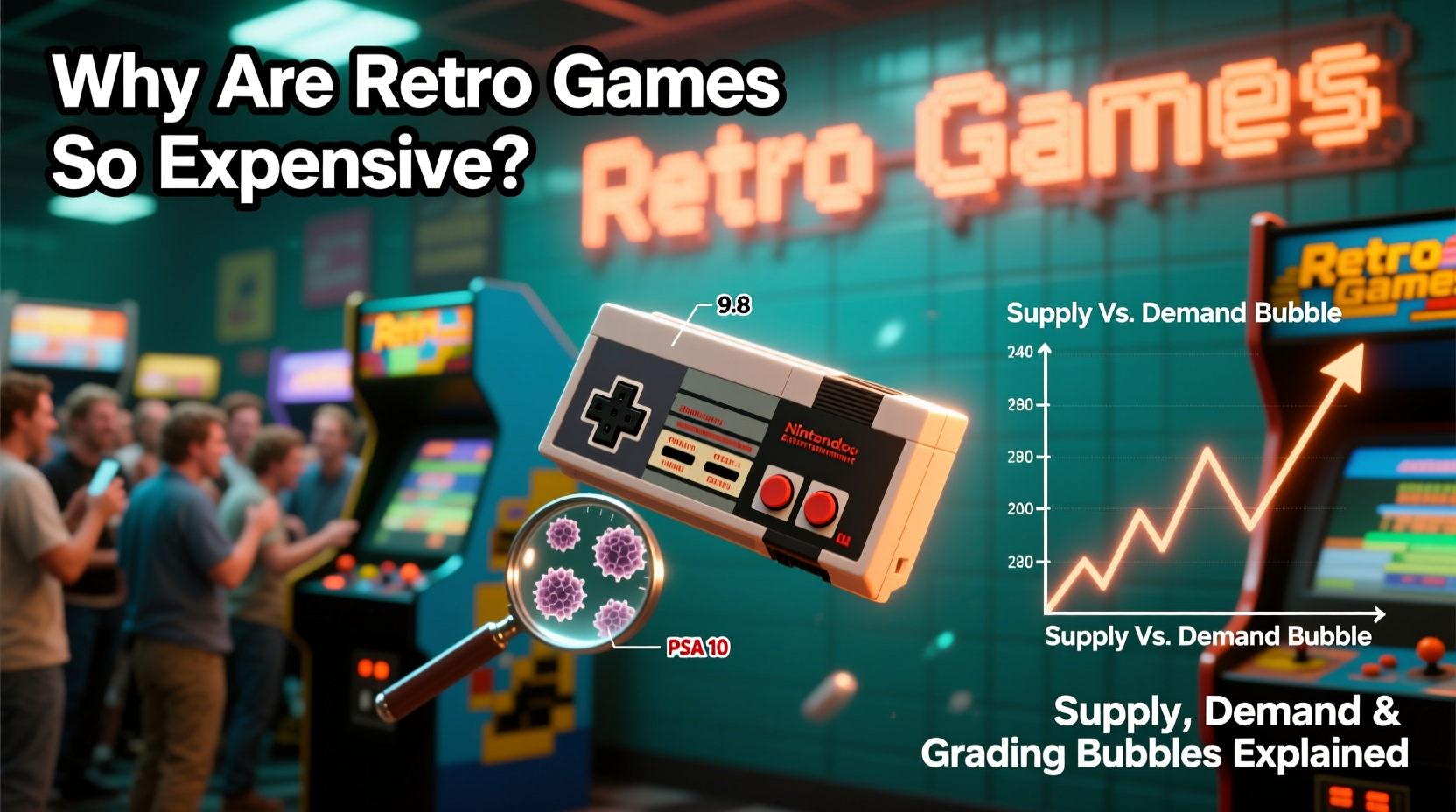
Retro games—typically defined as those released before the early 2000s—are finite. Unlike books or music, which can be reprinted or digitally preserved with fidelity, physical video games degrade over time. Tapes demagnetize, cartridges lose battery power (critical for saving progress), and optical discs suffer from laser rot. Many games were simply thrown away during system upgrades or household moves.
Manufacturing volumes also play a role. While popular franchises like *Super Mario Bros.* or *Sonic the Hedgehog* had high production runs, niche titles or late-generation releases often had small print runs. For example, the Atari 2600 game *Air Raid* is believed to have only 150–200 copies ever produced. Rarity isn't always intentional—it's often the result of poor sales, short shelf life, or rapid technological turnover.
As time passes, the number of playable, unaltered copies continues to shrink. This scarcity forms the foundation of retro gaming’s economic model: fewer intact units mean higher value, especially when demand increases.
Demand Surge: From Nostalgia to Investment
Nostalgia is a powerful driver. Millennials and Gen Xers who grew up playing Nintendo, Sega, and PlayStation now have disposable income. Reconnecting with childhood favorites has turned collecting into a widespread hobby. But nostalgia alone doesn’t explain six-figure price tags.
What’s changed is perception. Retro games are no longer seen just as entertainment—they’re assets. Collectors increasingly treat them like rare coins, vintage watches, or baseball cards. Social media, YouTube channels, and dedicated forums amplify awareness of high-profile sales, fueling FOMO (fear of missing out). When a sealed *Super Mario 64* sells for $1.5 million, it signals that these items aren’t just fun—they’re potentially profitable.
This shift has attracted not just passionate fans but investors. Some buy multiple sealed copies of key titles, hoping to resell at a premium years later. This speculative behavior inflates prices beyond what pure enthusiast demand would justify.
“Collectors used to trade games at garage sales for a few bucks. Now, people are treating them like blue-chip investments. That changes everything.” — David K., Vintage Game Appraiser & Founder of RetroAudit
The Role of Grading Companies: Authenticity or Inflation?
Enter professional grading services like WATA (Wata Games) and VGA (Video Game Authority). These companies authenticate, grade, and encapsulate retro games in tamper-proof cases, assigning scores from 0 to 10 based on condition. A perfect 10/10 rating can increase a game’s value tenfold overnight.
On the surface, this seems beneficial. Grading reduces fraud and gives buyers confidence. But critics argue that the system has created a speculative bubble. Because grades are subjective—especially for subtle flaws like label creases or seal imperfections—two experts might assign different scores to the same item. Worse, the highest grades are disproportionately rewarded in the marketplace.
For instance, a WATA 9.8 *EarthBound* for SNES might sell for $30,000, while an identical-looking 9.6 copy sells for $12,000. This tiny difference in condition creates massive financial disparity. As a result, collectors obsess over achieving perfect scores, sometimes paying for multiple submissions until they get a high grade—a practice known as “grade grubbing.”
Grading has also led to artificial scarcity. Only a fraction of existing games are professionally graded, and once slabbed, many never re-enter circulation. Investors hoard high-grade copies, removing them from the active market and further tightening supply.
How Grading Impacts Value: A Comparison
| Game | Condition (Ungraded) | WATA Grade | Average Sale Price |
|---|---|---|---|
| Super Metroid (SNES) | Mint, sealed | Ungraded | $400–$600 |
| Super Metroid (SNES) | Mint, sealed | 9.6 A+ | $2,200 |
| Pokémon Blue (Game Boy) | Complete, minor wear | Ungraded | $150–$250 |
| Pokémon Blue (Game Boy) | Like new | 10/10 | $75,000 (record sale) |
| Sonic the Hedgehog 2 (Genesis) | Sealed, slight warp | 9.4 | $1,800 |
| Sonic the Hedgehog 2 (Genesis) | Sealed, flawless | 10/10 | $12,000 |
The data shows a clear pattern: grading doesn’t just reflect value—it actively shapes it. And because grading standards have evolved over time, older assessments may not match current expectations, leading to re-evaluations and price swings.
The Collector’s Dilemma: Play vs. Preserve
One of the most ironic tensions in retro gaming is the conflict between use and preservation. Video games were designed to be played. Yet, the highest financial value is assigned to unused, factory-sealed copies. This transforms games from interactive art into static commodities.
Many collectors now face a moral and practical choice: Do they open the game and experience it, knowing they’ll destroy thousands in value? Or do they keep it sealed, turning it into a museum piece?
This dilemma illustrates a broader shift. Retro gaming culture is splitting into two camps: players and investors. Players modify consoles, burn ROMs, and enjoy games through emulation or reproduction carts. Investors focus on original packaging, warranty papers, and spotless seals—the trifecta of high-value collectibles.
Mini Case Study: The Rise and Fall of a Collector
Mark T., a software developer from Ohio, began collecting retro games in 2015. He bought a sealed copy of *Ocarina of Time* for the Nintendo 64 for $120 at a local pawn shop. Over the next five years, he curated a collection of 40 sealed titles, investing around $5,000. In 2021, after seeing news of record-breaking sales, he sent his *Ocarina of Time* to WATA. It received a 9.6 A+ grade. He listed it on eBay and sold it for $8,200.
Encouraged, Mark doubled down, buying more sealed games. But by 2023, prices plateaued. Buyers became cautious. His *GoldenEye 007* (graded 9.4) sat unsold for months. He realized too late that the market was oversaturated with investor-owned inventory. Today, he keeps his remaining games boxed but admits, “I never even got to play them. I don’t feel like a gamer anymore—I feel like a stock trader.”
Practical Advice for Navigating the Retro Market
If you're entering the retro game market—whether as a player, collector, or casual enthusiast—it pays to understand the dynamics at play. Here’s how to approach it wisely.
Checklist: Smart Collecting Practices
- Research before buying: Know typical prices using archives like PriceCharting or Heritage Auctions.
- Verify authenticity: Look for mismatched fonts, incorrect barcodes, or reproduction red flags.
- Consider long-term storage: Use anti-static bags and climate-controlled environments.
- Decide your goal: Are you collecting to play or to invest? Your strategy should reflect this.
- Be skeptical of ultra-high grades: A sudden spike in 10/10 sales may indicate manipulation.
Step-by-Step Guide: Evaluating a Retro Game Purchase
- Identify the platform and title: Confirm release year, publisher, and rarity level.
- Check for completeness: Manual, box, registration card, and inserts add significant value.
- Inspect physical condition: Look for stains, scratches, warping, or sticker residue.
- Test functionality: Boot the game if possible; avoid cartridges with corrosion.
- Review recent sales: Search completed listings on eBay or auction houses for realistic pricing.
- Decide on grading: Only consider professional grading if the game is near-mint and sealed.
Frequently Asked Questions
Are retro games a good investment?
They can be, but with major caveats. The market is highly speculative and driven by sentiment. Unlike stocks or real estate, retro games produce no income and depend entirely on resale demand. Prices could stagnate or drop if interest fades. Treat them as passion investments, not financial vehicles.
Should I get my games graded?
Only if they’re in exceptional condition and likely to appreciate. Grading costs $100–$200 per game and isn’t guaranteed to increase value. For average-condition games, grading is rarely worth it. Focus on preserving original integrity instead.
Is the retro game bubble going to burst?
Some correction is likely. Rapid price growth cannot continue indefinitely. Already, mid-tier CIB games have seen declining demand as investors focus only on top-tier, high-grade items. A full collapse isn’t inevitable, but normalization—where prices reflect genuine collector interest rather than speculation—is probable.
Conclusion: Passion Over Profit
The soaring prices of retro games reveal more than market mechanics—they reflect cultural value. These games shaped childhoods, inspired careers in tech and design, and laid the foundation for today’s billion-dollar industry. Their emotional resonance is real.
But when a cartridge costs more than a month’s rent, it’s worth asking: What are we really valuing? The joy of play? Or the promise of profit?
For lasting satisfaction, prioritize personal connection over appraisal sheets. Play the games. Share them. Let them be lived experiences, not just line items in a portfolio. The true legacy of retro gaming isn’t measured in dollars—it’s in the memories they continue to create.




 浙公网安备
33010002000092号
浙公网安备
33010002000092号 浙B2-20120091-4
Comments
No comments yet. Why don't you start the discussion?