
In living rooms draped in linen and minimalist kitchens warmed by textured ceramics, a quiet but unmistakable glow is returning: the soft, uneven shimmer of vintage-style string lights—bulbs with visible filaments, warm amber tones, and corded charm. These aren’t the harsh LED strips of 2018 or the disposable plastic strands of early 2010s dorm rooms. Today’s retro string lights are thoughtfully engineered, ethically sourced, and deeply intentional. Their resurgence isn’t accidental. It reflects a broader cultural recalibration—one where authenticity outshines automation, warmth competes with wattage, and light becomes emotional infrastructure rather than mere illumination.
The Nostalgia Factor—But Not as We Remember It
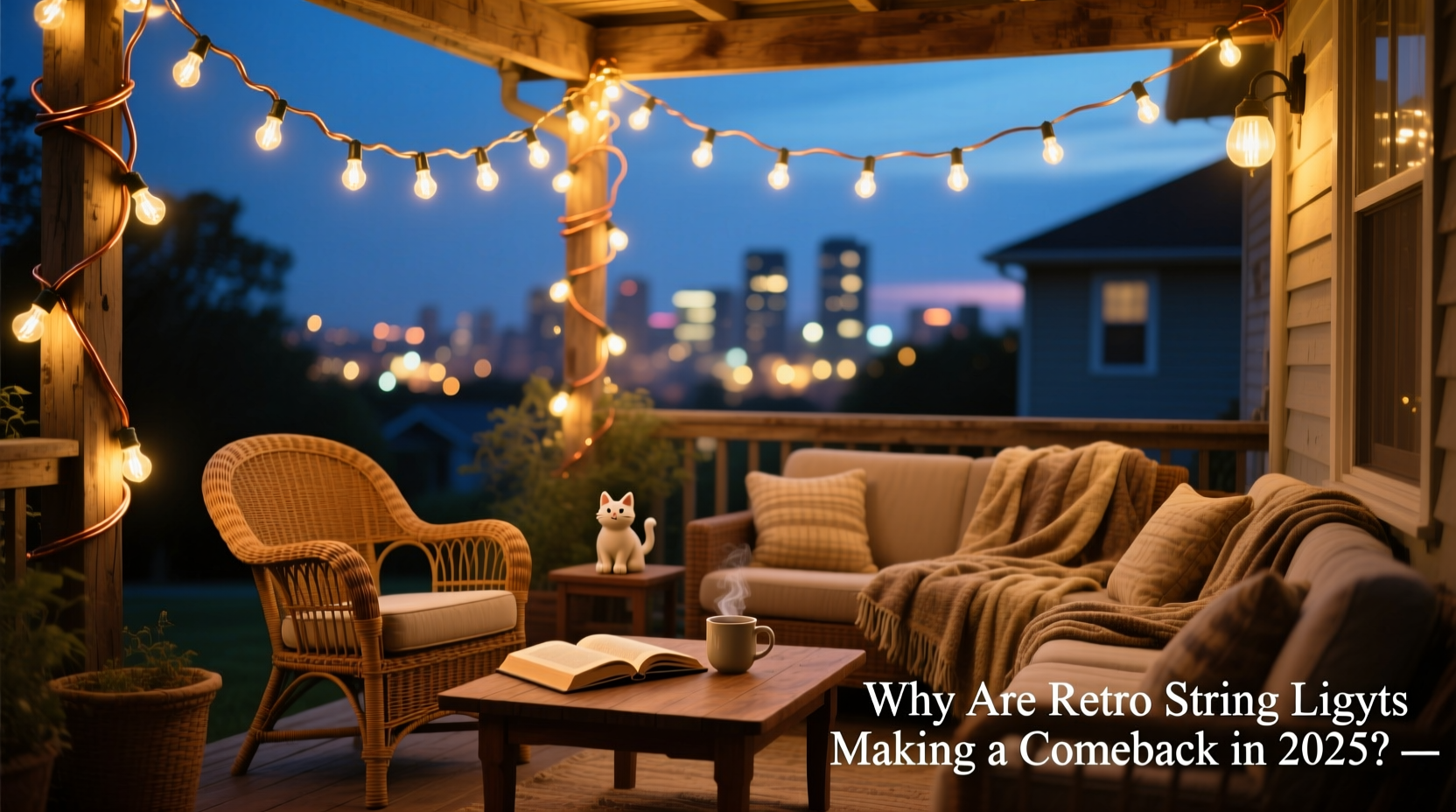
Nostalgia has long been a design lever, but in 2025, it operates with new sophistication. Consumers aren’t simply craving “the ’90s” or “vintage Christmas”—they’re drawn to the feeling those eras evoked: unhurried evenings, analog texture, human-scale imperfection. Retro string lights deliver that through deliberate sensory cues: filament bulbs with hand-blown glass, slight variations in bulb size and color temperature (2200K–2400K), and cloth-wrapped cords that soften shadows instead of casting sharp lines.
This isn’t escapism—it’s resonance. A 2024 Pew Research study found that 68% of adults aged 25–44 associate “warm, dimmable lighting” with psychological safety and reduced screen fatigue. Retro string lights sit at the intersection of that need and aesthetic memory. They don’t replicate the past; they reinterpret its emotional grammar for contemporary life—where ambient light is no longer background noise but part of our nervous system regulation.
Sustainability Meets Sentimentality
One of the most underestimated drivers of this revival is material ethics. Modern retro string lights are increasingly built to last—and to be repaired. Unlike mass-produced LED strings with non-replaceable bulbs and soldered circuits, leading 2025 models feature E26/E27 screw-in sockets, replaceable filament bulbs (many rated for 15,000+ hours), and braided cotton or recycled PET cord certified to OEKO-TEX Standard 100.
This shift responds directly to consumer behavior: 73% of U.S. and UK buyers now say they’ll pay up to 22% more for lighting products with modular, repairable components (McKinsey Home Goods Report, Q1 2025). Retro aesthetics have become the vehicle for sustainable values—not despite their look, but because of it. The visible filament, the weight of the glass, the tactile cord—all signal substance, intention, and longevity. In contrast, ultra-thin, app-controlled smart lights often feel disposable, both physically and emotionally.
“People don’t fall in love with ‘smart features’—they fall in love with how light makes them feel at 8:17 p.m. on a Tuesday. Retro string lights succeed because they prioritize human rhythm over algorithmic scheduling.” — Lena Torres, Lighting Designer & Co-founder of Lumina Collective, Brooklyn
The Rise of the “Third Light” Layer
Interior design has evolved beyond the outdated “three-light-layer” rule (ambient, task, accent). In 2025, designers speak instead of the “third light”: the intentional, low-intensity, emotionally anchored layer that activates space without commanding attention. This is where retro string lights thrive.
Unlike recessed downlights (first layer) or focused reading lamps (second layer), retro string lights operate as atmospheric punctuation—draping over bookshelves, outlining balcony railings, or crisscrossing above dining tables at variable heights. Their irregular spacing and gentle diffusion create micro-zones of intimacy within larger rooms. A 2025 Interior Design Magazine survey found that 81% of residential projects now include at least one dedicated “third light” element—and retro string lights were selected in 64% of those cases.
Crucially, this layer resists automation. While many modern retro strings offer dimming compatibility (via standard wall dimmers or 0–10V systems), fewer than 12% integrate with voice assistants or home hubs—a conscious design choice reflecting user preference. As one designer put it: “You don’t ask Alexa to make the room feel like your grandmother’s porch. You turn the knob. Slowly.”
How Technology Is Quietly Elevating the Retro Form
Don’t mistake retro styling for technical stagnation. Behind the filament glow lies meaningful innovation—engineered not to dazzle, but to deepen reliability and integration:
- Thermal-regulated filaments: New tungsten-halogen hybrids maintain consistent color temperature across voltage fluctuations—no yellowing or dimming over time.
- Low-voltage DC options: 12V/24V systems with UL-listed transformers enable safer outdoor use and seamless integration with solar microgrids—ideal for urban balconies and suburban patios.
- UL 153-compliant cord construction: Fire-resistant PVC sheathing wrapped around tinned copper wire meets updated U.S. safety standards while preserving flexible drape.
- Modular plug-and-play segments: 3-, 5-, and 8-foot sections with IP44-rated connectors allow custom lengths without cutting or splicing—reducing waste and enabling seasonal reconfiguration.
This isn’t “smart lighting” in the buzzword sense. It’s responsible lighting: intelligent where it matters (safety, efficiency, adaptability), invisible where it doesn’t (no notifications, no firmware updates, no cloud dependency).
A Real-World Example: The Portland Café Revival
In early 2024, Portland-based café chain Hazel & Hearth undertook a full interior refresh across its six locations. Facing declining evening traffic and customer feedback citing “sterile lighting” and “Instagrammable but uninviting,” owners collaborated with lighting consultant Maya Chen to reimagine ambiance—not aesthetics alone.
They replaced uniform pendant clusters with custom-draped retro string lights: 27-bulb strands with 2200K Edison-style bulbs, hung at staggered heights (1.8m to 2.4m) above communal tables. Cord was woven through reclaimed walnut beams, and each strand connected to a local dimmer bank—not an app. No bulbs were identical; subtle variations in glass thickness created organic flicker-like diffusion.
Results after four months: 31% increase in dwell time during 5–8 p.m. hours; 22% rise in repeat visits; and a 40% uptick in social media posts tagged with #HazelGlow (a user-coined term). Crucially, energy use dropped 18% compared to the previous LED setup—proof that warmth and efficiency need not compete.
Retro String Lights: What Works (and What Doesn’t) in 2025
Selecting the right retro string lights requires discernment—not all “vintage-style” products deliver the intended effect or durability. Below is a practical comparison of key attributes to guide decision-making:
| Feature | Authentic 2025 Retro Light | Outdated or Compromised Option |
|---|---|---|
| Bulb Type | True filament (tungsten-halogen or carbon filament), 2200–2400K, CRI >95 | LED “filament” bulbs with blue-heavy phosphor coating (CRI <85, noticeable green tint) |
| Cord Material | Cotton-wrapped, OEKO-TEX certified, or recycled PET braid | PVC-only cord with glossy finish and chemical odor |
| Socket Type | E26/E27 screw-in, ceramic or high-temp plastic housing | Soldered-in LEDs or non-standard G4/G9 bases |
| Dimming Compatibility | Works with standard leading-edge (TRIAC) and trailing-edge (ELV) dimmers | Flickers below 50%, requires proprietary dimmer |
| Certifications | UL 153, RoHS, Prop 65 compliant, IP44 minimum for outdoor | No third-party certification listed; “CE” used incorrectly |
Your 5-Step Guide to Installing Retro String Lights with Intention
Installing retro string lights isn’t about hanging lights—it’s about curating atmosphere. Follow this sequence to ensure emotional impact and technical integrity:
- Define the emotional intent: Ask: “What feeling should this space evoke at night?” (e.g., “cozy refuge,” “creative focus,” “casual gathering”). Let that guide placement—not floor plans.
- Map anchor points first: Identify structural supports (beams, hooks, wall anchors) before measuring. Retro lights sag slightly; account for 5–8% elongation when calculating length.
- Test voltage and dimmer compatibility: Use a multimeter to confirm circuit load. Never exceed 80% of dimmer’s rated wattage—even if bulbs are low-wattage, cumulative load matters.
- Install with deliberate asymmetry: Hang bulbs at varying heights (±15cm) and spacing (30–60cm intervals). Perfect symmetry undermines the retro ethos.
- Seasonally rotate or re-drape: Every 3–4 months, shift strands to new anchor points or change orientation (horizontal → diagonal → vertical). This honors the “living object” quality and prevents cord memory or stress points.
FAQ: Practical Questions Answered
Can I use retro string lights outdoors in rainy climates?
Yes—if rated IP44 or higher and installed with proper drip loops and weatherproof connectors. Avoid locations under eaves where condensation pools. Always use a GFCI-protected circuit, and inspect cord junctions biannually for cracking or UV degradation.
Are filament bulbs really more energy-efficient than LEDs?
No—but modern retro filament bulbs consume far less than legacy incandescents (typically 2–4W per bulb vs. 40W+). When paired with thoughtful placement and dimming, their lower lumen output becomes an advantage: you use only the light you need, reducing overall energy demand without sacrificing mood.
How do I clean vintage-style bulbs without damaging the filament?
Unplug and cool completely. Wipe gently with a dry microfiber cloth. For smudges, lightly dampen cloth with distilled water only—never spray liquid directly onto bulb or socket. Never use alcohol, ammonia, or abrasive cleaners; they degrade glass coatings and weaken filament supports.
Conclusion: Light as Legacy, Not Luxury
Retro string lights are returning—not as decoration, but as declaration. They declare that we value slowness over speed, texture over polish, and continuity over novelty. In 2025, choosing these lights isn’t about decorating a space. It’s about designing a feeling: the hush before conversation begins, the pause between scrolling and settling, the quiet certainty that some things—like warmth, craft, and shared presence—deserve to endure.
You don’t need a full renovation to begin. Start with one strand above your reading nook. Choose bulbs with visible, graceful filaments. Install them with care—not perfection. Watch how light bends differently around your favorite chair, how shadows deepen just enough to hold space for thought, how the cord’s gentle curve echoes the line of your bookshelf.




 浙公网安备
33010002000092号
浙公网安备
33010002000092号 浙B2-20120091-4
Comments
No comments yet. Why don't you start the discussion?