
Every holiday season, millions of households bring home a fresh or artificial Christmas tree to serve as the centerpiece of their celebrations. But one common frustration often arises: getting the tree to stand straight—especially when placed on an uneven floor. While it might seem like a minor inconvenience, an unbalanced tree can lead to instability, water leakage, and even safety hazards. This is where rotating Christmas tree bases come in. More than just a convenience feature, these specialized stands solve multiple problems at once, particularly when used on sloped, warped, or irregular flooring.
Rotating bases are designed with both functionality and user experience in mind. They allow the tree to spin smoothly in place, making decoration easier from all angles, but their real engineering value lies in how they compensate for imperfections in flooring. Whether you're setting up in an older home with creaky hardwoods or a modern space with slightly off concrete subfloors, understanding the mechanics behind these bases can transform your tree setup from stressful to seamless.
The Challenge of Uneven Floors
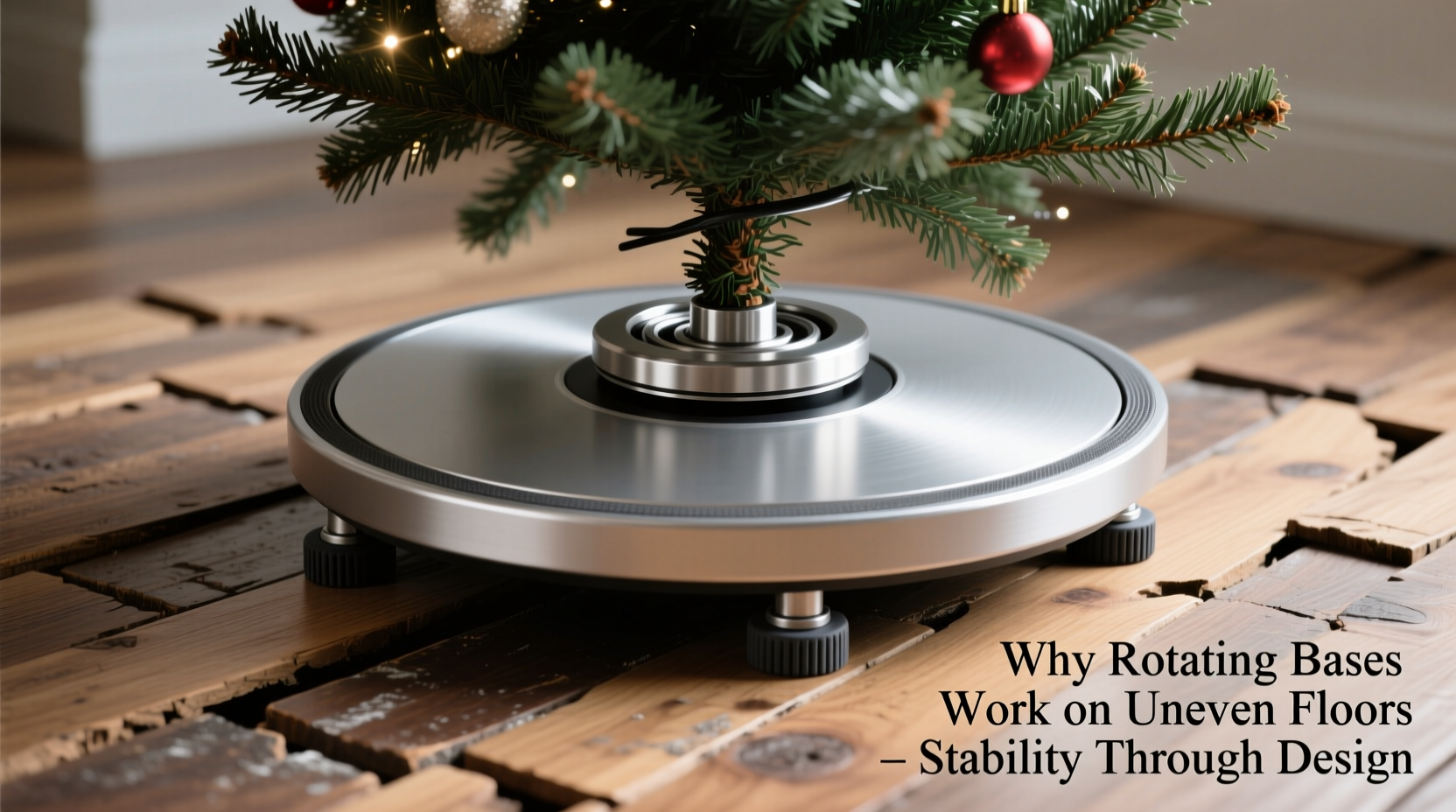
Many homes, especially those built decades ago, have floors that aren’t perfectly level. Even newer constructions can exhibit subtle gradients due to foundation settling, subfloor installation variances, or material expansion over time. These discrepancies may go unnoticed in daily life—but become glaringly obvious when trying to position a tall, top-heavy object like a Christmas tree.
When a traditional tree stand is placed on an uneven surface, several issues arise:
- Tilting: The tree leans visibly in one direction, creating an unappealing visual imbalance.
- Instability: A tilted center of gravity increases the risk of tipping, especially if pets or children brush against it.
- Water Spillage: Most real trees require regular watering. A slanted base causes water to pool on one side and potentially overflow.
- Difficult Decoration: Decorating becomes awkward when one side of the tree is closer to the ground than the other.
Traditional solutions—like shimming under the stand with cardboard or wood scraps—are temporary and unreliable. They don’t address rotational access or long-term stability. Rotating bases, however, are engineered specifically to overcome these limitations through advanced leveling mechanisms.
How Rotating Bases Compensate for Floor Irregularities
A high-quality rotating Christmas tree base isn’t simply a turntable with clamps. It’s a precision-engineered system that combines load-bearing durability with micro-adjustments to ensure vertical alignment regardless of floor conditions.
These bases typically feature three core components:
- Swivel Platform: Allows 360-degree rotation, enabling easy decoration without moving chairs or ladders.
- Leveling Feet or Adjustable Bolts: Located beneath the base, these can be raised or lowered independently to counteract slope.
- Tree Clamp System: Secures the trunk firmly while allowing slight angular correction within the stand.
When placed on an uneven floor, users adjust the leveling feet until the platform sits horizontally. Once balanced, the entire assembly—including the tree—rotates smoothly around a true vertical axis. This eliminates wobbling and ensures even weight distribution across the support points.
The result is a stable, upright tree—even if the floor drops half an inch over four feet. Some premium models even include built-in bubble levels so users can verify balance without additional tools.
Benefits Beyond Stability
While correcting for uneven floors is a primary advantage, rotating bases offer several secondary benefits that improve the overall holiday experience.
Easier Decoration and Maintenance
Reaching every branch of a six- or seven-foot tree usually requires constant repositioning. With a rotating base, you stay in one spot while the tree comes to you. This reduces physical strain and minimizes the chance of knocking ornaments loose during adjustments.
It also simplifies tasks like stringing garlands evenly or checking light connections. After decorating, rotating makes it easier to inspect for gaps or tangled wires—without walking around the tree repeatedly.
Improved Water Access and Safety
For real trees, hydration is critical. A dry tree not only sheds needles faster but also becomes a fire hazard near lights and heaters. On a tilted stand, water reservoirs drain unevenly, exposing roots prematurely.
Rotating bases keep the water tray level, ensuring consistent immersion of the cut trunk end. Many models integrate large-capacity tanks (holding up to two gallons) with external refill ports, so you never have to tip the tree to add water.
“Proper hydration starts with proper positioning. If your tree isn’t standing straight, neither is its water uptake.” — Dr. Laura Simmons, Arborist & Holiday Tree Specialist
Space Efficiency in Tight Rooms
In smaller living areas, furniture layout often forces the tree into corners or against walls. A non-rotating stand limits access to only part of the tree, leading to sparse decoration on the backside.
With a rotating base, full access is maintained regardless of placement. You can tuck the tree snugly into a corner and still decorate it completely by turning it as needed.
Real-World Example: Restoring Balance in a Historic Home
Sarah Thompson lives in a 1920s Craftsman-style house in Portland, Oregon. Each year, she struggled with her Douglas fir leaning toward the front of the room—a telltale sign of a sloped floor common in older structures.
“I tried everything—wood shims, folded towels, even adjusting the stand screws mid-season,” she recalls. “But nothing kept it steady after the first week.”
Last holiday season, Sarah invested in a heavy-duty rotating base with adjustable leveling feet. Within ten minutes of setup, she had the tree perfectly vertical despite a measurable 1.2-inch drop from back to front across the room.
“The difference was night and day,” she says. “Not only did it look better, but I could actually rotate it to finish decorating the far side. And no more spilled water on the hardwood.”
This scenario reflects what many homeowners face: structural charm comes with practical trade-offs. Rotating bases provide a modern solution to a timeless problem.
Choosing the Right Rotating Base for Your Needs
Not all rotating stands are created equal. When selecting one for use on uneven floors, consider the following factors:
| Feature | Why It Matters | Recommended Spec |
|---|---|---|
| Adjustable Leveling Feet | Compensates for floor slope; allows independent height tuning | At least 3 screw-adjustable feet with 1+ inch travel range |
| Weight Capacity | Supports taller or denser trees without sagging | Minimum 75 lbs for real trees; 50 lbs for artificial |
| Rotation Mechanism | Smooth turning without binding or resistance | Ball-bearing or gear-driven turntable |
| Trunk Clamp Type | Holds tree securely while allowing minor angle correction | Metal U-bolt with wing nuts or ratcheting lever |
| Water Reservoir | Prevents drying and supports hydration on level plane | Integrated tank with 1–2 gallon capacity and fill gauge |
Step-by-Step Setup Guide for Uneven Floors
Follow this process to install your rotating Christmas tree base correctly on an uneven surface:
- Select the Location: Choose where you want the tree, keeping clearance from heat sources and foot traffic.
- Test Floor Level: Place a spirit level on the floor in both directions (front-to-back, side-to-side). Note which way it slopes.
- Assemble the Base: Attach the legs or leveling feet loosely—do not fully tighten yet.
- Position and Pre-Level: Set the base in place. Rotate the adjustable feet to lift the lower side(s) until the platform is horizontal.
- Verify with Level: Double-check the platform surface with your level. Make fine adjustments as needed.
- Secure the Base: Tighten all locking mechanisms to prevent shifting under load.
- Insert the Tree: Center the trunk and tighten the clamp gradually, checking that the tree remains plumb.
- Final Rotation Test: Gently spin the tree to confirm smooth movement and no wobble.
- Add Water (if applicable): Fill the reservoir to the recommended line and monitor daily.
This method ensures maximum stability and longevity throughout the season.
Frequently Asked Questions
Can a rotating base fix any degree of floor slope?
Most quality rotating bases can compensate for slopes up to about 1.5 inches over a four-foot span. Beyond that, structural modifications or alternative placements may be necessary. Always check the manufacturer’s specifications for maximum adjustment range.
Are rotating bases compatible with artificial trees?
Yes, most are. However, ensure the center pole of your artificial tree fits within the clamp diameter. Some slim poles may require an adapter or foam padding to secure properly.
Do rotating bases require maintenance?
Minimal upkeep is required. After the season, clean the water tank thoroughly, dry all metal parts to prevent rust, and store in a cool, dry place. Check bearings annually for smooth operation.
Conclusion: A Smart Investment for Every Home
A Christmas tree should inspire joy, not frustration. Yet for countless families, the annual ritual begins with battling crooked floors and wobbly stands. Rotating Christmas tree bases eliminate this struggle by combining intelligent design with practical engineering.
Their ability to adapt to uneven surfaces isn't just a convenience—it's a fundamental upgrade in safety, aesthetics, and usability. From historic homes with aged joists to modern apartments with subtle concrete dips, these bases deliver reliable performance where standard stands fall short.
By investing in a well-built rotating base, you're not just buying a piece of hardware—you're securing peace of mind, saving time, and enhancing the beauty of your holiday display. As seasonal traditions evolve, smart solutions like these ensure that the focus stays where it belongs: on celebration, connection, and the warmth of the season.




 浙公网安备
33010002000092号
浙公网安备
33010002000092号 浙B2-20120091-4
Comments
No comments yet. Why don't you start the discussion?