
The term \"semi\" is everywhere in North America. From highways to diners, people refer to massive freight trucks as “semis” without a second thought. But if you’ve ever wondered why these vehicles are called \"semis,\" you’re not alone. The name doesn’t describe their size or power—it refers to a specific engineering feature that dates back over a century. Understanding the origin of the word reveals much about transportation history, technical design, and how language evolves alongside technology.
The Technical Definition: What Makes a Semi a Semi?
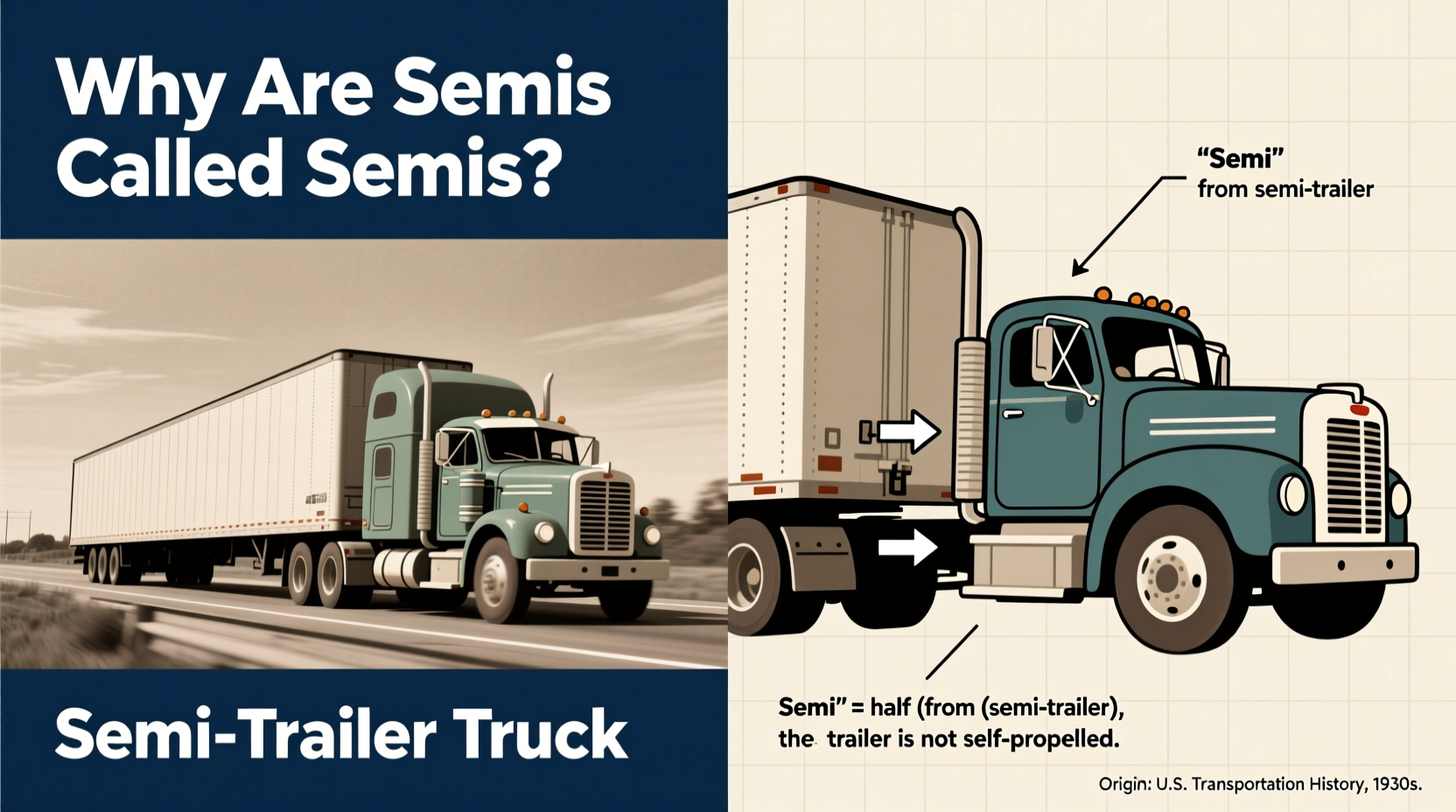
The word “semi” is short for “semi-trailer.” A semi-trailer is a trailer without a front axle. Instead, it relies on a portion of its weight being supported by the tractor unit (the truck cab) via a coupling device known as a fifth wheel. This setup distinguishes it from full trailers, which have both front and rear axles and carry their own weight independently.
Because the trailer is only “partially” supported by its own wheels—hence “semi”—it’s literally a *half* trailer in structural function. This design allows for greater load capacity, improved maneuverability, and easier hitching and unhitching compared to full trailers.
Historical Roots: From Horses to Highways
The concept of the semi-trailer predates the automobile. In the late 1800s, horse-drawn wagons began using detachable trailers to haul extra cargo. These early versions were rudimentary but followed the same principle: a front-supported trailer carrying part of its weight on the towing vehicle.
The real breakthrough came in 1914 when August Fruehauf, a blacksmith from Detroit, built the first modern semi-trailer for a farmer who needed to transport his logging equipment. Fruehauf mounted a wooden trailer on a Model T chassis, creating what he called a “semi-trailer” because it was only partially self-supporting. The invention was so successful that he founded the Fruehauf Trailer Corporation, which became one of the largest trailer manufacturers in the world.
As trucks replaced horses and roads improved, the semi-trailer became essential to long-haul freight. By the 1930s, with the expansion of paved highways and the growth of interstate commerce, semi-trucks dominated freight transport. The term “semi” gradually shifted from describing the trailer to referring to the entire rig—the combination of tractor and trailer.
“Fruehauf didn’t just invent a trailer—he revolutionized logistics. The semi-trailer made large-scale distribution possible.” — Dr. Linda Chen, Transportation Historian, University of Michigan
Why Not Just Call It a Truck?
Language often simplifies complex terms. While technically correct to say “tractor-trailer” or “semi-trailer truck,” most people opt for brevity. “Semi” is quick, recognizable, and distinct from other types of trucks like box trucks or dump trucks.
In everyday usage, “semi” now refers to the whole vehicle system: the cab, engine, and attached trailer. This linguistic shift mirrors how words like “van” or “sedan” came to represent entire vehicle classes rather than just body styles.
Outside North America, different terms prevail. In the UK, these vehicles are commonly called “articulated lorries” or “artics,” short for “articulated trucks,” referring to the joint between the cab and trailer. Australians often say “prime mover” for the tractor unit and “semi-trailer” for the full rig. Yet “semi” remains dominant in U.S. and Canadian English due to its simplicity and cultural entrenchment.
How Semis Work: A Structural Breakdown
To fully appreciate why they’re called semis, it helps to understand their mechanical design. Below is a comparison of key components in semi-trailers versus full trailers.
| Feature | Semi-Trailer | Full Trailer |
|---|---|---|
| Front Axle | No front axle; rests on tractor | Has front and rear axles |
| Weight Distribution | ~60% on trailer axles, ~40% on tractor | 100% supported by its own axles |
| Hitch Type | Fifth wheel coupling | Tongue and ball hitch |
| Maneuverability | High (tighter turning radius) | Lower (longer turning radius) |
| Common Use | Long-haul freight, intermodal transport | Recreational towing, small freight |
This design allows semi-trucks to carry up to 80,000 pounds legally in the U.S., making them the backbone of domestic supply chains. Without the semi-trailer’s weight-sharing structure, such loads would be impractical or unsafe.
Common Misconceptions About the Name
Several myths persist about why they’re called semis. Some believe “semi” refers to the truck being “halfway” between a car and a train, while others think it means “semi-large” or “semi-powerful.” None of these are accurate.
- Myth: “Semi” means the truck is half the size of a train.
- Reality: The term is purely mechanical, referring to the trailer’s partial support system.
- Myth: All big rigs are called semis regardless of design.
- Reality: True semis use fifth-wheel couplings. Vehicles like B-doubles or road trains are multi-articulated but still based on semi-trailer principles.
Mini Case Study: The Evolution of a Freight Route
In 1955, a Midwestern manufacturer shipped appliances using full trailers pulled by heavy-duty trucks. Each trailer required a separate hitch and had limited capacity. Loading was slow, and fuel efficiency was poor.
By 1970, the company switched to semi-trailers. They adopted standardized 53-foot dry vans connected via fifth wheels. The change reduced loading time by 40%, increased payload per trip, and cut fuel costs per ton-mile by nearly 30%. Drivers reported better handling and braking control.
Today, that same company uses aerodynamic tractors pulling double-semi configurations on major routes. The core innovation—the semi-trailer design—remains unchanged. The name “semi” has endured not just linguistically, but functionally, as the foundation of modern freight.
Practical Checklist: Identifying a Semi on the Road
Want to spot a true semi-truck? Use this quick checklist:
- Look for a gap between the cab and trailer where the fifth wheel connects.
- Notice that the trailer has no front wheels—it starts at the rear axle.
- Check for a kingpin under the front of the trailer that locks into the tractor.
- Observe the articulation point; the trailer bends relative to the cab during turns.
- Listen for the distinct sound of air brakes releasing when parked.
Frequently Asked Questions
Is a semi the same as an 18-wheeler?
Most 18-wheelers are semis, but not all semis have exactly 18 wheels. The term “18-wheeler” refers to the typical wheel count: 2 on the steering axle, 8 on the drive axles (twin duals), and 8 on the trailer axles. However, some configurations vary, especially with tri-axle trailers or lift axles.
Why don’t semi-trailers have front wheels?
They don’t need them. The front of the trailer is supported by the tractor’s fifth wheel, which bears about a third of the trailer’s weight. Adding front wheels would increase complexity, cost, and maintenance without benefit.
Can a semi-trailer be used without a tractor?
No. A semi-trailer cannot stand on its own. It must be coupled to a tractor or dolly to remain upright. When detached, it must be supported by landing gear at the front.
Conclusion: More Than Just a Nickname
The term “semi” may seem casual, even slang-like, but it’s rooted in precise engineering. It reflects a pivotal innovation in transportation—one that enabled the movement of goods across continents efficiently and reliably. Calling it a “semi” isn’t lazy shorthand; it’s a nod to a design that carries the weight of modern commerce.
Understanding the origin of the name adds depth to something we often take for granted. Every time you pass a semi on the highway, you’re seeing more than a truck—you’re witnessing the legacy of a simple yet revolutionary idea: a trailer that’s only half independent, but fully indispensable.




 浙公网安备
33010002000092号
浙公网安备
33010002000092号 浙B2-20120091-4
Comments
No comments yet. Why don't you start the discussion?