
Snowflakes have long captured human imagination—not just for their delicate beauty, but for their uncanny symmetry. Each flake appears as a perfectly balanced six-pointed star, with arms that mirror one another in intricate patterns. But what causes this symmetry? How can something formed in the chaos of a winter cloud maintain such precise order? The answer lies in the physics of water molecules, atmospheric conditions, and the quiet elegance of crystalline growth.
Despite common myths, no two snowflakes are exactly alike—but nearly all share a hexagonal symmetry. This isn’t random; it’s dictated by the molecular structure of ice. Understanding why snowflakes are symmetrical reveals a deeper story about nature’s ability to create complex order from simple rules.
The Molecular Blueprint: Why Six Sides?
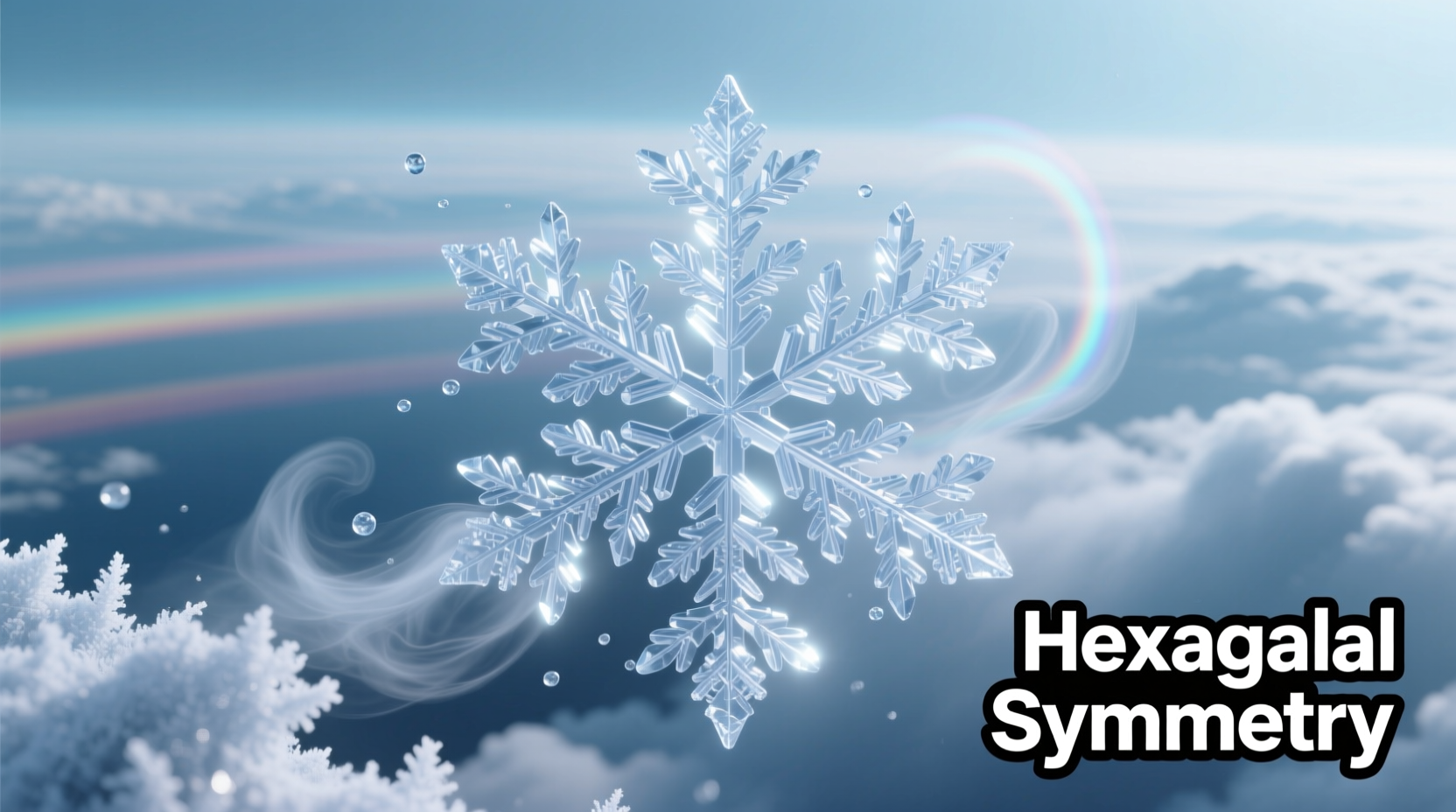
The symmetry of a snowflake begins at the atomic level. Water is composed of two hydrogen atoms bonded to one oxygen atom (H₂O). When water vapor cools below freezing in the atmosphere, these molecules begin to arrange themselves into a solid lattice—ice. Due to the angle of hydrogen bonds, water molecules naturally form a hexagonal (six-sided) ring structure when they freeze.
This hexagonal arrangement is the foundation of every snowflake. As more water vapor condenses and freezes onto the initial ice nucleus—often a speck of dust or pollen—the crystal grows outward from each of the six corners. Because each arm is exposed to nearly identical temperature and humidity conditions as the flake tumbles through the cloud, they grow in near-perfect synchrony.
“Snowflakes are a perfect example of how microscopic order translates into macroscopic beauty. The symmetry isn’t imposed—it emerges.” — Dr. Kenneth Libbrecht, Physicist and Snowflake Researcher, Caltech
How Symmetry Develops During Descent
A snowflake doesn’t form fully shaped at once. It begins as a tiny hexagonal prism and grows as it moves through varying layers of the atmosphere. The path each snowflake takes is unique, passing through different temperatures and humidity levels. These environmental fluctuations determine the branching patterns—whether the flake develops plates, dendrites, columns, or needles.
Yet despite this variability, symmetry persists because all six arms experience the same changes at roughly the same time. Think of it like six siblings growing up in the same household: though each may have a distinct personality, they’re shaped by the same environment.
Factors Influencing Snowflake Structure
The final appearance of a snowflake depends on two key atmospheric variables:
- Temperature: Determines the basic crystal habit. For example, thin plates form around -2°C, while needle-like crystals appear near -5°C, and complex dendrites emerge around -15°C.
- Humidity: Higher moisture levels lead to more branching and elaborate structures. Low humidity results in simpler, smaller crystals.
This means a single snowflake might start as a hexagon, develop branches at -12°C, then encounter a warmer layer that adds small plates to its arms—all while maintaining symmetry because all sides respond identically to the same shifts.
Why Aren’t All Snowflakes Identical?
If the process is so orderly, why do we say no two snowflakes are alike? The answer lies in sensitivity. A snowflake’s growth is exquisitely sensitive to micro-changes in its environment. Even a slight fluctuation in temperature or vapor density—on the scale of fractions of a degree—can alter where a new branch forms.
Since no two snowflakes follow the exact same atmospheric path, their detailed structures diverge over time. While their overall symmetry remains, the fine details—like the length of side branches or the placement of tiny ridges—become unique.
Wilson “Snowflake” Bentley, the first known photographer of individual snowflakes in the 1880s, captured over 5,000 images and never found a duplicate. Modern research confirms his observation: even flakes grown under controlled lab conditions show subtle differences unless conditions are perfectly uniform.
Mini Case Study: The Lab-Grown Snowflake
In Dr. Kenneth Libbrecht’s laboratory at Caltech, researchers grow snowflakes in controlled chambers where temperature and humidity are precisely regulated. Under these ideal conditions, they’ve produced pairs of nearly identical snowflakes—something rarely seen in nature.
One experiment involved growing two crystals simultaneously in the same chamber, ensuring identical conditions. The resulting flakes were mirror images in structure, with matching branching patterns. This demonstrated that symmetry arises not from chance, but from consistent physical laws acting uniformly across the crystal.
However, even in the lab, minute disturbances—such as air currents or electrical charges—can introduce asymmetry. In nature, such disturbances are constant, which is why perfect symmetry is rare beyond the primary six-fold pattern.
Common Misconceptions About Snowflake Symmetry
Several myths persist about snowflakes:
- Myth: All snowflakes are perfectly symmetrical.
Reality: Many are slightly lopsided due to collisions, melting, or uneven growth. - Myth: Snowflakes freeze instantly as they fall.
Reality: They grow gradually over 30 minutes to an hour as they descend. - Myth: Their shape is random.
Reality: Shape is predictable based on temperature and humidity zones.
| Temperature Range (°C) | Typical Snowflake Form |
|---|---|
| -0.5 to -3 | Thin hexagonal plates |
| -5 to -10 | Needles or columns |
| -12 to -16 | Branched dendrites (classic snowflake) |
| -16 to -22 | Thicker plates and columns |
| Below -22 | Small crystals and irregular forms |
Step-by-Step: How a Snowflake Forms
- Nucleation: A water vapor molecule clusters around a microscopic particle in the cloud, forming the first ice crystal—a hexagonal prism.
- Initial Growth: Vapor deposits onto the six corners of the prism, which are energetically favorable sites for attachment.
- Branching: At certain temperatures, corners sprout tiny protrusions that grow faster than flat surfaces, leading to arms.
- Environmental Response: As the flake drifts through changing air layers, each arm responds identically to shifts in temperature and humidity.
- Descent and Final Shape: The fully formed crystal falls to the ground, preserving its symmetrical structure unless disrupted by wind or partial melting.
Frequently Asked Questions
Can snowflakes be asymmetrical?
Yes. While most exhibit six-fold symmetry, collisions with other particles, uneven melting, or turbulent air can distort one or more arms. However, the underlying hexagonal structure usually remains visible.
Do all snowflakes have six sides?
Virtually all do. Three-sided snowflakes have been reported but are extremely rare and likely the result of observational error or unusual growth conditions. The six-sided pattern is a direct consequence of water’s molecular geometry.
Can you predict what a snowflake will look like?
To some extent. Scientists use temperature and humidity profiles to predict general categories—like dendrites or columns—but the fine details remain unpredictable due to chaotic atmospheric variations.
Checklist: Observing Snowflake Symmetry
- Wait for fresh, undisturbed snowfall during calm weather.
- Cool a black felt-covered board or tray in the freezer before use.
- Catch falling flakes directly to avoid damage from impact.
- Use a magnifying glass or low-power microscope for detail.
- Note the general shape and symmetry—look for six arms or facets.
- Sketch or photograph quickly before melting occurs.
Conclusion: Nature’s Delicate Balance of Order and Uniqueness
The symmetry of snowflakes is a testament to the hidden order within nature. From the hexagonal dance of water molecules to the gentle shaping forces of the atmosphere, each flake tells a story of physical law and environmental history. While no two are identical, their shared symmetry links them to a universal blueprint—one written in ice and shaped by the sky.
Next time you see snow falling, remember: each flake is a fleeting masterpiece of natural engineering. Whether you're a curious observer or a dedicated scientist, there’s wonder in understanding how such perfection arises from simplicity.




 浙公网安备
33010002000092号
浙公网安备
33010002000092号 浙B2-20120091-4
Comments
No comments yet. Why don't you start the discussion?