
The term \"GI\" is instantly recognizable in American culture as a nickname for U.S. soldiers, but its origins are far more technical than patriotic. Over decades, it has evolved from a mundane military designation into a symbol of resilience, duty, and national identity. Understanding why soldiers are called \"GI\" requires unpacking both linguistic history and cultural transformation. This article traces the phrase from its bureaucratic beginnings to its iconic status, offering clarity on how a simple abbreviation came to represent millions of service members.
The Literal Origin: What Does \"GI\" Stand For?
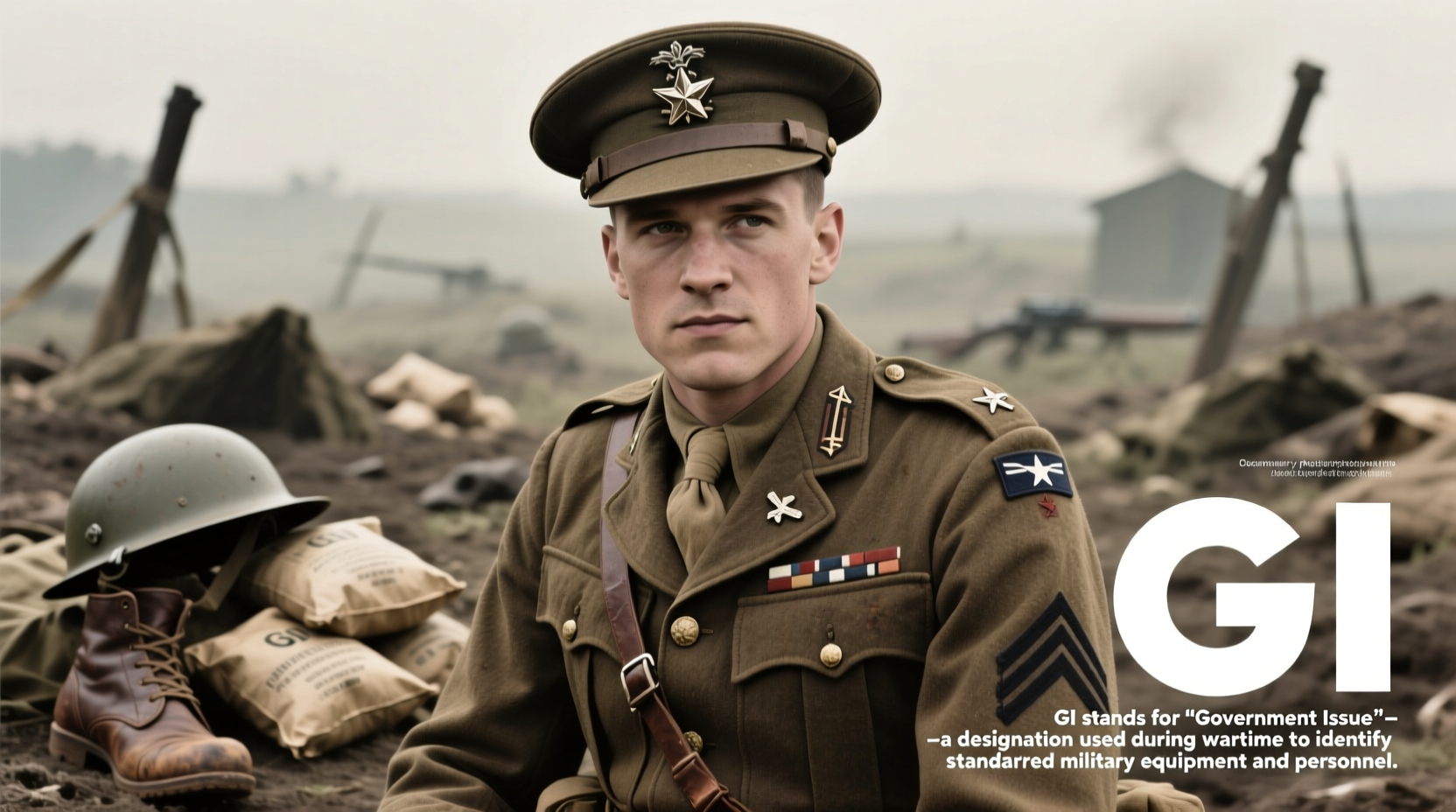
\"GI\" originally stood for \"Government Issue\" or \"General Issue\"—a label used by the U.S. Army to mark equipment, supplies, and clothing manufactured for military use. It was not initially associated with people at all. In the early 20th century, items like boots, helmets, mess kits, and uniforms were stamped with \"GI\" to indicate they were property of the federal government and standardized across units.
The term first appeared in official Army paperwork around World War I. Soldiers began referring to their gear as \"GI stuff,\" and eventually, the label extended to the men themselves. By the 1930s and especially during World War II, \"GI Joe\" emerged as a popular way to describe the average American infantryman—anonymous, uniformed, and issued everything he needed by the government.
“GI wasn’t meant to be heroic—it was logistical. But language has a way of turning procedure into poetry.” — Dr. Robert Mallory, Military Historian, U.S. Army War College
From Equipment Label to National Symbol
The shift from object to person happened gradually through usage and media influence. During the interwar period, cartoonists and journalists began using \"GI\" humorously or affectionately when writing about enlisted men. The 1940 introduction of the comic strip *GI Joe* by Dave Breger cemented the term in public consciousness. Breger, himself a soldier during WWII, used the phrase in a weekly feature published in *Yank, the Army Weekly*, portraying the everyday struggles and dark humor of military life.
By the mid-1940s, \"GI Joe\" had become synonymous with the archetype of the American foot soldier—stoic, adaptable, and enduring. The image was reinforced by war correspondents who described “the GI advancing through mud and gunfire,” emphasizing both vulnerability and grit. Hollywood soon followed, casting clean-cut, determined actors to play GI roles in films that shaped postwar perceptions of heroism.
Linguistic Evolution and Misconceptions
A common misconception is that \"GI\" stands for \"galvanized iron,\" referencing the metal cans used in field kitchens during WWI. While some older texts do show this usage—particularly in reference to trash cans or water barrels—the link to soldiers is tenuous. The galvanized iron theory likely arose from phonetic similarity and anecdotal storytelling rather than documented policy.
Linguists argue that \"Government Issue\" gained dominance because it fit the bureaucratic reality of mass conscription. As the U.S. mobilized millions of men during WWII, individuality was subsumed under standardization. Every recruit received identical haircuts, uniforms, rifles, and rations—all marked or understood as government property. In this environment, calling a soldier \"a GI\" was both literal and ironic: he was issued like any other piece of equipment.
Timeline: The Rise of the Term \"GI\"
- 1917–1918: U.S. enters WWI; \"GI\" appears on military supplies labeled \"Government Inspection\" or \"General Issue.\"
- 1920s: Soldiers begin using \"GI\" informally to describe their gear and living conditions.
- 1936: First known print use of \"GI Joe\" in a satirical column.
- 1940: Dave Breger’s comic strip popularizes \"GI Joe\" in military publications.
- 1944: U.S. War Department uses \"GI Joe\" officially in training materials and propaganda.
- 1960s: Toy manufacturer Hasbro launches the \"G.I. Joe\" action figure, redefining the term for new generations.
Cultural Impact and Modern Usage
The legacy of \"GI\" extends well beyond the battlefield. After WWII, veterans’ organizations, memorials, and literature embraced the term as a badge of honor. Phrases like \"the GI generation\" (popularized by historian Tom Brokaw) evoke a sense of collective sacrifice and civic responsibility. Today, \"GI\" appears in idioms such as \"going the extra mile like a GI\" or \"tough as a GI,\" reflecting enduring respect for military endurance.
The 1964 launch of the G.I. Joe toy line transformed the term once again—this time into a commercial brand. Initially marketed as a \"moveable fighting man,\" the doll allowed boys to engage with military themes in a sanitized, heroic format. Though criticized later for glorifying war, the franchise kept the term alive during peacetime and introduced it globally.
In contemporary discourse, \"GI\" remains widely understood, though younger generations may associate it more with toys or pop culture than actual soldiers. Still, within military communities, the term retains authenticity. Service members often use \"GI\" self-deprecatingly—\"just another GI\"—to acknowledge the routine demands of military life.
Table: Evolution of the Term \"GI\" Across Eras
| Era | Primary Meaning | Context | Public Perception |
|---|---|---|---|
| 1910s–1920s | Government/General Issue (equipment) | Military logistics | Neutral, bureaucratic |
| 1930s–1940s | Soldier (\"GI Joe\") | WWII media and comics | Respectful, humorous, relatable |
| 1950s–1960s | American warrior ideal | Propaganda, Cold War narratives | Patriotic, heroic |
| 1970s–present | Cultural icon / nostalgic brand | Toys, films, veteran advocacy | Mixed: respectful yet commercialized |
Mini Case Study: The Voice of the GI in Wartime Journalism
During the Battle of the Bulge in December 1944, journalist Ernie Pyle embedded with U.S. infantry units in Belgium. His dispatches, published in over 400 American newspapers, consistently referred to soldiers as \"GIs.\" One famous column opens: “The best man I know out here is the weary GI trudging through snow and fear, asking for nothing but to get the job done.”
Pyle didn’t invent the term, but his empathetic portrayal gave it emotional weight. Readers back home saw their sons, brothers, and husbands reflected in his descriptions—not as faceless troops, but as individuals bearing unimaginable strain. His work helped transform \"GI\" from slang into a symbol of quiet courage. Tragically, Pyle was killed in 1945 while covering the Pacific campaign, but his writings remain a cornerstone of how Americans understand the GI experience.
Frequently Asked Questions
Is \"GI\" still used today in the military?
Yes, though less formally. Active-duty personnel may use \"GI\" casually, particularly to refer to junior enlisted soldiers. However, terms like \"soldier,\" \"marine,\" or \"troop\" are more precise and commonly preferred in official contexts.
Does \"GI\" apply to all branches of the military?
Originally tied to the Army, \"GI\" is sometimes used loosely for any U.S. service member. However, veterans from the Navy, Air Force, or Marines may resist the label, as it carries strong Army connotations. Context matters—using \"service member\" is more inclusive.
Was \"GI Joe\" a real person?
No. \"GI Joe\" is a composite figure representing the average enlisted man. However, in 2008, the U.S. Postal Service honored a real WWII medic, Joseph Mueller, on a stamp titled \"GI Joe,\" blurring the line between myth and individual bravery.
Checklist: Understanding the Term \"GI\" in Context
- Recognize that \"GI\" began as a label for equipment, not people.
- Understand the shift during WWII from bureaucratic term to cultural symbol.
- Distinguish between \"GI\" as slang and formal military designations.
- Be mindful of context—using \"GI\" today can be respectful or reductive depending on tone.
- Explore primary sources like wartime letters, comics, and journalism to see how the term evolved organically.
Conclusion: More Than an Abbreviation
The story of \"GI\" is ultimately about how language reflects society. What started as a stencil on a steel helmet became a tribute to human perseverance. To call someone a GI is no longer just to note their uniform—it’s to acknowledge a tradition of service, sacrifice, and solidarity. Whether reading a WWII letter, watching a classic war film, or seeing a child play with a decades-old action figure, the echo of \"GI\" persists.




 浙公网安备
33010002000092号
浙公网安备
33010002000092号 浙B2-20120091-4
Comments
No comments yet. Why don't you start the discussion?