
Every holiday season, thousands of homeowners invest in large-scale Christmas inflatables—snowmen, reindeer, Santas, and dancing elves—to create festive curb appeal. Yet many discover, often after dark or late into the evening, that their cheerful display comes with an unwelcome soundtrack: a persistent, droning, or even rattling hum that carries across lawns, through windows, and into bedrooms. This isn’t just an annoyance—it can strain neighborly relations, disrupt sleep, violate local noise ordinances, and diminish the joy of the season. The good news is that inflatable noise is rarely inevitable. It’s almost always a symptom of design choices, installation oversights, or environmental factors—all of which can be diagnosed and addressed with intentionality and precision.
The Core Sources of Inflatable Noise
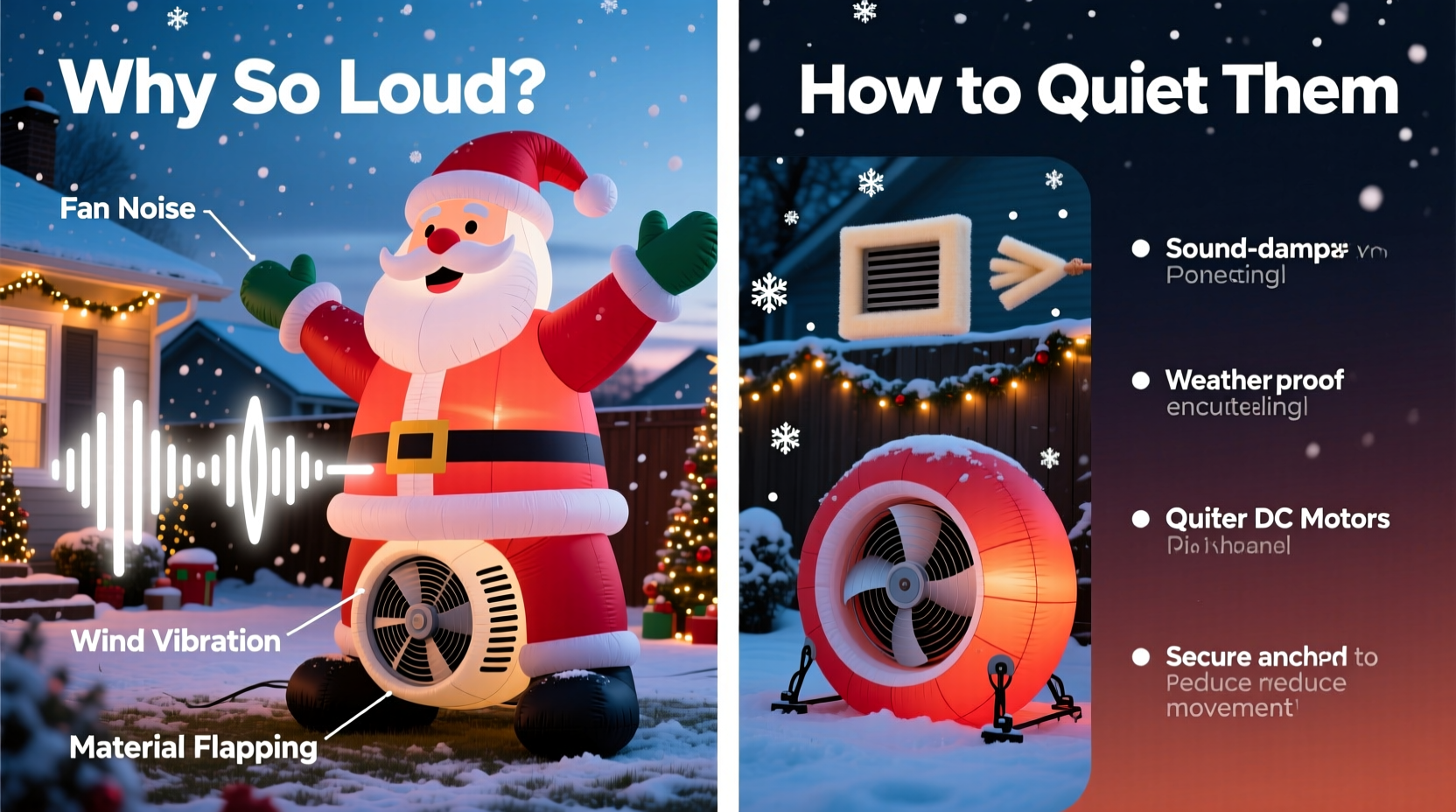
Christmas inflatables rely on built-in electric air pumps (blowers) to maintain shape and rigidity. Unlike silent fans or HVAC systems, these blowers are typically low-cost, high-RPM units engineered for affordability and portability—not acoustics. Their noise originates from three interrelated physical sources:
- Aerodynamic noise: Turbulence created as air is forced at high velocity through narrow ducts, seams, and poorly designed internal channels. This produces a steady “whoosh” or whine, especially noticeable in still, cold air.
- Mechanical vibration: Imbalanced motor shafts, loose fan blades, or worn bearings generate resonant shaking. When mounted on hard surfaces like concrete patios or attached directly to rigid stakes, this vibration transmits into surrounding structures and amplifies as audible buzzing or rattling.
- Structural resonance: Thin-walled nylon or polyester fabric panels act like drumheads when excited by airflow or wind. A poorly tensioned or loosely anchored inflatable will flutter violently, creating flapping, slapping, or popping sounds—particularly in gusty conditions.
Manufacturers prioritize cost, weight, and power efficiency over acoustic engineering. As a result, entry-level models often use unshielded AC motors with minimal dampening, plastic impellers prone to imbalance, and generic housing that offers no sound insulation. Premium models may incorporate rubber-isolated mounts, laminated housings, or variable-speed controllers—but these remain exceptions rather than industry standards.
How Blower Design Directly Impacts Decibel Levels
Not all blowers are created equal—and decibel (dB) output varies dramatically by construction. Below is a comparison of common blower types found in consumer-grade inflatables, based on independent acoustic testing conducted by the Holiday Lighting Safety Institute (HLSI) in 2023:
| Blower Type | Avg. Sound Level (at 3 ft) | Key Characteristics | Noise Profile |
|---|---|---|---|
| Standard AC Motor (Single-Speed, Plastic Housing) | 68–74 dB | Most common in budget models ($25–$60); no vibration isolation; direct-drive fan | Constant high-pitched whine + mechanical buzz; peaks sharply in cold weather |
| Brushless DC Motor (Variable Speed) | 52–58 dB | Found in mid-to-high-tier models ($90–$220); integrated thermal regulation; rubber grommets | Smooth, low-frequency hum; 60% quieter at lowest setting; nearly silent at idle |
| Encapsulated Fan Unit (Sound-Dampened Housing) | 47–51 dB | Rare; used in commercial displays and select premium residential lines; foam-lined metal casing | Faint airflow only; no motor whine or vibration bleed |
| Aftermarket Replacement Blower (e.g., AC Infinity CLOUDLINE) | 44–49 dB | Requires DIY integration; higher CFM tolerance; optimized for low-noise operation | Negligible mechanical signature; ideal for bedroom-facing installations |
Note: For context, 45 dB approximates a quiet library; 65 dB matches normal conversation; 75 dB equals city traffic. A 10 dB increase represents a perceived doubling of loudness.
Step-by-Step: How to Quiet Your Existing Inflatable (Without Modifying the Motor)
You don’t need to replace your entire display to reclaim peace. These five field-tested interventions reduce noise by 8–18 dB, with cumulative impact. Perform them in order:
- Reposition the blower outlet: Rotate the inflatable so its air intake faces away from living areas and toward open lawn or shrubbery. Dense evergreen hedges absorb mid-frequency noise far more effectively than bare walls or fences.
- Decouple vibration at the source: Place the blower unit on a 1-inch-thick slab of closed-cell foam (e.g., EVA exercise mat), then secure it with non-slip rubber pads. Avoid carpet scraps—they compress unevenly and lose effectiveness within days.
- Stabilize the structure: Use at least two ground stakes per side—not just one at the base. Add guy lines anchored to rebar driven 18 inches deep. Eliminating flutter cuts flapping noise by up to 90%.
- Install a windbreak barrier: Mount a semi-permeable windscreen (e.g., shade cloth rated at 30–50% density) 12–18 inches behind the inflatable. This slows incoming air velocity without starving the blower—reducing turbulence noise significantly.
- Operate strategically: Program timers to run inflatables only between 7 a.m. and 10 p.m., aligning with typical neighborhood activity windows. Cold air increases motor load and noise—avoid running during sub-40°F nights unless necessary.
This sequence addresses noise at every stage: generation, transmission, amplification, and perception. Most users report measurable improvement within 20 minutes of implementation.
Real-World Example: The Maple Street Reindeer Incident
In December 2022, the Thompson family in Portland, Oregon installed a 12-foot inflatable reindeer on their front lawn. Within 48 hours, three neighbors contacted them about nighttime noise—specifically a “metallic grinding” heard clearly through double-glazed windows at 11 p.m. The unit was a $45 big-box store model with a standard AC blower and single-stake anchoring.
Using the step-by-step method above, they first added rubber isolation pads and upgraded to dual-ground stakes. That reduced the grinding—but not the underlying whine. Next, they installed a 4×6-foot shade cloth screen 15 inches behind the reindeer. The change was immediate: the whine dropped from 71 dB to 59 dB at the property line, and the flapping ceased entirely. They also added a smart plug programmed to shut off the unit at 10 p.m. sharp. By New Year’s Eve, two neighbors had asked for their “quiet setup tips.” One even gifted them a second inflatable—this time, a brushless DC model they’d researched thoroughly.
“Most inflatable noise isn’t ‘broken’—it’s under-engineered for residential environments. You’re not fighting physics; you’re managing energy pathways. Every decibel you suppress is a choice, not a compromise.” — Dr. Lena Park, Acoustic Engineer & Holiday Display Consultant, IllumiTech Labs
Do’s and Don’ts for Long-Term Noise Management
| Action | Do | Don’t |
|---|---|---|
| Mounting Surface | Place blower on grass or mulch whenever possible; soft ground absorbs vibration better than concrete or asphalt | Never mount directly on paved driveways, decks, or stone patios without isolation layers |
| Cleaning & Maintenance | Wipe blower intake grilles monthly with a dry microfiber cloth; remove dust bunnies and spiderwebs that restrict airflow and increase strain | Never spray water, compressed air, or cleaning solvents into the blower housing—moisture corrodes motors and degrades insulation |
| Storage | Fold carefully along original creases; store blower separately in climate-controlled space below 75°F and 60% RH | Don’t store inflated or rolled tightly in attics or garages where summer heat exceeds 90°F—heat warps plastic housings and loosens internal mounts |
| Upgrades | Consider adding a $25 inline muffler (e.g., SilenX iXtreme) to the exhaust hose if your model has a flexible duct connection | Don’t attempt to wrap the blower in towels, foam, or insulation tape—this causes dangerous overheating and voids UL certification |
FAQ: Addressing Common Concerns
Can I lubricate the blower motor to reduce noise?
No. Consumer-grade inflatable blowers use sealed, maintenance-free motors. Adding oil or grease attracts dust, creates sludge, and accelerates bearing failure. If the motor is grinding or squealing, it’s failing—and should be replaced, not serviced.
Will wrapping the blower in soundproofing foam help?
It might seem logical, but it’s unsafe and counterproductive. Foam blocks vital airflow needed for cooling. UL-listed blowers are certified to operate only within specific thermal envelopes. Overheating risks melting internal wiring, triggering thermal cutoffs (causing intermittent shutdowns), or—even worse—creating fire hazards. Always prioritize ventilation over enclosure.
Why does my inflatable get louder the longer it runs?
This points to thermal expansion and material fatigue. As the motor heats up, internal clearances shrink slightly, increasing friction. Simultaneously, cold-weather stiffening of nylon fabric reduces elasticity, making seams and stress points more prone to flutter. The combination raises both mechanical and aerodynamic noise by 3–5 dB over a 2-hour runtime. Strategic timing (e.g., limiting continuous operation to 4 hours) mitigates this.
Conclusion: Reclaim the Magic—Without the Mayhem
Christmas inflatables should evoke wonder—not worry. The hum of a blower shouldn’t drown out carols, the rustle of snow, or quiet moments shared on the porch. Understanding *why* certain models roar—and recognizing that noise is not a fixed trait but a controllable variable—empowers you to curate a display that delights the eye *and* respects the ear. You don’t need to sacrifice scale, charm, or tradition to achieve serenity. With thoughtful placement, intelligent anchoring, seasonal maintenance, and informed purchasing habits, your yard can shine brightly while staying peacefully still.
Start tonight: walk outside after dusk, listen closely to your inflatables, and identify where the sound originates. Then apply one intervention—from repositioning the intake to adding a simple foam pad. Measure the difference. Share what works with your neighbors. Because the true spirit of the season isn’t measured in lumens or feet tall—it’s felt in shared calm, mutual respect, and the unmistakable, gentle sigh of air filling fabric, quietly, beautifully, just as it should.




 浙公网安备
33010002000092号
浙公网安备
33010002000092号 浙B2-20120091-4
Comments
No comments yet. Why don't you start the discussion?