
Every holiday season, thousands of homeowners face the same frustrating ritual: a single dark bulb halts an entire strand of Christmas lights. You twist, test, and swap bulbs—only to find the socket won’t accept replacements, or worse, the strand goes completely dark with no obvious fault. This isn’t user error. It’s by design. Modern Christmas light strands increasingly use integrated circuitry, proprietary connectors, and sealed construction that render traditional bulb replacement impossible. Understanding why this happens—and how to respond—saves time, money, and seasonal sanity.
The Engineering Shift: Why Replaceability Vanished
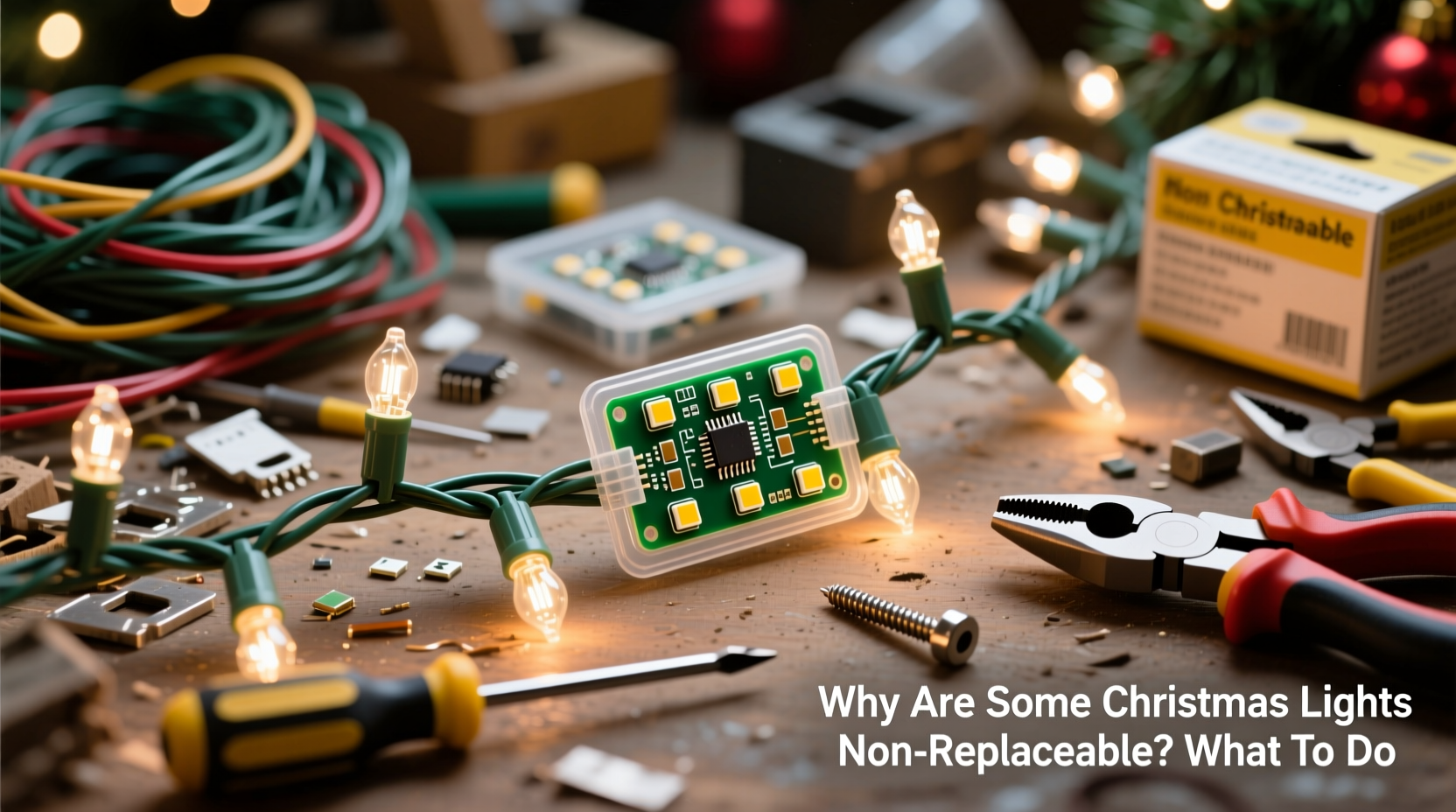
For decades, incandescent mini-lights used standardized E10 (candelabra) bases and simple series wiring. A failed filament could be swapped in seconds with any compatible bulb. Today’s market is dominated by LED technology—and while LEDs last longer, their integration has sacrificed serviceability. Three core engineering decisions explain the shift:
- Integrated LED chips: Many budget and mid-tier strands embed LEDs directly onto flexible printed circuit boards (PCBs), soldered in place with no socket interface. There’s no physical “bulb” to remove—just a tiny diode fused to copper traces.
- Constant-current driver architecture: Instead of simple resistive current limiting, many strands use microcontroller-based drivers that monitor voltage, temperature, and load. If one LED fails open-circuit, the driver may shut down the entire string—or bypass it using internal shunt paths that degrade over time and cannot be reset manually.
- Proprietary connector systems: Manufacturers like NOMA, GE, and newer brands such as Twinkly and Luminara use custom male/female plugs with unique pin counts, polarization, and data protocols. Even if you locate a physically similar bulb, its electrical signature (forward voltage, current draw, PWM compatibility) often mismatches the strand’s control logic.
This isn’t merely cost-cutting—it reflects real trade-offs. Sealed, soldered designs improve moisture resistance for outdoor use, reduce manufacturing defects, and allow tighter spacing for smoother light diffusion. But it also means the product lifecycle ends not when the LEDs fail, but when the first point of failure renders the system nonfunctional *and* unrepairable.
How to Diagnose Whether Your Strand Is Truly Non-Replaceable
Before assuming defeat, verify whether replacement is genuinely impossible—or just inconvenient. Start with these diagnostic steps:
- Check for visible sockets: Examine each bulb base under bright light. If you see a threaded metal base (E10 or E12) or push-in plastic socket, replacement *may* be possible—even if bulbs aren’t sold separately. Look for markings like “5V,” “12V,” or “24V” near the plug or controller box.
- Test continuity with a multimeter: Set your meter to continuity mode. Touch probes to the two contact points inside a dark socket (not the bulb itself). If you hear a beep, the socket is intact and likely designed for removable bulbs. No beep suggests either a broken wire or a solid-state PCB node.
- Identify the power supply type: Plug-in adapters labeled “AC/DC converter” or “LED driver” with output specs (e.g., “12V DC, 2.5A”) indicate low-voltage operation—common in non-replaceable systems. Strands labeled “120V AC” with no external transformer often use replaceable bulbs but require caution due to line-voltage hazards.
- Look for a controller or IC chip: Some strands have a small black rectangular module near the plug end or midway along the cord. This is almost always a microcontroller managing sequencing, dimming, or color changes—and signals non-replaceable architecture.
What to Do When Replacement Isn’t Possible: Practical Solutions
Once confirmed non-replaceable, don’t toss the strand yet. Several strategies restore function—or prevent recurrence next year.
1. Bypass Failed Segments (For Series-Wired Strands)
Many LED strands divide into 2–5 independent circuits (“segments”). If only part of the strand is dark, the failure may be isolated. Locate the segment boundary—usually marked by thicker insulation or a small white dot on the wire. Carefully cut the wire *just before* the dark section, strip ¼ inch of insulation from both ends, and twist-connect the live and neutral wires from the working side directly to the corresponding wires feeding the next segment. Secure with waterproof wire nuts (for outdoor use) or heat-shrink tubing. This sacrifices one segment but restores partial functionality.
2. Reuse Functional Components
A dead strand isn’t worthless. Harvest usable parts:
- Controllers and remotes: Many smart strands retain full functionality even after bulb failure. Test the controller with a known-working strand of the same brand/model—some support daisy-chaining or multi-strand sync.
- Power adapters: Output specs are usually printed on the label. If rated for 12V or 24V DC with sufficient amperage (e.g., ≥2A), it can power other compatible LED projects—from DIY signs to under-cabinet lighting.
- Wiring and plugs: The UL-listed cordage and molded connectors meet safety standards rarely found in generic replacement wire. Save them for future repairs or custom builds.
3. Retrofit with Socket Adapters (Advanced)
For technically inclined users, retrofit kits exist. Companies like Lightorama and DIY suppliers sell “LED socket adapters”—small PCBs with solder pads on one side and standard E10 sockets on the other. These mount between existing PCB nodes and accept replaceable bulbs. Requires desoldering original LEDs and precise voltage matching, but extends lifespan significantly. Not recommended for beginners or indoor-only strands where safety margins are tighter.
Smart Buying Strategies for Next Season
Prevention beats repair. Choose strands built for longevity and serviceability—not just price or flashiness. Use this comparison table when shopping:
| Feature | Replaceable-Friendly Strands | Non-Replaceable Strands | What to Look For |
|---|---|---|---|
| Bulb Type | Removable E10/E12 LED bulbs (often labeled “user-replaceable”) | Integrated SMD LEDs (no socket visible; flat lens surface) | Physical socket + packaging that states “replaceable bulbs included” |
| Wiring Architecture | Parallel or segmented series wiring (one bulb out ≠ whole strand dark) | Single-series or microcontroller-dependent topology | “Shunt technology” or “fail-safe” claims on packaging |
| Connector Standard | Universal 2- or 3-pin plugs (compatible with most extension cords) | Proprietary plugs (brand-specific shape, pins, or data lines) | Look for “standard plug” or “interchangeable with [Brand X]” |
| Warranty & Support | 2+ year limited warranty; bulb replacement packs sold separately | 90-day warranty; no spare parts listed | Check manufacturer website for “replacement bulbs” or “accessories” tab |
Brands consistently offering replaceable options include Holiday Time (Target), Novelty Lights, and commercial-grade lines like Gemmy and Larson Electronics. Avoid ultra-cheap “smart” strands under $20 unless you’re certain you’ll discard them annually—their firmware updates often sunset within 18 months, rendering controllers obsolete.
Real-World Case Study: The Community Tree Project
In Portland, Oregon, the Sellwood neighborhood association maintains a 30-foot community Christmas tree lit by 12 identical 200-light LED strands. In 2022, three strands failed entirely within six weeks of installation. Volunteers assumed bulbs were burnt out—until they discovered all three used integrated SMD LEDs with no sockets. Rather than replace all 12 strands ($480), they contacted the manufacturer (a private-label brand sold exclusively at a regional hardware chain). After escalation, the company provided free replacements—but only because the association had retained original packaging and receipts.
For 2023, they switched to Novelty Lights’ “Pro-Series” strands: E10-base LEDs, parallel wiring, and published bulb SKU numbers. When two bulbs failed this December, volunteers replaced them in under 90 seconds using spares purchased for $3.99 per 25-pack. Total maintenance cost: $0.32 per strand. “We paid 12% more upfront,” said project lead Maria Chen, “but saved over $400 in labor, disposal, and replacement costs—and gained peace of mind.”
Expert Insight: What Industry Engineers Say
“The move away from replaceable bulbs wasn’t about planned obsolescence—it was about reliability at scale. A single loose socket in a 500-light display causes intermittent shorts, fire risk, and customer returns. Soldered LEDs eliminate that vector. But we’re now seeing demand shift back: UL is drafting new standards for ‘serviceable LED lighting systems,’ and major OEMs are piloting modular bulb carriers. The next five years will balance durability with repairability.”
— Rajiv Mehta, Senior Electrical Engineer, UL Solutions Lighting Division
FAQ: Your Most Pressing Questions Answered
Can I cut a non-replaceable strand to fix one dead section?
Yes—if the strand uses segmented wiring (check for break points every 25–50 lights). Cut *only* at designated cut marks (often indicated by scissors icons or dashed lines). Never cut between marks: you’ll sever critical data or power lines. Always seal cut ends with waterproof tape or heat-shrink tubing before re-energizing.
Why do some strands say “replaceable” but don’t include spare bulbs?
Marketing language is inconsistent. “Replaceable” often means *physically possible*, not *practically supported*. Always verify whether spare bulbs are sold by the same brand, in the same color/size/voltage, and with matching SKU numbers. If not listed on the brand’s official site, assume they’re unavailable.
Is it safe to mix replaceable and non-replaceable strands on one circuit?
No. Replaceable strands typically run at higher voltages (e.g., 120V AC) and draw different current profiles than low-voltage non-replaceable ones (e.g., 12V DC). Mixing them risks overloading transformers, damaging controllers, or creating fire hazards. Use separate outlets or dedicated power supplies for each type.
Conclusion: Take Control of Your Holiday Lighting Future
Non-replaceable Christmas lights aren’t inherently flawed—they reflect evolving priorities in safety, efficiency, and mass production. But that doesn’t mean you must accept disposability as inevitable. By learning to diagnose architecture, repurpose components, and choose wisely next season, you transform frustration into agency. Every strand you repair saves landfill waste. Every informed purchase supports manufacturers investing in serviceable design. And every hour spent troubleshooting becomes knowledge that pays dividends for years—not just during December, but across seasons.
This holiday, don’t just hang lights. Understand them. Maintain them. Advocate for better design. Then share what you’ve learned—whether with neighbors troubleshooting their porch display, local schools teaching basic electronics, or online communities pushing for right-to-repair legislation in consumer lighting. The most enduring holiday tradition isn’t perfection—it’s thoughtful care, passed on.




 浙公网安备
33010002000092号
浙公网安备
33010002000092号 浙B2-20120091-4
Comments
No comments yet. Why don't you start the discussion?