
When a strand of Christmas lights fails to illuminate after plugging in—or worse, stops working partway down the string—it’s rarely random. Series-connected incandescent and many LED mini-light sets rely on a single continuous circuit: if one component interrupts current flow, the entire chain goes dark. Unlike parallel-wired commercial displays or smart lights, traditional series strings offer no redundancy. That makes diagnosing connection failures both urgent and precise. This isn’t about guesswork or replacing the whole set prematurely. It’s about understanding how voltage distributes across 50–100 bulbs, why a 2.5V bulb can’t tolerate 3.5V drift, and how a 0.02-ohm cold solder joint can kill illumination. Below is a field-tested, electrician-informed breakdown—not just of what goes wrong, but exactly how to find and fix it.
How Series Wiring Actually Works (and Why It’s Fragile)
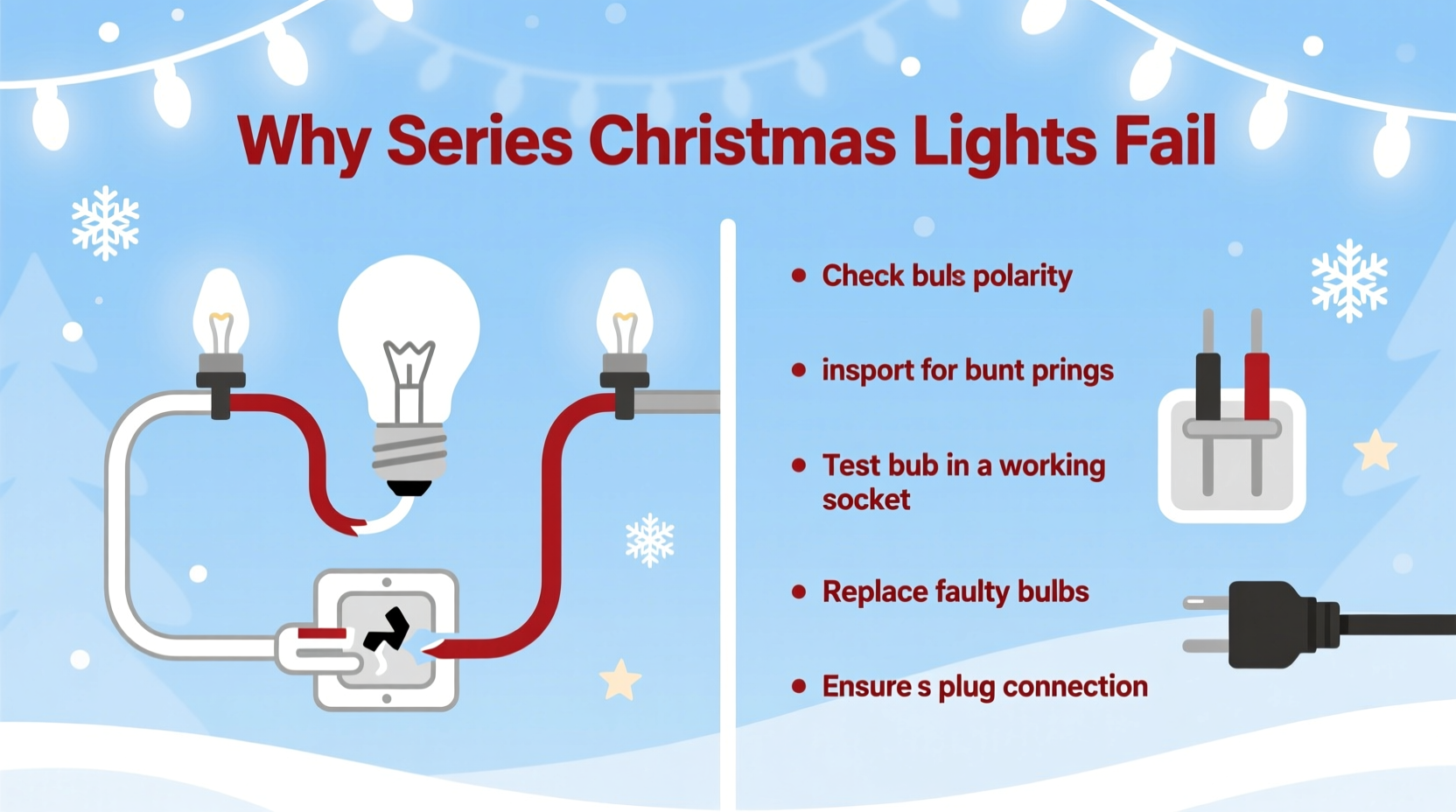
In a classic series-connected light string, electricity flows from the plug through each bulb socket in sequence—like beads on a single thread—before returning to the outlet. Each bulb acts as both load and conductor. With incandescent mini-lights, typical configurations use 50 bulbs rated at 2.5 volts each, adding up to 125V nominal—close enough to standard North American 120V supply. LED versions often use 100+ bulbs at ~1.2–1.8V each, engineered to match line voltage with precision internal resistors or shunt circuits. The critical nuance? No bulb is isolated. If one filament breaks, a socket loses contact, or a shunt fails to activate, the circuit opens—and all downstream bulbs go out.
This design prioritizes simplicity and cost over reliability. It also means troubleshooting isn’t about “which bulb is dead?” but rather “where did continuity break—and why?” Voltage drop accumulates across each bulb: even a 5% resistance increase in one socket (from corrosion or bent contacts) can reduce downstream voltage below the threshold needed for adjacent LEDs to emit light. That’s why the last 20 bulbs may glow dimly—or not at all—even if the first 30 appear fine.
Top 5 Causes & How to Diagnose Each
Most series-light failures trace to five root causes. Here’s how to identify and resolve each—without replacing the whole strand.
1. Blown Inline Fuse (Most Common)
Every series light set includes two small, glass-tube fuses—usually located inside the male plug housing. These protect against overcurrent from short circuits or moisture intrusion. One fuse handles the hot leg; the other, the neutral. If either blows, the circuit is dead. Fuses rarely fail spontaneously—they blow for a reason (e.g., a shorted bulb or pinched wire).
Diagnosis: Unplug the lights. Slide open the plug cover. Use needle-nose pliers to gently remove each fuse. Hold it up to light: if the thin wire inside is severed or blackened, it’s blown. Replace only with the exact amperage rating printed on the fuse (typically 3A or 5A). Never substitute with higher-rated fuses—this risks overheating wires.
2. Failed Shunt in an LED Bulb
Modern LED mini-lights include a tiny “shunt” (a conductive path) across each bulb’s base. When the LED fails, the shunt should activate—bypassing the dead diode and keeping the circuit closed. But shunts degrade. Moisture, heat cycling, or manufacturing defects cause them to weld shut (creating a short) or remain open (breaking the circuit).
Diagnosis: With the strand unplugged, remove bulbs one by one starting from the *end* of the string (the last socket). After removing each bulb, plug the strand in briefly. If the rest light up, the removed bulb was the faulty one—or more precisely, its shunt failed to bypass. Mark suspect bulbs and test them individually using a battery-powered LED tester or 3V coin-cell battery.
3. Socket Contact Failure
Bulb sockets rely on spring-loaded metal contacts that press against the bulb’s base. Over time, these contacts fatigue, corrode, or bend away from optimal position—especially in outdoor sets exposed to humidity and temperature swings. A loose contact creates intermittent or high-resistance connections, dropping voltage downstream.
Diagnosis: Visually inspect each socket for greenish corrosion or bent metal tabs. Gently press a bulb into each socket while the strand is plugged in (use insulated gloves). If flickering occurs, the contact is weak. Clean contacts with electrical contact cleaner and a soft brass brush. For persistent issues, replace the socket using a crimp tool and UL-listed replacement parts.
4. Wire Break or Cold Solder Joint
Internal wiring in light strings uses ultra-thin stranded copper—often 30–32 AWG. These wires flex repeatedly during storage and installation, leading to strand fractures. Worse, factory solder joints at plug terminals or between sections can develop micro-fractures (“cold joints”) that resist conduction under load.
Diagnosis: Use a multimeter in continuity mode. Start at the plug: touch one probe to the hot prong, the other to the first bulb’s hot contact. If no beep, the break is near the plug. Then test incrementally: hot prong → bulb 1 → bulb 2 → bulb 3… until continuity stops. A cold joint often shows continuity when cold but fails under load—so test while gently wiggling wires near suspected joints.
5. Voltage Mismatch Between Strands
Not all “mini-light” strands are compatible for end-to-end connection. Older incandescent strings draw 0.3–0.5A; newer LED versions draw 0.05–0.12A. More critically, their voltage-per-bulb ratings differ. Connecting a 50-bulb/2.5V string (125V total) to a 100-bulb/1.2V string (120V total) forces unequal voltage distribution—overloading some bulbs and starving others. The result? Immediate burnout or non-connection due to protective thermal cutoffs.
| Strand Type | Voltage per Bulb | Total Bulbs per String | Max Safe Connections in Series | Why Limitation Exists |
|---|---|---|---|---|
| Incandescent Mini | 2.5 V | 50 | 2–3 strings | Exceeding 3 strains transformer/fuse; voltage drop exceeds tolerance |
| Standard LED Mini | 1.2–1.8 V | 100–150 | 1 string only (unless labeled “connectable”) | Shunt design varies; most lack robust cascading circuitry |
| Commercial Grade LED | 1.5–2.0 V | 70–100 | Up to 5 strings (check label) | Engineered with reinforced shunts and low-resistance wiring |
| Constant-Current LED | N/A (regulated) | Variable | Follow manufacturer specs strictly | Uses IC drivers; mismatched strings disrupt regulation |
Step-by-Step Diagnostic Protocol
Follow this sequence methodically—skipping steps invites misdiagnosis and wasted time.
- Unplug everything. Safety first: never troubleshoot live circuits without proper PPE.
- Inspect the plug fuses. Replace if blown—but note: if they blow repeatedly, a deeper fault exists (e.g., shorted bulb or damaged insulation).
- Test bulb continuity. Using a multimeter (continuity or diode mode), check each bulb. Incandescents should show 2–10Ω resistance. LEDs should conduct in one direction only (0.4–0.8V forward drop); no conduction either way = dead LED.
- Check socket tension. Insert a known-good bulb into each socket. If it wobbles or requires excessive force, the contact is compromised.
- Trace voltage drop. Plug in the strand. Set multimeter to AC voltage. Measure between hot and neutral at the plug (should be ~120V). Then measure across bulb 1, bulb 2, bulb 3… until voltage drops >15% from expected (e.g., 2.1V instead of 2.5V). That’s your fault zone.
- Isolate the section. Cut the wire *just before* the first low-voltage bulb. Cap both ends with wire nuts. Re-test upstream bulbs. If they light, the break is downstream. Repeat until isolated.
- Repair or replace. For wire breaks: strip, twist, solder, heat-shrink. For socket failure: replace socket assembly. For repeated shunt failure: retire the strand—its manufacturing quality is substandard.
Real-World Case Study: The “Half-Lit Porch” Incident
Last December, Sarah in Portland strung three 100-light LED mini-light strands along her porch railing. Two lit fully. The third illuminated only the first 37 bulbs—then went dark. She replaced bulbs in the dark section, swapped fuses, and even tried a different outlet. Nothing worked. She assumed the strand was defective and nearly discarded it.
A neighbor suggested checking voltage drop. Using a multimeter, Sarah measured 1.72V across bulb #36—but only 0.28V across bulb #37. That sharp drop pointed to a failed shunt in bulb #37 itself. Yet when she removed bulb #37, the rest still didn’t light. She then checked bulb #36—and found its base slightly bent, preventing full contact. Straightening the base restored pressure, and the entire strand lit. The lesson? Voltage drop doesn’t always mean the *next* bulb is faulty—it often means the *preceding* socket isn’t delivering adequate voltage due to poor contact.
“Series lights expose weaknesses other wiring hides. A 0.3-ohm contact resistance that’s irrelevant in parallel circuits becomes catastrophic in series—because it directly subtracts from the voltage available to every subsequent bulb.” — Rafael Mendez, Lighting Systems Engineer, UL Certified Product Safety Lab
FAQ: Quick Answers to Persistent Questions
Can I mix incandescent and LED strands in series?
No. Their electrical characteristics are incompatible. Incandescents behave as resistive loads with stable resistance; LEDs are diodes with nonlinear IV curves and built-in current regulation. Connecting them risks immediate LED burnout, fuse blowing, or unpredictable dimming. Always use identical technology, voltage rating, and manufacturer-recommended connection limits.
Why do my lights work when cold but fail after 10 minutes?
This points to thermal expansion breaking a marginal connection—most commonly a cold solder joint at the plug or a fatigued wire strand. As the copper heats, expansion increases resistance at the fracture point until voltage drop exceeds operational thresholds. Confirm with a thermal camera (if available) or by applying gentle heat with a hair dryer while monitoring voltage drop.
Is it safe to cut and re-splice a broken light string?
Yes—if done correctly. Use UL-listed wire connectors (not tape or wire nuts alone), solder all joints, and apply dual-wall heat-shrink tubing rated for 105°C. Never splice near bulbs or in high-flex zones (e.g., within 6 inches of a socket). Note: splicing voids most warranties and may violate local electrical codes for permanent installations. For safety-critical or outdoor applications, replacement is strongly advised.
Prevention Strategies That Actually Work
Troubleshooting fixes today’s problem. Prevention avoids next year’s frustration.
- Store wound—not knotted. Use flat plastic reels or cardboard tubes to prevent kinking fine-gauge wires.
- Label strands by type and year. Note voltage/bulb count and connection limits on tape affixed to the plug. Discard strands older than 5 years—shunt degradation accelerates with age.
- Test before decorating. Plug in each strand separately indoors, at room temperature, for 15 minutes. Monitor for flickering, dimming, or warm spots near sockets.
- Use a GFCI-protected outlet outdoors. Not just for shock protection—GFCIs trip faster than fuses during developing shorts, limiting damage.
- Invest in commercial-grade sets. Look for “UL 588 certified,” “shatter-resistant lenses,” and “IP44 or higher” ratings. They use thicker wire, gold-plated contacts, and redundant shunts.
Conclusion: Light Up with Confidence, Not Guesswork
Christmas lights failing in series isn’t a mystery—it’s physics made visible. Every unlit bulb tells a story about voltage, resistance, and material integrity. You don’t need an electrician’s license to restore function; you need systematic observation, the right tools (a $15 multimeter is sufficient), and respect for how tightly engineered these simple-looking strings really are. Stop replacing entire strands when one socket or shunt is at fault. Stop blaming “bad luck” when corrosion or thermal fatigue is the real culprit. Armed with this guide, you’ll diagnose faster, repair smarter, and extend the life of your lights by years—not just seasons.




 浙公网安备
33010002000092号
浙公网安备
33010002000092号 浙B2-20120091-4
Comments
No comments yet. Why don't you start the discussion?