
Every holiday season, thousands of homeowners plug in their favorite string lights—only to discover their new dimmer switch does nothing. The bulbs glow at full brightness, flicker erratically, or refuse to turn on entirely. This isn’t a faulty dimmer or wiring issue: it’s a fundamental mismatch between lighting technology and control architecture. Understanding why some Christmas lights resist dimming isn’t just about convenience—it’s about electrical safety, energy efficiency, longevity, and avoiding costly replacements. Unlike incandescent holiday lights from decades past—which dimmed smoothly with simple resistive controls—modern LED strings rely on complex internal electronics that either enable or block dimming functionality at the component level.
The Core Issue: It’s Not About Bulbs—It’s About Drivers
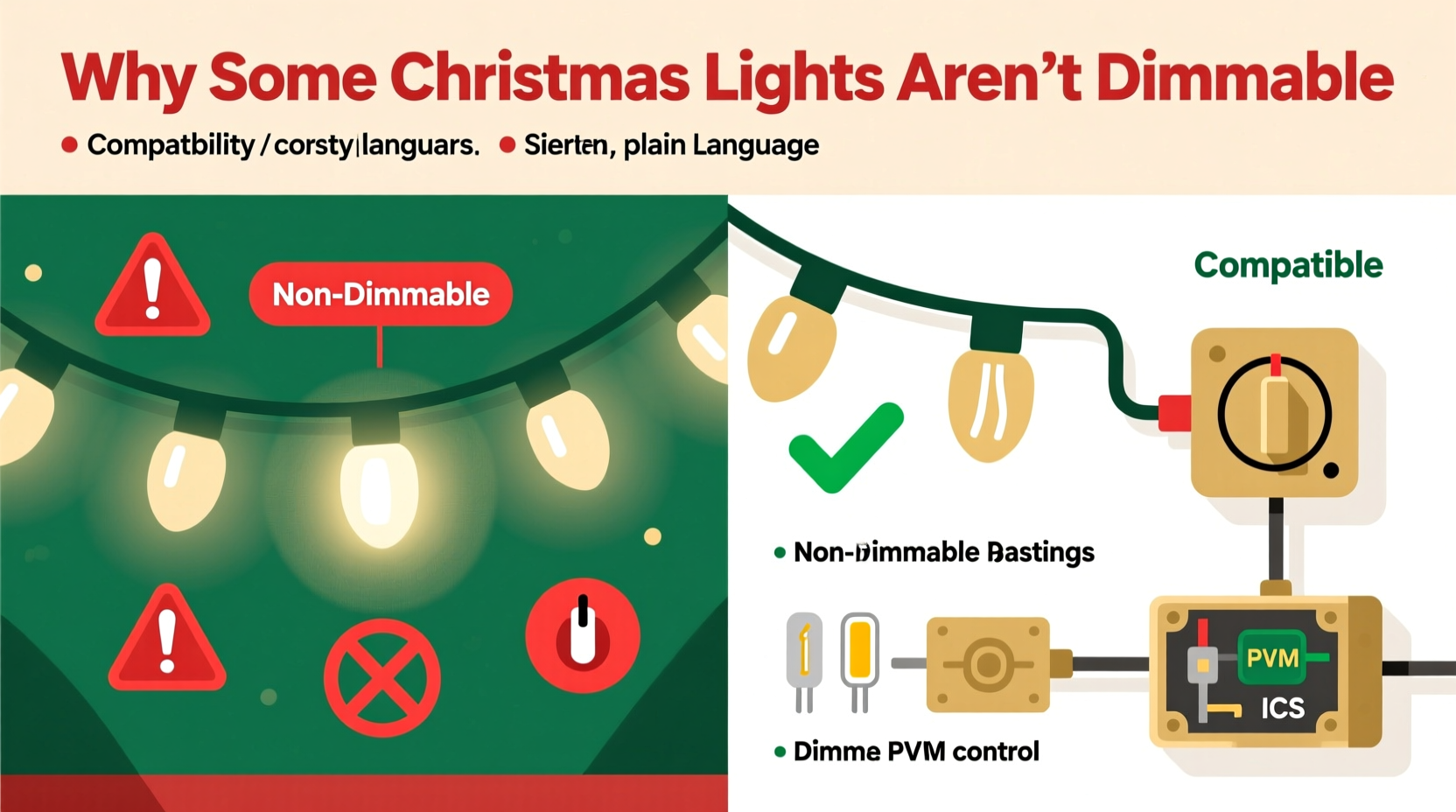
Most people assume dimmability is a property of the light-emitting diode itself. In reality, LEDs require precise low-voltage DC power to operate. Since household current is high-voltage AC (120V in North America, 230V in Europe), every LED Christmas light string contains an internal power supply called a driver. This driver converts AC to DC and regulates current flow to prevent thermal runaway and premature failure. Dimmability depends almost entirely on whether that driver is designed to interpret and respond to dimmer signals.
There are two dominant driver architectures used in consumer-grade Christmas lights:
- Constant Voltage (CV) Drivers: Deliver fixed DC output (e.g., 12V or 24V) regardless of load. Common in inexpensive LED strings. These drivers lack feedback circuitry and ignore input voltage fluctuations—making them inherently non-dimmable via standard wall dimmers.
- Constant Current (CC) Drivers with Dimming Circuitry: Include integrated ICs (integrated circuits) that monitor incoming phase-cut waveforms (from TRIAC or ELV dimmers) and adjust output current accordingly. These support smooth dimming—but only when paired with compatible dimmers and properly rated loads.
A string labeled “dimmable” may still fail under real-world conditions if its driver lacks sufficient headroom, thermal management, or signal filtering. Conversely, a non-dimmable string won’t become dimmable—even with a high-end smart dimmer—because its driver has no pathway to receive or process the control signal.
TRIAC Dimmers vs. Modern LED Loads: A Physics Mismatch
Most residential wall dimmers sold before 2015 were designed for incandescent loads: high-wattage, purely resistive, and tolerant of low minimum loads (often as low as 40W). These dimmers use TRIAC (Triode for Alternating Current) switching to “chop” portions of the AC sine wave—a technique known as phase-cut dimming.
LED Christmas lights, however, present three critical challenges to TRIAC dimmers:
- Low Load Requirement: A typical 100-light LED string draws only 4–7 watts—far below the 25–40W minimum most legacy dimmers require to stay latched. Without sufficient current, the TRIAC fails to trigger reliably, causing flickering or dropout.
- Non-Resistive Impedance: LED drivers behave capacitively or inductively—not resistively. This distorts the zero-crossing detection that TRIAC dimmers rely on, resulting in inconsistent firing angles and unstable output.
- No Neutral Wire in Many Installations: Older dimmer boxes (especially in multi-gang switches or 3-way setups) often omit a neutral wire. Many modern dimmable LED drivers need neutral reference for stable operation—without it, they cannot maintain consistent bias voltage across internal control logic.
This isn’t a flaw in the lights or the dimmer alone. It’s a systems-level incompatibility rooted in how electricity flows, how semiconductors switch, and how manufacturers prioritize cost versus performance.
Driver Types & Dimming Protocols: What’s Actually Inside Your Light String
Not all “dimmable” labels mean the same thing. The underlying dimming protocol determines compatibility, range, and behavior. Here’s how major driver types compare:
| Driver Type | Dimming Method | Compatible Dimmers | Typical Dimming Range | Key Limitation |
|---|---|---|---|---|
| TRIAC-Compatible CC Driver | Leading-edge (forward-phase) phase-cut | Standard Lutron Maestro, Leviton Decora | 10%–100% | Fails with ELV (electronic low-voltage) dimmers; sensitive to line noise |
| ELV-Compatible CC Driver | Trailing-edge (reverse-phase) phase-cut | Lutron Diva DVCL-153P, Legrand Adorne | 1%–100% | Requires neutral wire; incompatible with most TRIAC dimmers |
| PWM-Only Driver | Pulse-width modulation via dedicated controller | Brand-specific remotes or app-based hubs only | 5%–100% | No wall-dimmer support whatsoever; requires proprietary ecosystem |
| 0–10V Analog Driver | Voltage signal (0V = off, 10V = full) | Commercial-grade 0–10V dimmers (e.g., Crestron, Lutron Homeworks) | 0.1%–100% | Rare in consumer strings; requires separate control wiring |
| DMX512 Driver | Digital multiplexed signal (512 channels) | Stage lighting consoles or DMX controllers | 0.01%–100% | Overkill for home use; requires professional installation |
Note: Many budget-friendly “dimmable” LED strings use rudimentary PWM drivers controlled solely by an included IR remote. These units have no internal dimming interface for wall switches—they’re only dimmable *within their own closed system*. If you remove the remote or battery dies, dimming vanishes entirely.
A Real-World Case Study: The Neighborhood Holiday Lighting Project
In Portland, Oregon, homeowner Maya Chen installed 12 strands of 200-light “dimmable” LED icicle lights along her eaves and porch railings. She’d purchased a Lutron Caseta PD-6WCL smart dimmer—rated for LED loads as low as 5W—and followed all manufacturer instructions. On installation night, six strings dimmed beautifully. Six others flickered violently, then went dark after 90 seconds.
A licensed electrician inspected the setup and discovered the issue wasn’t with Maya’s wiring or dimmer. Two different brands—both labeled “dimmable”—had been mixed in the same order. Brand A used ELV-compatible drivers requiring neutral wires. Brand B used TRIAC drivers but had a minimum load threshold of 15W per circuit—well above the 6W drawn by each individual strand. When wired in parallel across one dimmer channel, the total load (72W) met the threshold—but the ELV strings couldn’t interpret the leading-edge waveform, while the TRIAC strings overloaded the dimmer’s internal thermal cutoff during extended low-brightness operation.
The fix? Maya replaced the mixed strands with a single brand using universal dimmable drivers (supporting both TRIAC and ELV inputs), added a neutral wire to her dimmer box, and limited each dimmer channel to no more than four strings (under 25W). Total resolution time: 3.5 hours. Cost saved: $280 in unnecessary dimmer upgrades.
“Dimmability claims on seasonal lighting are often marketing shorthand—not engineering specifications. Always verify the driver datasheet, not the box label.” — Dr. Alan Torres, Electrical Engineer & Lighting Standards Consultant, IESNA
How to Choose Truly Dimmable Christmas Lights: A Step-by-Step Guide
Selecting lights that actually work with your existing dimmers—or planning a new installation—requires methodical verification. Follow this sequence before purchasing or installing:
- Identify your dimmer type: Check the model number on the dimmer faceplate or packaging. Search online for its technical specs: Does it support LED? What’s its minimum load? Is it TRIAC or ELV? Does it require a neutral?
- Check the light string’s fine print: Look beyond “dimmable” on the package. Search the product’s spec sheet (often PDF on the manufacturer’s site) for terms like “TRIAC-compatible,” “ELV-ready,” “universal dimming,” or “works with Lutron CL series.” Avoid vague phrases like “smart dimmable” or “app-controlled only.”
- Calculate total load per circuit: Add up the wattage of all strings on one dimmer channel. Ensure it exceeds your dimmer’s minimum load (e.g., 10W) but stays under 80% of its maximum rating (e.g., 600W max → ≤480W load).
- Verify neutral availability: Turn off power and remove your dimmer cover. If you see a white wire capped separately (not connected to the dimmer), you have neutral access. If not, choose only TRIAC-compatible lights—and confirm your dimmer model explicitly supports “no-neutral” LED operation.
- Test with one strand first: Before committing to dozens of strings, buy a single unit and test it at multiple brightness levels over 30 minutes. Watch for flicker, audible buzzing, delayed response, or shutdown. If any occur, return it immediately—don’t assume “more strings will fix it.”
FAQ: Addressing Common Confusion
Can I make non-dimmable Christmas lights dimmable with an external dimmer module?
Technically yes—but rarely advisable. External inline dimmers (like the Philips Hue Play Dimmer or third-party PWM boxes) can work if matched precisely to voltage, current, and driver topology. However, most consumer-grade modules lack overtemperature protection, short-circuit isolation, or EMI filtering. They often introduce audible hum, reduce LED lifespan by 30–50%, and void UL safety certifications. For permanent installations, replacement with certified dimmable strings is safer and more reliable.
Why do some “dimmable” LED lights work with one dimmer but not another—even from the same brand?
Dimmer firmware and calibration vary significantly between models and production batches. A Lutron Maestro MACL-153M may handle a 12W load smoothly, while the nearly identical MACL-153MH (designed for higher-horsepower fans) requires 25W minimum. Similarly, newer dimmers include adaptive learning algorithms that “train” to load characteristics over several cycles—older units lack this. Always consult the dimmer’s *latest compatibility list*, not just its general category.
Do color-changing RGB Christmas lights dim differently than white-only strings?
Yes. Most RGB strings use separate red, green, and blue channels controlled by microcontrollers. Their “dimming” is usually achieved through PWM at the pixel level—not analog current reduction. This means brightness changes are digitally stepped (e.g., 100%, 75%, 50%, 25%) rather than smooth. True analog dimming across RGB spectrums requires advanced constant-current drivers with independent channel regulation—found almost exclusively in commercial architectural lighting, not retail holiday strings.
Conclusion: Dimmability Is a System—Not a Feature
Christmas lights that won’t dim aren’t broken. They’re operating exactly as engineered—for a different purpose. The disconnect arises when we treat lighting as interchangeable components rather than integrated electrical systems. Understanding drivers, dimmer physics, and protocol mismatches transforms frustration into informed decision-making. You don’t need the most expensive lights or dimmers to achieve beautiful, controllable holiday illumination—you need alignment between what’s inside the string and what’s in your wall box. Start by auditing your existing dimmers, cross-referencing manufacturer datasheets (not marketing copy), and prioritizing verified compatibility over flashy labels. When your lights finally fade gently to candlelight warmth instead of cutting out abruptly, you’ll know it wasn’t luck—it was precision.




 浙公网安备
33010002000092号
浙公网安备
33010002000092号 浙B2-20120091-4
Comments
No comments yet. Why don't you start the discussion?