
Every year, the moment arrives: you pull out your carefully stored Christmas lights, plug them in—and nothing happens. Or worse, only half the strand lights up. It’s frustrating, especially when you’re racing against time to decorate before guests arrive. The good news is that most post-storage lighting failures have simple explanations and even simpler fixes. With a methodical approach, you can identify the problem and get your display glowing again—without buying a new set.
Christmas lights endure more than we realize during storage. Temperature swings, moisture, rodent activity, and physical stress from coiling or tangling can all compromise their function. Understanding why they fail helps prevent future issues and saves money over time. This guide walks through the most common causes of malfunctioning lights after storage and offers actionable steps to troubleshoot and resolve them.
Common Reasons Christmas Lights Fail After Storage
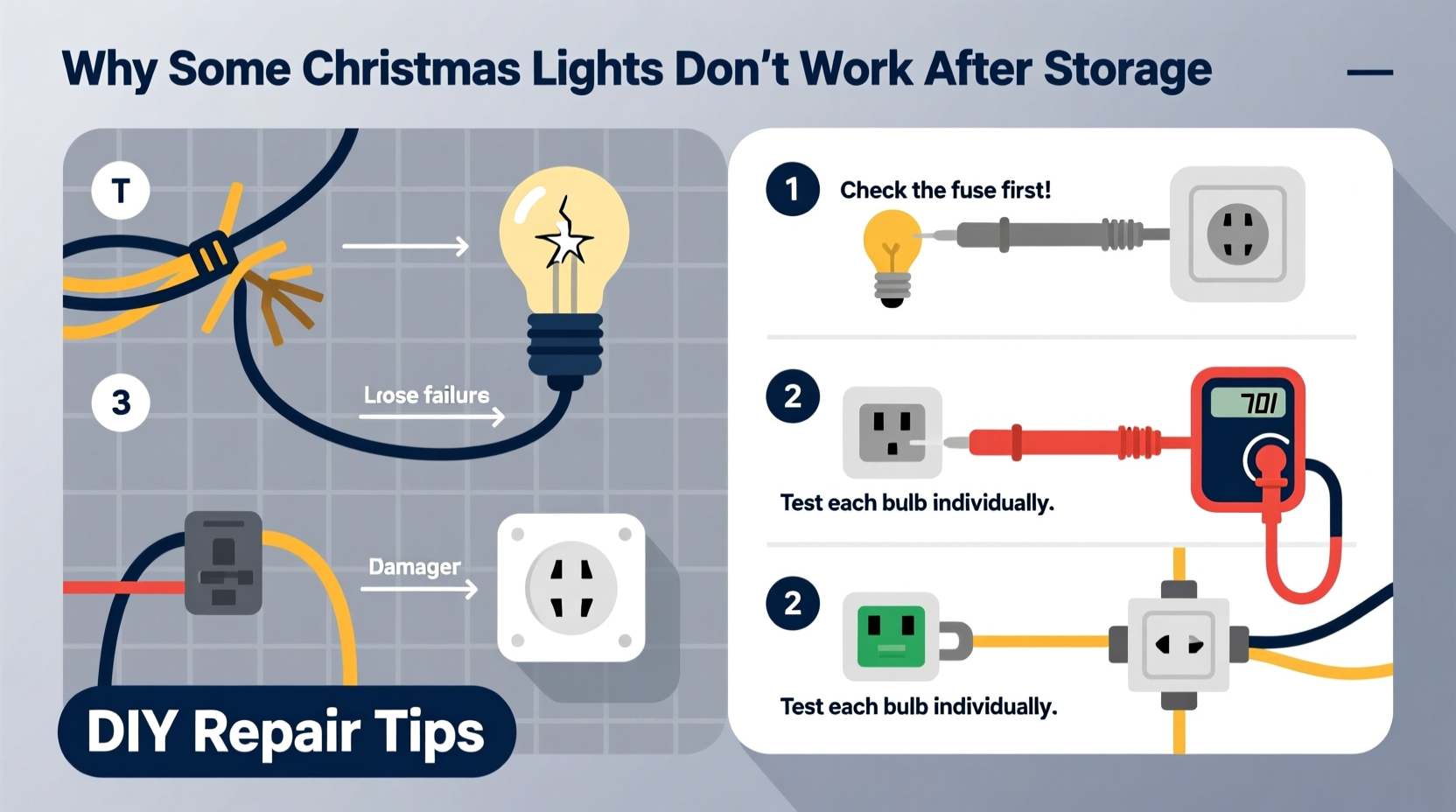
Lights don’t just \"go bad\" on their own. When a string doesn’t work after being stored for months, there's usually a mechanical or electrical reason. Identifying the root cause is the first step toward a solution.
- Frayed or damaged wires: Rodents may chew through insulation, or sharp bends during storage can break internal conductors.
- Loose or corroded bulbs: Vibration or temperature changes can loosen bulbs, breaking the circuit. Corrosion from humidity can also interfere with conductivity.
- Blown fuses: Many plug-in light sets have small fuses located in the plug. Power surges or short circuits can blow these without damaging the entire strand.
- Broken sockets: Plastic sockets can crack or warp, preventing proper bulb contact.
- Open circuits due to single-bulb failure: In older series-wired strands, one dead bulb can cut power to the rest of the string.
Unlike modern LED strings that often use parallel wiring (so one failed bulb doesn’t affect others), many traditional incandescent lights operate in series. That means if one connection fails, the whole circuit stops. This design makes troubleshooting essential but also manageable with the right tools and patience.
Step-by-Step Guide to Diagnosing & Fixing Non-Working Lights
Follow this systematic process to restore your lights efficiently. This sequence minimizes guesswork and maximizes results.
- Unplug and visually inspect the strand. Look for obvious damage: chew marks, cracked sockets, kinks, or frayed wires near the plug or ends.
- Check the fuse compartment. Open the plug’s fuse door (usually on the male end). Use a small screwdriver or fingernail. Replace any blown fuses with identical amperage ratings (typically 3A or 5A).
- Test each bulb manually. Remove bulbs one by one and check for darkened filaments (in incandescents) or loose bases. Re-seat each firmly.
- Use a light tester or multimeter. For faster diagnosis, pass a non-contact voltage detector or dedicated Christmas light tester along the strand to locate breaks.
- Replace faulty bulbs. Match wattage and size. Keep spare bulbs from previous sets or purchase a universal replacement kit.
- Plug in and test sections. If using multiple strands, test individually to isolate the problem.
If the entire strand remains dark after checking fuses and bulbs, the issue may be internal wire damage. In such cases, consider cutting out the damaged section and rewiring—or retiring the strand for safety.
Do’s and Don’ts of Christmas Light Maintenance
Prevention is far easier than repair. How you store and handle your lights directly impacts their longevity. This table outlines best practices versus common mistakes.
| Do’s | Don’ts |
|---|---|
| Label each strand by location (e.g., “front porch”) to simplify setup next year. | Toss lights into a box loosely—this creates tangles and increases strain on wires. |
| Wrap lights around a cardboard reel or spool to prevent kinking and reduce stress. | Store in damp basements or hot attics—moisture and heat degrade insulation and connections. |
| Test all lights before storing so replacements can be made early. | Leave old-style incandescent bulbs in sockets during storage—they can loosen and fall out. |
| Keep original packaging or use compartmentalized bins to protect bulbs and plugs. | Use staples or nails to secure outdoor wires—these puncture insulation and create hazards. |
Real Example: Recovering a Strand from Holiday Frustration
Sarah from Portland kept a favorite set of warm-white C7 lights for her rooftop display. Last November, she unpacked them—only to find half the strand dark. She followed a few basic steps: first, checked the fuses (both intact), then re-seated every bulb. Still no luck. Using a light tester, she discovered a dead section near the middle. Closer inspection revealed a small mouse had chewed through the wire inside the storage bin. Sarah cut out the damaged segment, spliced in a new section using waterproof wire nuts, and resealed it with heat-shrink tubing. The strand worked perfectly—and she now stores all lights in sealed plastic containers with peppermint-soaked cotton balls to deter pests.
This real-world case shows how a combination of inspection, tools, and minor repair skills can save what seems like a lost cause.
Expert Insight: What Professionals Recommend
Industry experts emphasize proactive care over reactive fixes. According to Mark Reynolds, a seasonal lighting technician with over 15 years of experience:
“Over 70% of light failures I see stem from poor storage. People think ‘it’s just lights,’ but consistent handling makes a huge difference. Test before storing, wrap properly, and invest in LED. They last longer, use less power, and many are designed to stay lit even if one bulb fails.” — Mark Reynolds, Holiday Lighting Specialist
His advice aligns with modern trends: upgrading to commercial-grade LED strings reduces long-term hassle and energy costs. While the upfront cost is higher, durability and efficiency pay off within two to three seasons.
Troubleshooting Checklist
Use this checklist as a quick reference when diagnosing non-working lights:
- ✅ Unplugged the strand before inspection?
- ✅ Checked both fuses in the plug?
- ✅ Visually inspected for cuts, chew marks, or crushed sockets?
- ✅ Re-seated all bulbs securely?
- ✅ Tested with a known-working outlet?
- ✅ Used a light tester or multimeter to locate open circuits?
- ✅ Verified compatibility when connecting multiple strands (max load not exceeded)?
- ✅ Considered upgrading to shunt-based or LED lights for next season?
Going through each item systematically eliminates guesswork and ensures no detail is overlooked.
FAQ: Common Questions About Post-Storage Light Issues
Why do only half my Christmas lights work after storage?
This typically happens in series-wired strands where one bulb burns out or becomes loose, breaking the circuit. It can also occur if a section of wire is damaged, creating an open loop. Use a light tester to pinpoint the gap or inspect each bulb manually.
Can I replace incandescent bulbs with LED ones in the same string?
Only if they are the same voltage and base type. Mixing types in a series circuit can cause uneven current flow, leading to flickering or premature failure. Better to use complete LED strands designed for reliability and lower heat output.
How can I prevent lights from failing next year?
Test before storing, wrap on reels, store in climate-controlled areas, and keep away from pests. Label everything clearly. Consider switching to pre-lit trees or modular LED systems that are easier to maintain.
Conclusion: Restore, Reuse, and Decorate with Confidence
Non-working Christmas lights after storage are a common but solvable issue. With a calm, structured approach, most problems can be diagnosed and repaired in under an hour. From checking fuses to reseating bulbs and protecting wires during storage, the key lies in consistency and attention to detail. Upgrading to modern LED options further reduces future headaches while enhancing brightness and energy efficiency.
Don’t let a dark strand ruin your holiday spirit. Most failures have simple fixes—and every repaired set represents savings, sustainability, and pride in a job well done. Take the time this season to care for your lights properly. Next year, you’ll plug them in with confidence, knowing they’ll shine just as brightly as the first night you used them.




 浙公网安备
33010002000092号
浙公网安备
33010002000092号 浙B2-20120091-4
Comments
No comments yet. Why don't you start the discussion?