
Every holiday season, millions of households unpack their festive lights, only to discover that a portion of the string isn’t lighting up. Instead of a full, radiant display, you’re left with dim or dark sections—often exactly half the strand. This common frustration stems from the way modern Christmas lights are wired and how electrical current flows through them. Understanding the underlying circuitry and knowing how to troubleshoot can save time, money, and seasonal cheer.
Most contemporary mini-light strings use series-wired circuits, meaning each bulb shares the same electrical path. When one component fails, it can disrupt the entire flow. However, many newer designs incorporate shunt wires within the bulbs to bypass a dead filament, theoretically keeping the rest of the string lit. In practice, this system isn’t foolproof—and when it fails, you're left with half-lit strands. The good news: most issues are diagnosable and repairable without replacing the whole set.
How Series Circuits Work in Christmas Lights
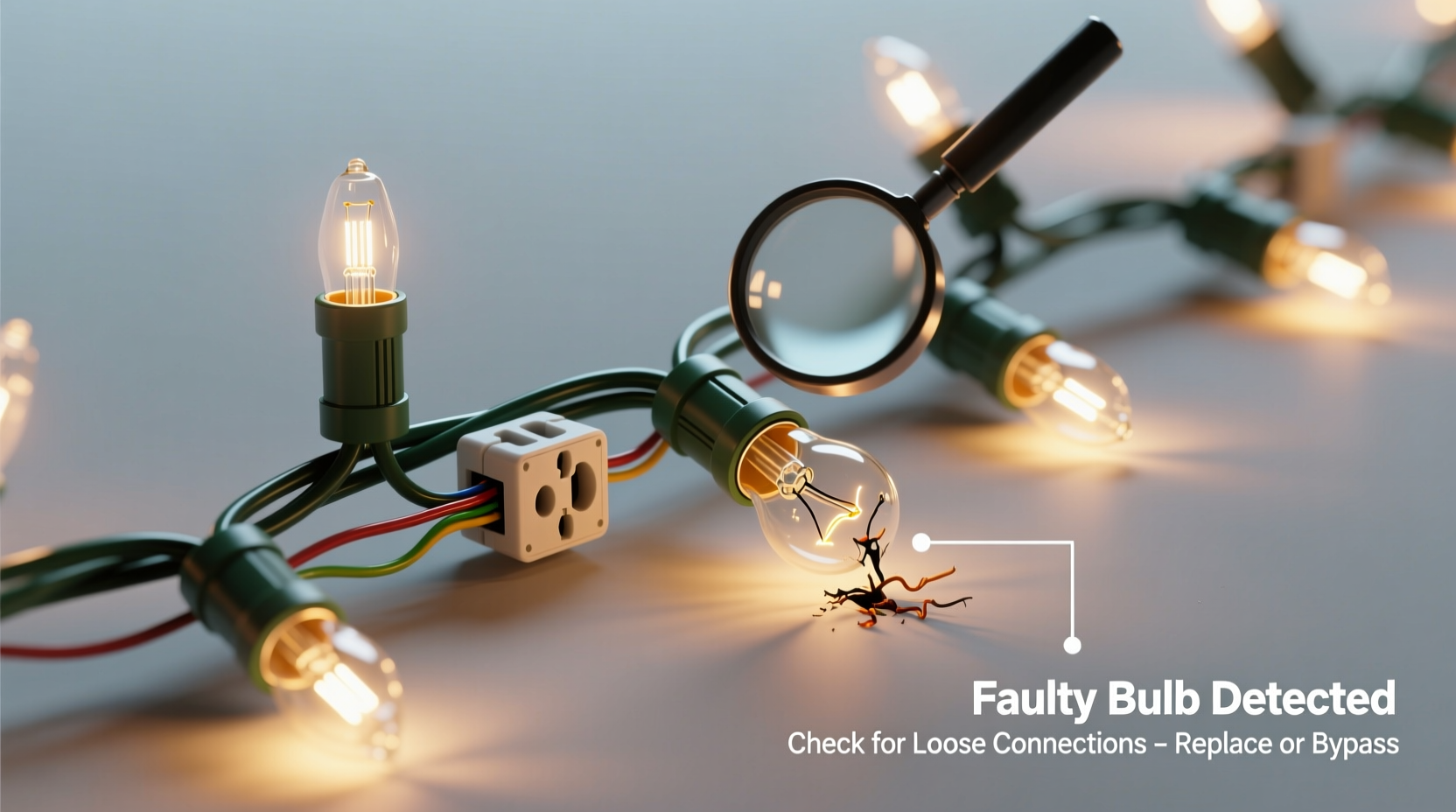
Traditional incandescent Christmas light strings are typically wired in series, where electricity passes through each bulb sequentially before returning to the power source. If any single bulb burns out or becomes loose, the circuit breaks, cutting off power to all bulbs downstream. This explains why an entire section—or half—of a light string may go dark.
Modern light sets attempt to solve this problem using shunted sockets and special filaments. A shunt is a small wire wrapped beneath the filament that activates when the filament fails. As the filament burns out, increased heat melts a coating on the shunt, allowing it to conduct electricity and keep the circuit closed. While clever in theory, shunts don’t always activate reliably—especially if corrosion, poor contact, or manufacturing defects interfere.
Additionally, many strings are divided into two or more independent circuits. For example, a 100-light strand might actually be two 50-light circuits wired in parallel across the same cord. If one circuit fails due to a broken filament or bad socket, only half the lights will illuminate. This design helps limit total failure but introduces partial failures that confuse users.
Common Causes of Half-Lit Christmas Light Strings
Several factors can cause only part of a light string to function. Identifying the root cause is essential for effective repair.
- Blown or loose bulb: A single missing, cracked, or improperly seated bulb can break the circuit.
- Failed shunt: Even if the filament is burned out, the shunt may not have activated, leaving the circuit open.
- Wire damage: Frayed, pinched, or chewed wiring—especially near plugs or connectors—can interrupt current.
- Corroded or dirty socket: Moisture or debris in outdoor lights can prevent proper conductivity.
- Bad fuse: Most plug ends contain small fuses; one blown fuse can disable half the string.
- Damaged male/female connector: If connecting multiple strings, a faulty link between them can cut power mid-run.
One often-overlooked issue is voltage drop in long runs. Connecting too many strings end-to-end can exceed manufacturer limits, causing dimming or non-functioning sections even without visible damage.
Step-by-Step Guide to Fixing a Partially Working Light String
Follow this systematic approach to identify and resolve the issue safely and efficiently.
- Unplug the lights and inspect the entire length for obvious damage—cracked bulbs, exposed wires, bent prongs, or moisture buildup.
- Check the fuses. Open the plug’s fuse compartment (usually on the male end). Use a flashlight to examine the tiny metal strip inside. If it’s broken or blackened, replace it with an identical-rated fuse (typically 3–5 amps, 125V).
- Test continuity with a multimeter (optional). Set the meter to continuity mode. Touch probes to both sides of the fuse. A beep indicates the fuse is good. No sound means it’s blown.
- Separate multi-circuit strings. If your string has two lit sections and one dark half, test each circuit independently by disconnecting at junction points.
- Use a light tester or voltage detector. Devices like the “LightKeeper Pro” send pulses through the string to clear shunt failures or detect open circuits. Insert the probe into each socket along the dark section until you find where voltage stops.
- Replace suspect bulbs. Remove each bulb in the dark section and insert it into a known-working string. If it doesn’t light, replace it. Even if it works, reseat it firmly—poor contact is common.
- Clean sockets. Use a cotton swab dipped in isopropyl alcohol to wipe out corroded or dirty sockets. Let dry completely before reinserting bulbs.
- Inspect connections between strings. If chaining multiple sets, ensure female connectors are snug and free of debris. Try reversing the connection order to isolate faulty links.
- Check for wire breaks. Gently flex the wire near the halfway point while the string is plugged in (use caution). Flickering may indicate an internal break.
- Replace or retire damaged sections. If repairs fail, consider cutting out the damaged segment and rewiring or replacing the string entirely.
“Over 70% of ‘dead’ light strings can be restored with simple bulb replacement and fuse checks. Most people toss them prematurely.” — Greg Thompson, Electrical Technician & Holiday Lighting Installer
Tips and Tools for Effective Troubleshooting
Having the right tools makes diagnosis faster and more reliable. Here’s what professionals recommend keeping in your holiday repair kit:
| Tool | Purpose | Recommended Model/Type |
|---|---|---|
| Fuse puller | Safely removes tiny fuses from plug compartment | Plastic tool included with some light sets |
| Spare fuses | Immediate replacement for blown fuses | 3A or 5A 125V, match original rating |
| Light tester | Detects live voltage and clears shunt failures | LightKeeper Pro MK2 |
| Multimeter | Tests continuity, voltage, and resistance | Digital model with continuity beep |
| Isopropyl alcohol & swabs | Cleans dirty or corroded sockets | 90%+ concentration, lint-free applicators |
| Needle-nose pliers | Removes stubborn bulbs or bends wire tabs | Insulated handles for safety |
Mini Case Study: Restoring a 50-Light Strand for a Community Display
A local community center was preparing its annual holiday display when volunteers discovered that three of their 100-light incandescent strings were only half lit. Each had 50 working bulbs and 50 dark ones. Rather than discard them—risking budget overruns—they followed a structured repair process.
The team began by checking fuses. One string had a visibly blown fuse, which was replaced. That restored full lighting. The other two still had dark halves. Using a LightKeeper Pro, they tested each socket in the non-working section. Voltage dropped off after the 12th bulb in both cases. They removed and tested each bulb manually, finding one with a broken filament and another that seated poorly due to a bent base.
After replacing the faulty bulbs and cleaning the sockets with alcohol swabs, both strings lit fully. The repaired sets were used in the display, saving $45 in replacement costs and reducing waste. The center now includes basic light repair training for volunteers every November.
Do’s and Don’ts of Christmas Light Maintenance
Proper care extends the life of your lights and reduces future failures. Follow these guidelines to keep your displays bright year after year.
| Do | Don’t |
|---|---|
| Store lights coiled loosely around a cardboard reel or spool | Throw lights into a box without winding, causing tangles and wire stress |
| Inspect bulbs and cords annually before installation | Assume last year’s working lights will function again without testing |
| Use indoor/outdoor-rated lights appropriately | Leave indoor-only strings exposed to rain or snow |
| Replace bulbs promptly when flickering or dimming occurs | Wait until entire sections fail, increasing troubleshooting difficulty |
| Keep spare fuses and matching bulbs on hand | Discard packaging and extra parts immediately after first use |
Frequently Asked Questions
Why do only half my Christmas lights work when I plug them in?
This usually happens because the string contains two separate circuits, and one has failed. Common causes include a blown fuse, a dead bulb with a failed shunt, or a damaged wire interrupting power to one half. Check fuses first, then inspect each bulb in the dark section.
Can I fix a light string without a tester or multimeter?
Yes. You can manually remove and test each bulb in a known-working string, or use the \"swap method\"—replace bulbs one by one with new ones until the circuit restores. It’s slower but effective. Reseating all bulbs firmly can also resolve poor-contact issues.
Are LED Christmas lights less prone to half-string failures?
Generally, yes. Many LED strings use parallel or constant-voltage wiring, so one dead bulb won’t affect others. They also lack filaments and shunts, reducing failure points. However, LED strings can still suffer from driver failure, bad connectors, or power supply issues—especially in cheaper models.
Conclusion: Keep Your Lights Bright with Smart Care
Half-working Christmas lights aren’t a lost cause—they’re a solvable electrical puzzle. With a basic understanding of series circuits, access to simple tools, and a methodical approach, most strings can be restored quickly. The key is early detection, routine maintenance, and avoiding the temptation to discard repairable sets.
As holiday traditions evolve, so should our approach to maintaining them. Taking time to troubleshoot and fix your lights reduces waste, saves money, and ensures your home shines as brightly as intended. Don’t let a few faulty bulbs dim your display—grab your toolkit, follow the steps, and bring your lights back to life.




 浙公网安备
33010002000092号
浙公网安备
33010002000092号 浙B2-20120091-4
Comments
No comments yet. Why don't you start the discussion?