
The lengthening of days during summer is a familiar experience for most people in temperate regions. As the season approaches, sunlight stretches into the evening hours, and mornings brighten earlier. While this shift may seem intuitive, the underlying mechanics involve precise astronomical phenomena—primarily Earth’s axial tilt and its orbit around the Sun. Understanding why summer days are longer reveals not only how our planet functions but also how these changes affect climate, ecosystems, and human behavior.
Earth’s Tilt: The Primary Driver of Seasonal Daylight Changes
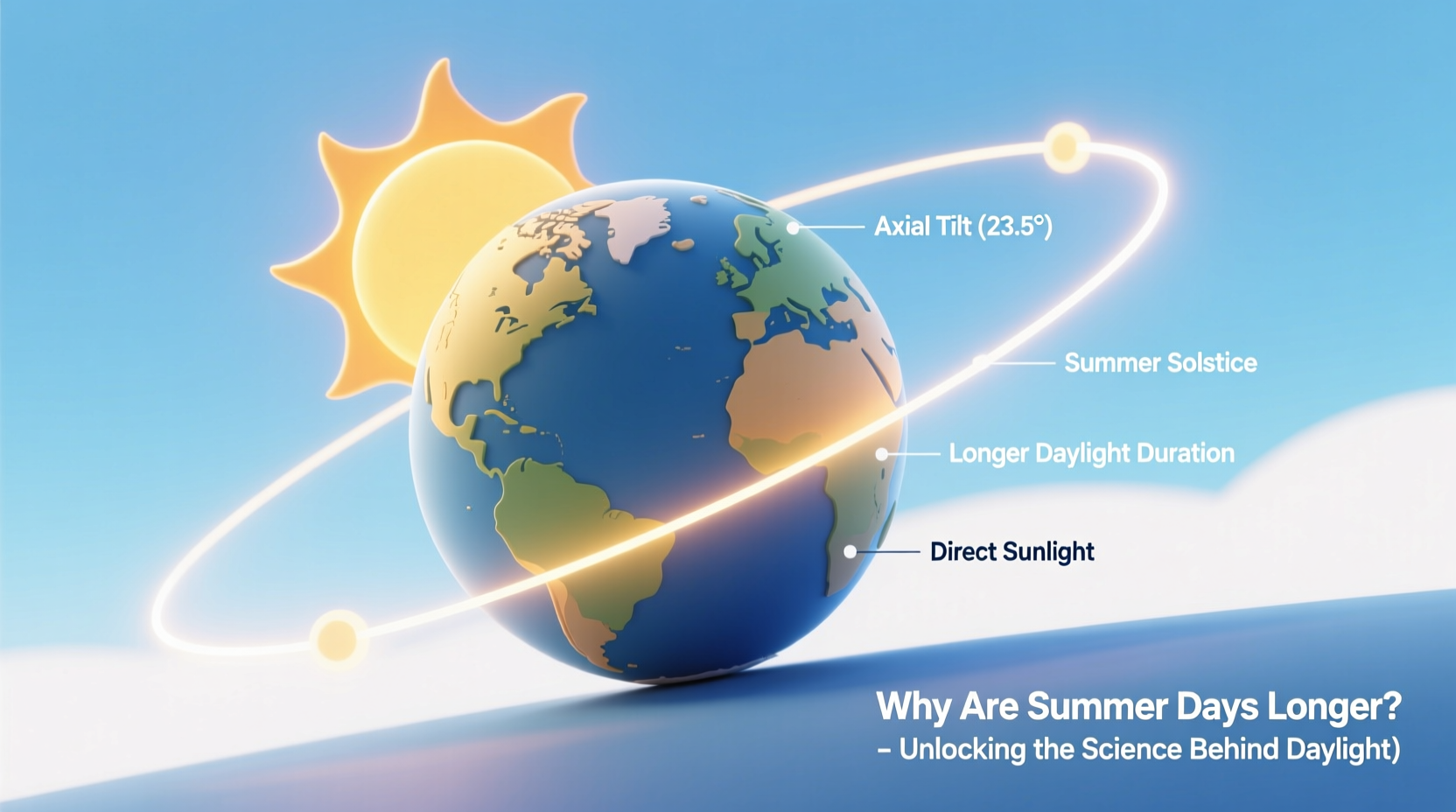
The key to longer summer days lies in Earth’s 23.5-degree axial tilt relative to its orbital plane around the Sun. Unlike a perfectly upright spin, Earth leans on its axis throughout its journey around the Sun. This tilt means that different parts of the planet receive varying amounts of direct sunlight at different times of the year.
During summer in the Northern Hemisphere (approximately June through August), the North Pole is tilted toward the Sun. This orientation allows sunlight to strike the northern latitudes more directly and for longer durations each day. Conversely, the Southern Hemisphere experiences winter at this time, with shorter days and less intense solar exposure.
This tilt doesn’t change—it’s constant. What changes is Earth’s position in orbit. Around June 21st, the Northern Hemisphere reaches its maximum tilt toward the Sun, marking the summer solstice—the longest day of the year. After that point, days gradually shorten until the winter solstice in December.
“Earth’s axial tilt is the single most important factor in creating seasonal variations in daylight. Without it, every day would be roughly 12 hours long everywhere on Earth.” — Dr. Lena Torres, Astrophysicist, National Observatory Institute
How Latitude Affects Daylight Duration
The effect of Earth’s tilt becomes more pronounced with increasing distance from the equator. Near the equator, day length remains relatively stable year-round—typically between 11.5 and 12.5 hours. But as you move toward the poles, the variation in daylight grows dramatically.
In cities like New York or Madrid, summer days can last 14 to 15 hours. In contrast, places above the Arctic Circle, such as Tromsø, Norway, experience the “Midnight Sun,” where the Sun remains visible for 24 hours a day during peak summer. Similarly, during winter, these same regions face extended periods of darkness.
This extreme variation occurs because, at high latitudes, the curvature of Earth allows one hemisphere to remain in continuous sunlight when tilted sufficiently toward the Sun. The opposite happens during winter, when the region tilts away entirely.
Orbital Mechanics: Debunking Common Misconceptions
A common misconception is that summer occurs because Earth is closer to the Sun. In reality, Earth’s orbit is nearly circular, and the distance variation has minimal impact on seasons. In fact, Earth is actually farthest from the Sun (at aphelion) in early July—right in the middle of Northern Hemisphere summer.
The real driver is insolation—the amount of solar radiation received per unit area. When a region is tilted toward the Sun, sunlight strikes the surface more directly, concentrating energy over a smaller area and increasing warmth. Additionally, the longer path of the Sun across the sky extends daylight hours, allowing more time for heating.
Another misunderstood concept is the role of sunrise and sunset angles. In summer, the Sun rises in the northeast and sets in the northwest (in the Northern Hemisphere), taking a higher and longer arc across the sky. This elevated trajectory increases both the duration and intensity of daylight.
Daylight Patterns Across the Seasons: A Comparative Overview
| Season | Hemisphere (Example) | Average Day Length | Sun Path Characteristics |
|---|---|---|---|
| Summer | Northern (e.g., Toronto) | 15–16 hours | High arc, rises NE, sets NW |
| Winter | Northern (e.g., Toronto) | 8–9 hours | Low arc, rises SE, sets SW |
| Spring/Fall | Global (equinoxes) | ~12 hours | Direct east to west rise/set |
| Summer | Arctic Circle (e.g., Fairbanks) | 18–24 hours | Sun circles the sky, never fully sets |
Practical Impacts of Extended Summer Daylight
Longer days influence more than just outdoor activities—they affect agriculture, energy use, mental health, and even economic productivity. Farmers rely on extended daylight for crop growth, particularly in regions with short growing seasons. Countries like Canada and Russia take advantage of nearly 20-hour photoperiods to cultivate cold-hardy crops.
From an energy perspective, longer daylight reduces the need for artificial lighting in homes and offices, lowering electricity demand in the evenings. Cities often see increased foot traffic and retail activity during summer months due to extended business hours enabled by natural light.
On the psychological side, increased sunlight boosts serotonin levels, which can improve mood and reduce symptoms of seasonal affective disorder (SAD). However, excessively long days can disrupt circadian rhythms, especially in northern latitudes, leading to sleep disturbances if not managed properly.
Mini Case Study: Life in Reykjavik During Midnight Sun
In Reykjavik, Iceland, summer days last nearly 21 hours, with twilight persisting through the night. Residents adapt by using heavy curtains and maintaining consistent bedtime routines. A local teacher, Anna Jónsdóttir, shared her experience: “For three months, it never gets truly dark. At first, my children struggled to fall asleep. We installed blackout blinds and started reading before bed instead of watching screens. It made a huge difference.”
This example highlights how communities adjust to extreme daylight—not by resisting it, but by integrating practical solutions into daily life.
Actionable Checklist: Making the Most of Long Summer Days
- Plan outdoor activities in the early morning or late evening to avoid peak heat.
- Use window coverings to control indoor light and temperature.
- Adjust sleep routines to maintain circadian rhythm despite extended daylight.
- Take advantage of natural light to reduce energy consumption.
- Stay hydrated and apply sunscreen regularly due to prolonged UV exposure.
- Engage in seasonal hobbies like gardening or hiking while daylight permits.
Frequently Asked Questions
Why aren’t the longest days also the hottest days?
There’s a phenomenon called seasonal lag. Even though the longest day occurs at the summer solstice, oceans and landmasses take time to absorb and release heat. As a result, the warmest temperatures typically arrive several weeks later, in July or August in the Northern Hemisphere.
Do all countries experience longer summer days?
No. Countries near the equator experience minimal variation in day length. For example, Singapore sees about 12 hours of daylight year-round. Significant changes in day length are only noticeable beyond approximately 30 degrees latitude north or south.
Can daylight duration affect mental health?
Yes. Increased daylight generally improves mood due to higher serotonin production. However, for some individuals, especially in polar regions, constant daylight can interfere with melatonin production and sleep quality, potentially contributing to anxiety or insomnia.
Conclusion: Embracing the Science of Sunlight
The reason summer days are longer is rooted in the elegant mechanics of our planet’s motion—a steady tilt and a reliable orbit that together shape the rhythm of life on Earth. From the angle of sunlight to the arc across the sky, every aspect of extended daylight serves a purpose in regulating climate, supporting ecosystems, and influencing human culture.
Understanding this science empowers us to make better decisions—from optimizing home lighting to improving sleep hygiene during bright summer nights. By aligning our habits with natural patterns, we not only enhance well-being but also deepen our connection to the cosmos.




 浙公网安备
33010002000092号
浙公网安备
33010002000092号 浙B2-20120091-4
Comments
No comments yet. Why don't you start the discussion?