
Christianity is one of the most widespread religions in the world, with over two billion followers. Despite sharing a common foundation in the life and teachings of Jesus Christ, Christianity is not a monolithic faith. Instead, it is divided into hundreds of denominations—ranging from Roman Catholicism and Eastern Orthodoxy to Protestant traditions like Baptists, Methodists, Lutherans, Pentecostals, and many others. This diversity often raises a fundamental question: Why are there different Christian denominations? The answer lies in a complex interplay of history, theology, culture, and human interpretation.
Historical Splits and Major Schisms
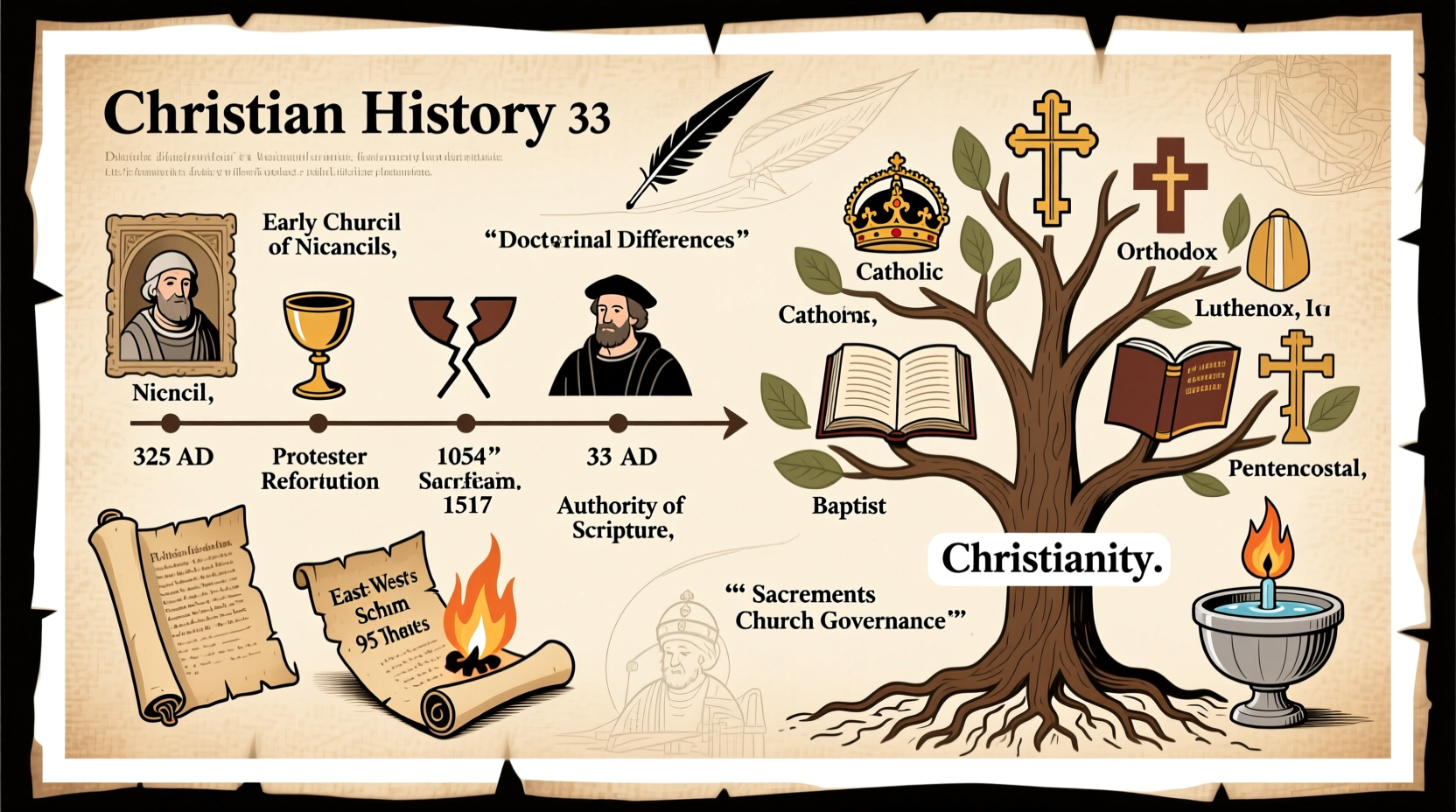
The division within Christianity did not happen overnight. It unfolded over centuries through major schisms—formal divisions rooted in doctrinal disagreement, ecclesiastical authority, or political circumstances.
The first major split occurred in 1054 AD, known as the Great Schism, which separated the Western (Roman) Church from the Eastern (Orthodox) Church. Disputes over papal authority, the use of unleavened bread in communion, and the inclusion of the Filioque clause (\"and the Son\") in the Nicene Creed about the Holy Spirit’s origin led to mutual excommunications between leaders in Rome and Constantinople. This divide persists today between Roman Catholics and Eastern Orthodox believers.
The second pivotal moment came during the 16th century Reformation. Figures like Martin Luther, John Calvin, and Ulrich Zwingli challenged practices of the Roman Catholic Church—particularly the sale of indulgences, clerical corruption, and centralized authority. Luther's posting of the 95 Theses in 1517 sparked widespread reform movements that gave rise to Protestantism. Over time, these movements splintered further due to differences in worship style, church governance, and biblical interpretation.
Theological Differences That Shape Denominations
At the heart of denominational diversity are deep theological disagreements. While all Christians affirm core beliefs such as the Trinity and salvation through Christ, they diverge significantly on secondary doctrines.
- Sacraments: Catholics and Orthodox recognize seven sacraments (e.g., baptism, Eucharist, confirmation), while most Protestants acknowledge only two—baptism and communion—and view them more as symbolic acts.
- Authority: Catholics hold Scripture and Sacred Tradition as equally authoritative, guided by the Magisterium (teaching authority of the Church). Protestants emphasize *sola scriptura*—Scripture alone—as the ultimate authority.
- Salvation: Views on predestination, free will, and how grace operates vary widely. For example, Calvinists stress divine election, whereas Arminians emphasize human response to God’s grace.
- Church Governance: Some churches are episcopal (led by bishops, e.g., Anglicans), others presbyterian (elders-led, e.g., Presbyterians), and others congregational (local church autonomy, e.g., Baptists).
“The unity of the Spirit must be preserved, but truth cannot be compromised for the sake of artificial harmony.” — Dr. Timothy George, Dean of Beeson Divinity School
Cultural and Geographic Influences
Christianity spread rapidly across continents, adapting to local languages, customs, and social structures. As it moved beyond its Middle Eastern roots into Europe, Africa, Asia, and the Americas, cultural context shaped how doctrine was understood and practiced.
In Ethiopia, for instance, the Ethiopian Orthodox Tewahedo Church developed unique liturgical traditions and fasts while maintaining apostolic succession. In Latin America, Catholicism blended with indigenous beliefs, creating distinct expressions of faith. Similarly, African Independent Churches emerged in the 20th century as responses to colonial missionary models, emphasizing spiritual gifts, healing, and cultural identity.
Migration and globalization have further diversified Christianity. Korean Presbyterian churches in the U.S. may prioritize Confucian values of respect and education, while urban megachurches in Nigeria blend charismatic worship with entrepreneurial leadership styles. These adaptations often lead to new denominational identities or independent networks.
A Timeline of Key Events Leading to Denominational Proliferation
The development of Christian denominations can be better understood through a chronological lens.
- 33 AD: Christianity begins in Jerusalem after Jesus’ resurrection; early church described in Acts.
- 4th Century: Council of Nicaea establishes foundational creeds; Christianity becomes state religion under Constantine.
- 1054: Great Schism divides Eastern and Western Christianity.
- 1517: Protestant Reformation begins with Martin Luther’s critique of indulgences.
- 1530s–1600s: Rise of Anabaptists, Anglicans, Calvinists, and other Protestant groups.
- 1700s: First and Second Great Awakenings in America fuel evangelical movements and new sects.
- 1906: Azusa Street Revival launches global Pentecostal movement.
- Late 20th Century: Charismatic renewal spreads across mainline denominations; house churches and non-denominational movements grow rapidly.
Modern Trends: From Denominations to Non-Denominationalism
In recent decades, especially in North America, there has been a noticeable shift toward non-denominational churches. These congregations often avoid formal affiliation with larger bodies, focusing instead on accessible preaching, contemporary worship, and community outreach.
This trend reflects both dissatisfaction with institutional rigidity and a desire for personalized spiritual experience. However, even non-denominational churches tend to align theologically with broader traditions—most are functionally evangelical Protestant in doctrine.
Meanwhile, ecumenical efforts continue. Organizations like the World Council of Churches promote dialogue among denominations, seeking greater cooperation without requiring full doctrinal unity. Yet complete reunification remains unlikely given persistent differences in theology and practice.
| Denomination | Key Belief | Distinctive Practice |
|---|---|---|
| Roman Catholic | Papal authority, transubstantiation | Mass, veneration of saints |
| Eastern Orthodox | Holy Tradition, mystical theology | Divine Liturgy, iconography |
| Lutheran | Justification by faith alone | Confessional liturgy, two sacraments |
| Baptist | Believer’s baptism, soul liberty | Closed communion, congregational rule |
| Pentecostal | Baptism in the Holy Spirit | Speaking in tongues, healing services |
FAQ
Are all Christian denominations equally valid?
From an inclusive Christian perspective, most denominations that affirm the core tenets of the faith—such as the divinity of Christ and His resurrection—are considered legitimate expressions of Christianity. However, some groups may fall outside orthodox boundaries if they deny essential doctrines (e.g., Oneness Pentecostals who reject the Trinity).
Can a person switch denominations?
Yes. Many Christians change denominations due to relocation, marriage, theological growth, or dissatisfaction with their current church. Most denominations welcome transfer members, though some require reaffirmation of faith or baptism (especially if moving from a non-Trinitarian group).
Is one denomination closer to the \"original\" church?
The Roman Catholic and Eastern Orthodox Churches claim direct apostolic succession and continuity with the early church. Historically, they trace leadership lines back to the apostles. However, Protestants argue that returning to biblical teaching—not institutional lineage—is what defines authentic Christianity.
How to Navigate Denominational Diversity: A Practical Checklist
For individuals seeking a church home or trying to understand others’ beliefs, consider this actionable checklist:
- ✔️ Identify your core theological convictions (e.g., view of baptism, authority of Scripture)
- ✔️ Research the denomination’s official statements of faith or confessions
- ✔️ Attend services to observe worship style, preaching, and community life
- ✔️ Ask questions about leadership structure, membership, and discipleship programs
- ✔️ Reflect on whether the church fosters spiritual growth, accountability, and service
“We are not called to uniformity, but to unity in love—even amid our differences.” — Archbishop Desmond Tutu
Conclusion
The existence of different Christian denominations is neither accidental nor purely negative. It reflects the dynamic interaction between eternal truths and changing contexts—historical conflicts, theological reflection, cultural adaptation, and personal conviction all play a role. While division can grieve the ideal of Christian unity, it also demonstrates the faith’s capacity to engage diverse minds and cultures.
Understanding the reasons behind denominational diversity fosters empathy, reduces sectarianism, and encourages thoughtful engagement with the broader Body of Christ. Rather than seeing differences as barriers, they can become opportunities for learning, humility, and deeper appreciation of how God works through varied communities.




 浙公网安备
33010002000092号
浙公网安备
33010002000092号 浙B2-20120091-4
Comments
No comments yet. Why don't you start the discussion?